Covering a broad range of polymer science topics, Handbook of Polymer Synthesis, Characterization, and Processing provides polymer industry professionals and researchers in polymer science and technology with a single, comprehensive handbook summarizing all aspects involved in the polymer production chain. The handbook focuses on industrially important polymers, analytical techniques, and formulation methods, with chapters covering step-growth, radical, and co-polymerization, crosslinking and grafting, reaction engineering, advanced technology applications, including conjugated, dendritic, and nanomaterial polymers and emulsions, and characterization methods, including spectroscopy, light scattering, and microscopy.
Chapter 1: Introduction to Polymers and Polymer Types
Enrique Saldívar-Guerra and Eduardo Vivaldo-Lima
1.1 Introduction to Polymers
1.1.1 Basic Concepts
Polymers are very large molecules, or macromolecules, formed by the union of many smaller molecules. These smaller units are termed monomers before they are converted into polymers. In fact, the word “polymer” has a Greek origin meaning “many members.” Natural polymers have been around since the early times in Planet Earth. Life itself is linked to polymers since deoxyribonucleic acid (DNA), ribonucleic acid (RNA), and proteins, which are essential to all known forms of life, are macromolecules. Cellulose, lignin, starch, and natural rubber are just a few other examples of natural polymers. Some of these polymers were used by early human civilizations to produce simple artifacts; for example, the play balls from natural rubber for the ball game of several of the Mesoamerican civilizations (which contained ritual content and not only entertaining purposes). In the 1800s, natural polymers began to be chemically modified to produce many materials, such as vulcanized rubber, gun cotton, and celluloid. Although natural polymers are very important, this book is mainly concerned with synthetic polymers, especially organic synthetic polymers. The chemical reaction by which polymers are synthesized from monomers is termed polymerization; however, this is a generic term, since there are a number of chemical mechanisms involved in different polymerization reactions.
Synthetic polymers are relatively modern materials, since they entered into the technological and practical scene only in the first decades of the twentieth century. This makes them very different from some other materials that have been known to humanity for centuries or millennia. Also, given the fact that synthetic polymers are created by chemical reactions, the possibilities of building different polymers are virtually endless, only restricted by chemical and thermodynamic laws and by the creativity of the synthetic polymer chemist. These endless possibilities have given rise to an enormous variety of synthetic polymers that find application in almost every conceivable field of human activity that deals with matter or physical objects. In addition, the enormous molecular structural versatility that is derived from the rich synthetic possibilities, translates into materials with extremely diverse properties, and therefore applications.
We can find polymers as components of many of the objects that surround us, as well as in a broad diversity of applications in daily life: clothing, shoes, personal care products, furniture, electrical and electronic appliances, packaging, utensils, automobile parts, coatings, paints, adhesives, tires, and so on. The list is endless, and these few examples should provide an idea of the importance of synthetic polymers to modern society, in terms of both their usefulness and the economic value that they represent.
1.1.2 History
Some synthetic polymers were inadvertently prepared since the mid-nineteenth century by chemists working in organic synthesis without necessarily knowing the chemical structure of these materials, although some of them may have had some intuition of the right character of these molecules as very large ones [1]. Only in 1920, Staudinger [2] proposed the concept of polymers as macromolecules, and this idea slowly gained acceptance among the scientific community during the next decade. Some of the supporting evidence for the macromolecular concept came from measurements of high molecular weight molecules in rubber using physicochemical methods. Later, around 1929, Carothers [3] started an experimental program aimed at the synthesis of polymers of defined structures using well-known reactions of organic chemistry; this work, together with the confirmation of high molecular weight molecules by other experimental measurements (e.g., the viscosity of polymer solutions), helped to confirm the correctness of the macromolecular hypothesis of Staudinger. An interesting book on the history of polymer science is that by Morawetz [4].
1.1.3 Mechanical and Rheological Properties
1.1.3.1 Mechanical Properties
Long chains with high molecular weights impart unique properties to polymers as materials. This can be illustrated by analyzing the change in the properties of the homologous series of the simplest hydrocarbon chains, the alkanes, which can be seen as constituted of ethylene repeating units (with methyl groups at the chain ends),1 as the number of repeating units increase. At relatively low molecular weights (C6–C10), compounds in these series are relatively volatile liquids (gasolines). As the number of ethylene units increases, the compounds in this series start to behave as waxes with low melting points. However, if the number of ethylene units exceeds some 200–300, such that the molecular weight of the chains is in the order of 5000–8000, the material starts to behave as a solid exhibiting the higher mechanical properties associated with a polymer (polyethylene in this case). In general, above some minimum molecular weight, polymers exhibit increased mechanical properties and they are considered “high polymers”, alluding to their high molecular weight.
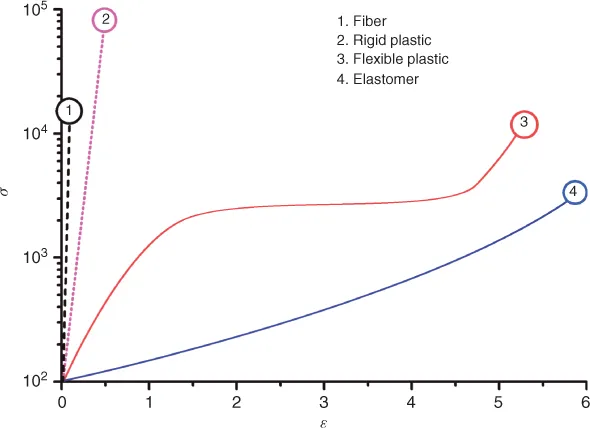
The mechanical behavior of a polymer is characterized by stress–strain curves in which the stress (force per unit area) needed to stretch the material to a certain elongation is plotted. In order to experimentally generate these curves, a tension stress is applied on a polymer sample of known dimensions, which is elongated until it breaks. The elongation is expressed as a fractional or percentage increase of the original length of the sample, which is denominated strain, ϵ, and is defined as
1.1
where L is the original length of the sample and ΔL is the increase in length under the applied tension. The nature of the stress–strain curve for a given polymer defines its possible use as elastomer, fiber, or thermoplastic. Figure 1.1 shows the form of the stress–strain curves for these types of polymers, and Table 1.1 shows typical values of some of the mechanical properties that can be defined as a function of the stress–strain behavior.
Figure 1.1 Schematic stress–strain curves for different types of polymers.
Table 1.1 Typical Values of Mechanical Properties for Different Polymer Types
Abbreviation: PMMA, Poly(methyl methacrylate).
The elastic or Young's modulus is the initial slope of the stress–strain curve and gives a measure of the resistance to deformation of the material. The ultimate tensile strength is the stress required to rupture the sample, and the ultimate elongation is the extent of elongation at which the rupture of the sample occurs.
Mechanical properties are discussed here only in an introductory manner in order to understand the main applications of polymers. An extended discussion of the mechanical properties of polymers and their measurement can be found in Chapter 21.
1.1.3.2 Rheological Properties
Thermoplastics are processed and shaped in the molten state. This can be loosely defined as a state in which a polymer flows under the action of heat and pressure. Molten polymers are non-Newtonian fluids, as opposed to the simpler Newtonian fluids. In the latter, the stress σ (force per unit area) is proportional to the shear rate
(velocity per unit length) with a proportionality factor μ (viscosity) which is constant at a given temperature. Newtonian fluids follow the law
1.2
On the o...
Table of contents
Cover
Title Page
Copyright
Dedication
Preface
Acknowledgments
Contributors
Part I: Basic Concepts
Part II: Polymer Synthesis and Modification
Part III: Polymerization Processes and Engineering
Part IV: Polymer Characterization
Part V: Polymer Processing
Part VI: Polymers for Advanced Technologies
Index
Trusted by 375,005 students
Access to over 1.5 million titles for a fair monthly price.
Study more efficiently using our study tools.
Frequently asked questions
Yes, you can cancel anytime from the Subscription tab in your account settings on the Perlego website. Your subscription will stay active until the end of your current billing period. Learn how to cancel your subscription
No, books cannot be downloaded as external files, such as PDFs, for use outside of Perlego. However, you can download books within the Perlego app for offline reading on mobile or tablet. Learn how to download books offline
Perlego offers two plans: Essential and Complete
Essential is ideal for learners and professionals who enjoy exploring a wide range of subjects. Access the Essential Library with 800,000+ trusted titles and best-sellers across business, personal growth, and the humanities. Includes unlimited reading time and Standard Read Aloud voice.
Complete: Perfect for advanced learners and researchers needing full, unrestricted access. Unlock 1.5M+ books across hundreds of subjects, including academic and specialized titles. The Complete Plan also includes advanced features like Premium Read Aloud and Research Assistant.
Both plans are available with monthly, semester, or annual billing cycles.
We are an online textbook subscription service, where you can get access to an entire online library for less than the price of a single book per month. With over 1.5 million books across 990+ topics, we’ve got you covered! Learn about our mission
Look out for the read-aloud symbol on your next book to see if you can listen to it. The read-aloud tool reads text aloud for you, highlighting the text as it is being read. You can pause it, speed it up and slow it down. Learn more about Read Aloud
Yes! You can use the Perlego app on both iOS and Android devices to read anytime, anywhere — even offline. Perfect for commutes or when you’re on the go. Please note we cannot support devices running on iOS 13 and Android 7 or earlier. Learn more about using the app
Yes, you can access Handbook of Polymer Synthesis, Characterization, and Processing by Enrique Saldivar-Guerra,Eduardo Vivaldo-Lima in PDF and/or ePUB format, as well as other popular books in Technology & Engineering & Materials Science. We have over 1.5 million books available in our catalogue for you to explore.