The Wiley International Handbook of Clinical Supervision
eBook - ePub

The Wiley International Handbook of Clinical Supervision

  1. English
  2. ePUB (mobile friendly)
  3. Available on iOS & Android
eBook - ePub

The Wiley International Handbook of Clinical Supervision

About this book

This is the first handbook to examine the theory, research, and practice of clinical supervision from an international, multi-disciplinary perspective.

  • Focuses on conceptual and research foundations, practice foundations, core skills, measuring competence, and supervision perspectives
  • Includes original articles by contributors from around the world, including Australia, Finland, Hong Kong, Slovenia, South Africa, Sweden, the United Kingdom, and the United States
  • Addresses key aspects of supervision, including competency frameworks, evidence-based practice, supervisory alliances, qualitative and quantitative assessment, diversity-sensitive supervision, and more
  • Features timely and authoritative coverage of the latest research in the field and novel ideas for clinical practice

Frequently asked questions

Yes, you can cancel anytime from the Subscription tab in your account settings on the Perlego website. Your subscription will stay active until the end of your current billing period. Learn how to cancel your subscription.
No, books cannot be downloaded as external files, such as PDFs, for use outside of Perlego. However, you can download books within the Perlego app for offline reading on mobile or tablet. Learn more here.
Perlego offers two plans: Essential and Complete
  • Essential is ideal for learners and professionals who enjoy exploring a wide range of subjects. Access the Essential Library with 800,000+ trusted titles and best-sellers across business, personal growth, and the humanities. Includes unlimited reading time and Standard Read Aloud voice.
  • Complete: Perfect for advanced learners and researchers needing full, unrestricted access. Unlock 1.4M+ books across hundreds of subjects, including academic and specialized titles. The Complete Plan also includes advanced features like Premium Read Aloud and Research Assistant.
Both plans are available with monthly, semester, or annual billing cycles.
We are an online textbook subscription service, where you can get access to an entire online library for less than the price of a single book per month. With over 1 million books across 1000+ topics, we’ve got you covered! Learn more here.
Look out for the read-aloud symbol on your next book to see if you can listen to it. The read-aloud tool reads text aloud for you, highlighting the text as it is being read. You can pause it, speed it up and slow it down. Learn more here.
Yes! You can use the Perlego app on both iOS or Android devices to read anytime, anywhere — even offline. Perfect for commutes or when you’re on the go.
Please note we cannot support devices running on iOS 13 and Android 7 or earlier. Learn more about using the app.
Yes, you can access The Wiley International Handbook of Clinical Supervision by C. Edward Watkins, Derek L. Milne, C. Edward Watkins, Jr.,Derek L. Milne in PDF and/or ePUB format, as well as other popular books in Psicología & Psicología clínica. We have over one million books available in our catalogue for you to explore.

Information

Year
2014
Print ISBN
9781119943327
eBook ISBN
9781118846346

Part I
Conceptual and Research Foundations

1
Defining and Understanding Clinical Supervision
A Functional Approach

Derek L. Milne and C. Edward Watkins, Jr.

Introduction

Definition of Clinical Supervision

In this book, we use the term “supervision” synonymously with “clinical supervision” and “psychotherapy supervision.” However, what is meant by these terms requires some consideration, as there has been a wide range of practices across the mental health professions (e.g., “management” supervision, clinical “case” supervision), with the use of correspondingly different definitions. There are also differences of emphasis internationally. A popular definition in the United States regards supervision as
… an intervention provided by a more senior member of a profession to a more junior colleague or colleagues who typically (but not always) are members of that same profession. This relationship is evaluative and hierarchical, extends over time, and has the simultaneous purposes of enhancing the professional functioning of the more junior person(s), monitoring the quality of professional services offered to the clients, she, he, or they see, and serving as a gatekeeper for the particular profession the supervisee seeks to enter. (Bernard & Goodyear 2014)
In the United Kingdom, supervision has been defined within the National Health Service (NHS) as “A formal process of professional support and learning which enables practitioners to develop knowledge and competence, assume responsibility for their own practice, and enhance consumer protection and safety of care in complex situations” (Department of Health, 1993, p. 1). However, prior reviews suggest that these definitions of supervision are problematic (e.g., Hansebo & Kihlgren, 2004; Lyth, 2000). For example, the popular Bernard and Goodyear (2014) definition does not specify the nature of the “intervention.” Additionally, surveys indicate that practitioners are unclear over the nature and purposes of supervision (e.g., Lister & Crisp, 2005).
To develop an improved, empirical definition of clinical supervision, a systematic review of 24 empirical studies was reported by Milne (2007). The first part of that review was “logical,” clarifying the criteria for such an improved definition. This indicates that a definition needs to state the precise, essential meaning of a word or a concept in a way that makes it distinct (COED, 2004), the “precision” criterion. This requires comparisons and examples to distinguish related concepts (e.g., therapy, coaching, or consultancy). Second, a sound definition also needs “specification,” namely a detailed description of the elements that make up the concept of supervision (COED, 2004). The next task is to operationalize the key relationships in supervision, so that appropriate forms of measurement are indicated, and so that we know what it means to manipulate supervision with fidelity (e.g., to prepare a manual or guideline). The fourth and final logical condition for an empirical definition of supervision is that it has research support: it is corroborated by the available evidence. Milne then applied these logical criteria to the available definitions, building on Bernard and Goodyear, to offer a definition that synthesized those available: “The formal provision, by approved supervisors, of a relationship-based education and training that is work-focussed and which manages, supports, develops and evaluates the work of colleague/s. It therefore differs from related activities, such as mentoring and therapy, by incorporating an evaluative component and by being obligatory. The main methods that supervisors use are corrective feedback on the supervisees' performance, teaching, and collaborative goal-setting. The objectives of supervision are “normative” (e.g., case management and quality control issues), “restorative” (e.g., encouraging emotional experiencing and processing, to aid coping and recovery), and “formative” (e.g., maintaining and facilitating the supervisees' competence, capability, and general effectiveness). These objectives could be measured by current instruments (e.g., Teachers' PETS; Milne, James, Keegan, & Dudley, 2002).” This definition was then tested through a systematic review, to assess whether it was consistent with and supported by the findings of the most relevant supervision research (a sample of 24 studies). Overall, the systematic review indicated that the definition was valid. We have shared this definition with the contributors to this handbook, with the aim of working from a clear and shared definition.

Functions of Psychotherapy Supervision

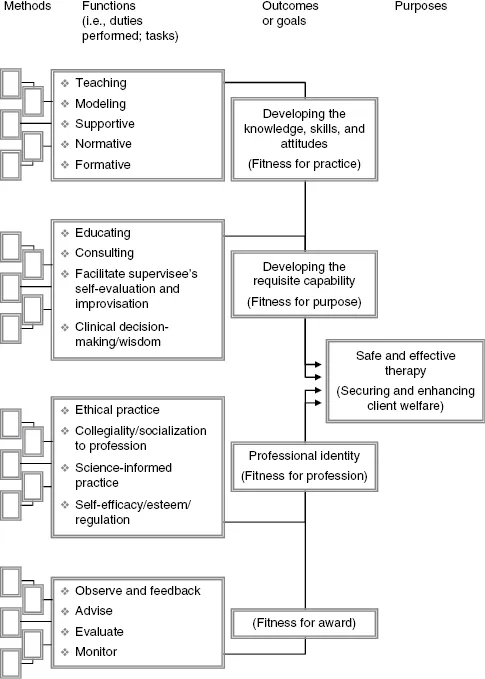
Milne's (2007) definition identified three broad objectives of supervision: normative, restorative, and formative. This follows Proctor (1988) and is consistent with the one used by the NHS in the United Kingdom (Department of Health, 1993). Bernard and Goodyear's (2014) definition also identifies three purposes of supervision, two of which overlap with the normative (i.e., monitoring the quality of professional services and serving as a gatekeeper) and one with the formative objective (i.e., enhancing professional functioning). As will be indicated shortly, there are additional functions that supervision can serve, although the terms that are used by different authors can obscure the distinctions that they make. To provide a more complete specification of what supervision can achieve and to clarify how these functions relate, we distinguish between what supervisors do (i.e., the methods or techniques that they use, such as the different approaches to teaching), the functions that these methods serve (e.g., normative, formative, and restorative), and the outcomes or goals that normally result (i.e., competencies, capability, a sense of professional identity, and the obtaining of a professional qualification or award). Figure 1.1 provides a graphic display of those distinctions. It indicates that the ultimate purpose of all this integrated activity is safe and effective psychotherapy.
c1-fig-0001
Figure 1.1 How the different functions of supervision combine to foster safe and effective clinical practice. Source: Milne (2009). Reproduced with permission of Wiley.

Developing Competent Therapists

Perhaps the best-recognized function of supervision is to enable supervisees to become competent as psychotherapists. It also appears to be supervision's key contribution: “Supervision has been identified as perhaps the most important mechanism for developing competencies in therapists in training” (Callahan, Almstrom, Swift, Borja, & Heath, 2009, p. 72), something that has been recognized by others previously (Falender & Shafranske, 2004; Holloway & Poulin, 1995; Watkins, 1997a). This endorsement also comes from both parties: a UK survey suggested that supervision was the main influence on clinical practice, as perceived by supervisors and their supervisees (Lucock, Hall, & Noble, 2006). As indicated by Figure 1.1, supervisors utilize interventions such as teaching and modeling to assist supervisees in becoming competent therapists, but it is also noted there that supervisors need to provide a supportive environment (Ladany & Inman, 2012; Russell & Petrie, 1994; Watkins & Scaturo, 2013), one that acknowledges the requirements for competent practice (e.g., recognizing any service standards that apply, such as those that specify how clinical reports should be completed).

Developing Capable Therapists

Of course, it has also been recognized that no amount of expert supervision prepares novice therapists for their whole careers. This is why there are systems of continuing professional development (Golding & Gray, 2006; Grant & Schofield, 2007). But one of the vital building blocks that a supervisor can help to cultivate during initial professional training is the capacity for future development. A term that is used in the United Kingdom to capture the distinction between such current and future competence is “capability.” This refers to those problem-solving, creative features of a rounded practitioner (Fraser & Greenhalgh, 2001). In pursuing this function, Figure 1.1 notes that a supervisor may emphasize education rather than training so as to facilitate career-fostering qualities such as critical thinking and self-evaluation.

Creating a Professional Identity

Alongside competence and capability, the supervisee needs to develop an ethical approach (Thomas, 2010) and so the supervisor will encourage suitable reflection (and similar methods, such as guided reading) to foster cultural competence, related awareness of sound practice, and therapist identity development (cf. Leszcz, 2011; Watkins, 2012b). Linked to ethical awareness is socialization to the supervisee's profession, as in developing collegial attitudes and practices, and in highlighting distinctive features of one's own profession. This is captured in Figure 1.1 as the third broad goal of supervision, one that is concerned with enabling practitioners to fulfill the expectations (purpose) of their own profession. To illustrate, a capab...

Table of contents

  1. Cover
  2. Table of Contents
  3. Title page
  4. Copyright page
  5. Dedication
  6. Contributors
  7. Preface
  8. Part I: Conceptual and Research Foundations
  9. Part II: Practice Foundations The Context for Clinical Supervision
  10. Part III: Core Skills in Clinical Supervision
  11. Part IV: Measuring Competence In Supervisees and Supervisors
  12. Part V: Supervising Psychotherapies – Theory-Specific, Developmental, and Social Role Perspectives
  13. Part VI: Endnotes
  14. Index
  15. End User License Agreement