Provides the latest QMRA methodologies to determine infection risk cause by either accidental microbial infections or deliberate infections caused by terrorism
• Reviews the latest methodologies to quantify at every step of the microbial exposure pathways, from the first release of a pathogen to the actual human infection
• Provides techniques on how to gather information, on how each microorganism moves through the environment, how to determine their survival rates on various media, and how people are exposed to the microorganism
• Explains how QMRA can be used as a tool to measure the impact of interventions and identify the best policies and practices to protect public health and safety
• Includes new information on genetic methods
• Techniques use to develop risk models for drinking water, groundwater, recreational water, food and pathogens in the indoor environment
- English
- ePUB (mobile friendly)
- Available on iOS & Android
eBook - ePub
Quantitative Microbial Risk Assessment
About this book
Information
Chapter 1
Motivation
The prevention of infectious disease transmission from human exposure to contaminated food, water, soil, and air remains a major task of environmental and public health professionals. There are numerous microbial hazards, including exposure via food, water, air, and malicious release of pathogens that may arise. Indeed, some have argued that the property of virulence of human pathogens is one which is favored by evolutionary interactions between pathogens and host populations and therefore will always be of important concern [1]. To make rational decisions in preparing, responding, and recovering from exposures to such hazards, a quantitative framework is of high benefit.
The objective of this book is to comprehensively set forth the methods for assessment of risk from infectious agents transmitted via these routes in a framework that is compatible with the framework for other risk assessments (e.g., for chemical agents) as set forth in standard protocols [2, 3].
In this chapter, information on the occurrence of infectious disease in broad categories will be presented, along with a historical background on prior methods for assessment of microbial safety of food, water, and air. This will be followed by an overview of key issues covered in this book.
Prevalence of Infectious Disease
Outbreaks of infectious waterborne illness continue to occur, although it remains impossible to identify the infectious agent in all cases. For example, in 1991, a waterborne outbreak in Ireland resulting from sewage contamination of water supplies infected about 5000 persons. However, the infectious agent responsible for this outbreak could not be determined [4]. In the United States, it has been estimated that 38 million cases of foodborne infectious disease occur annually with unidentified agents [5].
In the United States, there have typically been three to five reported outbreaks per year in community drinking water systems involving infectious microorganisms, with perhaps up to 10,000 annual cases [6]. The 1994 Milwaukee Cryptosporidium outbreak with over 400,000 cases [7, 8] was a highly unusual event among these statistics. As shown in Figure 1.1, there has been an increasing ability to identify microorganisms responsible for waterborne diseases, and it is expected that with advances in molecular biology, this will increase.
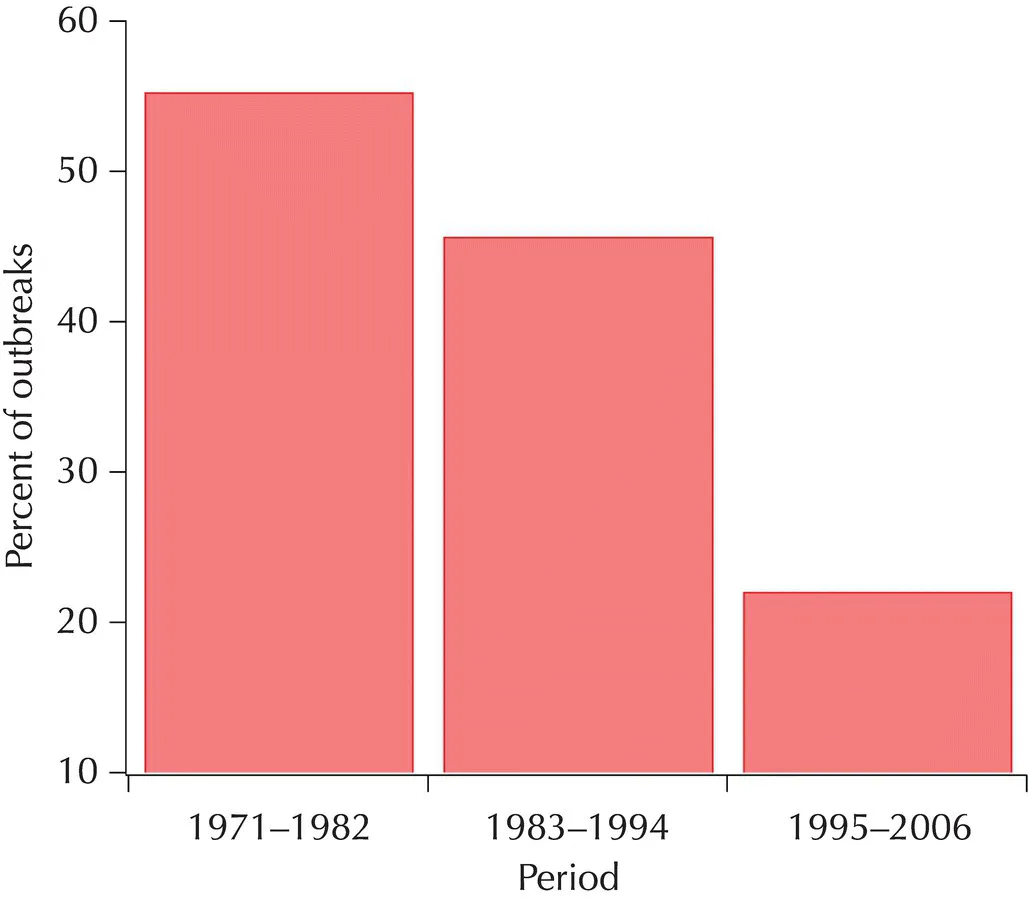
Figure 1.1 Percentages of outbreaks associated with public water systems (n = 680) by time period 1971–2006 that had unknown etiologies based on data from Ref. [6].
There are substantially more outbreaks and cases of foodborne infectious diseases than are reported. Table 1.1 summarizes reports of U.S. cases of principal microbial infectious foodborne illnesses for two 5-year periods (1988–1992 and 2002–2006). There is a mix of causal agents, including bacteria, virus, and protozoa. It is noteworthy that (as in the case of waterborne outbreaks) the frequency of outbreaks of unknown etiology has dramatically decreased but the frequency of outbreaks associated with norovirus has dramatically increased. These changes are due in part to the ability to better identify causal agents (e.g., via molecular methods).
Table 1.1 Comparison of Five-Year Averages for Common Foodborne Reported Outbreaks
Source: From Refs. [9, 10].
| Agent | Annual Average 1988–1992 | Annual Average 2002–2006 | ||
| Cases | Outbreaks | Cases | Outbreaks | |
| Campylobacter | 99.6 | 4.4 | 624 | 22 |
| Escherichia coli | 48.8 | 2.2 | 481a | 30a |
| Salmonella | 4,235.4 | 109.8 | 3,475 | 144 |
| Shigella | 957.6 | 5 | 495 | 12 |
| Staphylococcus aureus | 335.6 | 9.4 | 554 | 25 |
| Hepatitis | 421.8 | 8.6 | 238 | 1 |
| Listeria monocytogenes | 0.4 | 0.2 | 22 | 2 |
| Giardia | 36.8 | 1.4 | 2 | 1 |
| Norovirus | 58.4 | 0.4 | 10,854 | 338 |
| Vibrio (all) | 11.4 | 1.8 | 114 | 5 |
| Unknown etiologies | 40,483 | 1,422 | 4,052 | 30 |
a Include both Shiga toxigenic and enterotoxigenic.
It is generally recognized that reported outbreaks, either of water- or foodborne infectious disease, represent only a small fraction of the total population disease burden. However, particularly in the United States, voluntary reporting systems and the occurrence of mild cases (for whic...
Table of contents
- Cover
- Title page
- Copyright page
- Preface
- Chapter 1: Motivation
- Chapter 2: Microbial Agents and Transmission
- Chapter 3: Risk Assessment Paradigms
- Chapter 4: Conducting the Hazard Identification (HAZ ID)
- Chapter 5: Analytical Methods and the Qmra Framework
- Chapter 6: Exposure Assessment
- Chapter 7: Predictive Microbiology
- Chapter 8: Conducting the Dose–Response Assessment
- Chapter 9: Uncertainty
- Chapter 10: Population Disease Transmission
- Chapter 11: Risk Characterization and Decision Making
- Index
- End User License Agreement
Trusted by 375,005 students
Access to over 1.5 million titles for a fair monthly price.
Study more efficiently using our study tools.
Frequently asked questions
Yes, you can cancel anytime from the Subscription tab in your account settings on the Perlego website. Your subscription will stay active until the end of your current billing period. Learn how to cancel your subscription
No, books cannot be downloaded as external files, such as PDFs, for use outside of Perlego. However, you can download books within the Perlego app for offline reading on mobile or tablet. Learn how to download books offline
Perlego offers two plans: Essential and Complete
- Essential is ideal for learners and professionals who enjoy exploring a wide range of subjects. Access the Essential Library with 800,000+ trusted titles and best-sellers across business, personal growth, and the humanities. Includes unlimited reading time and Standard Read Aloud voice.
- Complete: Perfect for advanced learners and researchers needing full, unrestricted access. Unlock 1.5M+ books across hundreds of subjects, including academic and specialized titles. The Complete Plan also includes advanced features like Premium Read Aloud and Research Assistant.
We are an online textbook subscription service, where you can get access to an entire online library for less than the price of a single book per month. With over 1.5 million books across 990+ topics, we’ve got you covered! Learn about our mission
Look out for the read-aloud symbol on your next book to see if you can listen to it. The read-aloud tool reads text aloud for you, highlighting the text as it is being read. You can pause it, speed it up and slow it down. Learn more about Read Aloud
Yes! You can use the Perlego app on both iOS and Android devices to read anytime, anywhere — even offline. Perfect for commutes or when you’re on the go.
Please note we cannot support devices running on iOS 13 and Android 7 or earlier. Learn more about using the app
Please note we cannot support devices running on iOS 13 and Android 7 or earlier. Learn more about using the app
Yes, you can access Quantitative Microbial Risk Assessment by Charles N. Haas,Joan B. Rose,Charles P. Gerba in PDF and/or ePUB format, as well as other popular books in Technology & Engineering & Environmental Management. We have over 1.5 million books available in our catalogue for you to explore.