Clinical Data Interpretation for Medical Finals
eBook - ePub

Clinical Data Interpretation for Medical Finals

Single Best Answer Questions

  1. English
  2. ePUB (mobile friendly)
  3. Available on iOS & Android
eBook - ePub

Clinical Data Interpretation for Medical Finals

Single Best Answer Questions

About this book

Written by senior clinicians across a range of specialties, Data Interpretation for Medical Finals: Single Best Answer Questions is the perfect way to prepare for data interpretation assessments and clinical practice.

Featuring over 200 questions on key topics in medicine, each question is set around an image or investigation, such as an X-ray, CT scan, or blood film, and tests identification and interpretation of the data provided. Thorough explanation of the correct and incorrect answers helps you learn from mistakes.ย  The questions reflect current exam question style and incorporate high quality images, many of which are annotated, and are presented in full colour throughout.

Data Interpretation for Medical Finals will help build the confidence of all medical students, and Foundation Doctors, as it encourages application of investigation results to clinical decision making.
Frequently asked questions

Yes, you can cancel anytime from the Subscription tab in your account settings on the Perlego website. Your subscription will stay active until the end of your current billing period. Learn how to cancel your subscription.
No, books cannot be downloaded as external files, such as PDFs, for use outside of Perlego. However, you can download books within the Perlego app for offline reading on mobile or tablet. Learn more here.
Perlego offers two plans: Essential and Complete
  • Essential is ideal for learners and professionals who enjoy exploring a wide range of subjects. Access the Essential Library with 800,000+ trusted titles and best-sellers across business, personal growth, and the humanities. Includes unlimited reading time and Standard Read Aloud voice.
  • Complete: Perfect for advanced learners and researchers needing full, unrestricted access. Unlock 1.4M+ books across hundreds of subjects, including academic and specialized titles. The Complete Plan also includes advanced features like Premium Read Aloud and Research Assistant.
Both plans are available with monthly, semester, or annual billing cycles.
We are an online textbook subscription service, where you can get access to an entire online library for less than the price of a single book per month. With over 1 million books across 1000+ topics, weโ€™ve got you covered! Learn more here.
Look out for the read-aloud symbol on your next book to see if you can listen to it. The read-aloud tool reads text aloud for you, highlighting the text as it is being read. You can pause it, speed it up and slow it down. Learn more here.
Yes! You can use the Perlego app on both iOS or Android devices to read anytime, anywhere โ€” even offline. Perfect for commutes or when youโ€™re on the go.
Please note we cannot support devices running on iOS 13 and Android 7 or earlier. Learn more about using the app.
Yes, you can access Clinical Data Interpretation for Medical Finals by Philip Pastides, Parveen Jayia, Philip Pastides,Parveen Jayia in PDF and/or ePUB format, as well as other popular books in Medicine & Internal Medicine & Diagnosis. We have over one million books available in our catalogue for you to explore.

Information

3 Haematology
Questions
Philip S. Pastides, Parveen Jayia and Neil Chauhan

Question 1

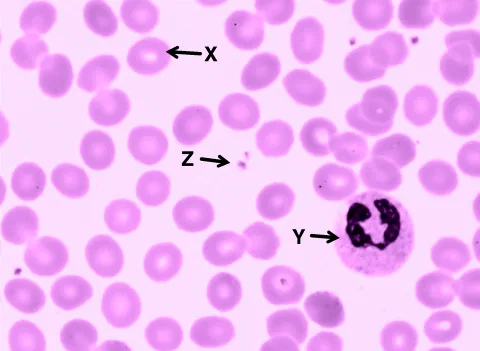
Consider the blood film below:
img
1. What is cell X?
A. Erythroblast
B. Erythrocyte
C. Reticulocyte
D. Sickle cell
E. Pencil cell
2. What is cell Y?
A. Neutrophil
B. Lymphocyte
C. Eosinophil
D. Monocyte
E. Basophil
3. What is structure Z?
A. Red cell fragment
B. Malarial parasite
C. Platelets
D. Spherocyte
E. Howellโ€“Jolly body

Question 2

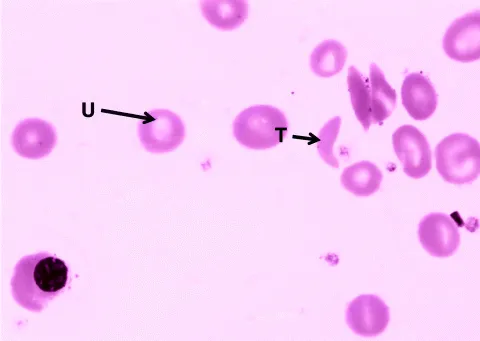
The red cells in the following film are abnormal:
img
1. What is cell T?
A. Pencil cell
B. Target cell
C. Sickle cell
D. Spherocyte
E. Elliptocyte
2. What is structure U?
A. Red cell fragment
B. Malarial parasite
C. Platelet
D. Spherocyte
E. Howellโ€“Jolly body

Question 3

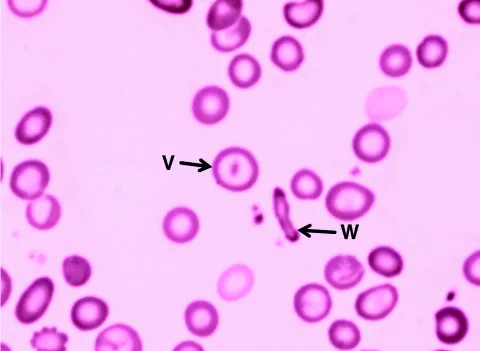
Consider the film below:
img
1. What is cell V?
A. Pencil cell
B. Target cell
C. Sickle cell
D. Spherocyte
E. Elliptocyte
3. What is cell W?
A. Pencil cell
B. Target cell
C. Sickle cell
D. Spherocyte
E. Elliptocyte

Question 4

A 32-year-old woman visits her GP due to ongoing nausea and tiredness. She is pleasantly surprised to discover that she is pregnant. On examination she looks a bit pale, so the GP performs some blood tests to investigate further. These are shown below:
Range
White cell count (WCC) 5.0 ร— 109/L 3.8โ€“11.8 ร— 109
Haemoglobin (Hb) 8.1 g/dL 11.5โ€“16.5
Platelets 274 ร— 109/L 150โ€“400 ร— 109
Haematocrit 0.249 L/L 0.37โ€“0.50
Mean cell volume (MCV) 106 fL 78โ€“100
Neutrophils 2.75 ร— 109/L 2.00โ€“6.77 ร— 109
Lymphocytes 2 ร— 109/L 1โ€“4 ร— 109
Monocytes 0.5 ร— 109/L 0.2โ€“0.8 ร— 109
Eosinophils 0.04 ร— 109/L 0.04โ€“0.40 ร— 109
Basophils 0.01...

Table of contents

  1. Cover
  2. Title Page
  3. Copyright
  4. Contributors
  5. Foreword
  6. Preface
  7. Acknowledgements
  8. Reference Values
  9. Chapter 1q: Cardiac Medicine
  10. Chapter 1a: Cardiac Medicine
  11. Chapter 2q: Respiratory Medicine
  12. Chapter 2a: Respiratory Medicine
  13. Chapter 3q: Haematology
  14. Chapter 3a: Haematology
  15. Chapter 4q: Microbiology
  16. Chapter 4a: Microbiology
  17. Chapter 5q: Radiology
  18. Chapter 5a: Radiology
  19. Chapter 6q: General Surgery and Gastroenterology
  20. Chapter 6a: General Surgery and Gastroenterology
  21. Chapter 7q: Musculoskeletal Medicine and Trauma
  22. Chapter 7a: Musculoskeletal Medicine and Trauma
  23. Chapter 8q: Dermatology
  24. Chapter 8a: Dermatology
  25. Chapter 9q: Ophthalmology
  26. Chapter 9a: Ophthalmology
  27. Chapter 10q: Evidence-based Medicine
  28. Chapter 10a: Evidence-based Medicine
  29. Appendix A: How to Interpret an ECG
  30. Appendix B: How to Interpret a Chest Radiograph
  31. Appendix C: How to Interpret an Arterial Blood Gas
  32. Appendix D: How to Interpret an Abdominal Radiograph
  33. Appendix E: How to Interpret a CT Head