Dental Materials at a Glance
eBook - ePub

Dental Materials at a Glance

  1. English
  2. ePUB (mobile friendly)
  3. Available on iOS & Android
eBook - ePub

Dental Materials at a Glance

About this book

Dental Materials at a Glance, 2 nd edition, is the latest title in the highly popular At a Glance series, providing a concise and accessible introduction and revision aid. Following the familiar, easy-to-use at a Glance format, each topic is presented as a double-page spread with key facts accompanied by clear diagrams encapsulating essential information.

Systematically organized and succinctly delivered, Dental Materials at a Glance covers:

  • Each major class of dental material and biomaterial
  • Basic chemical and physical properties
  • Clinical handling and application
  • Complications and adverse effects of materials

Dental Materials at a Glance is the ideal companion for all students of dentistry, residents, and junior clinicians. In addition, the text will provide valuable insight for general dental practitioners wanting to update their materials knowledge and be of immediate application for dental hygienists, dental nurses, dental assistants, and technicians.
Frequently asked questions

Yes, you can cancel anytime from the Subscription tab in your account settings on the Perlego website. Your subscription will stay active until the end of your current billing period. Learn how to cancel your subscription.
No, books cannot be downloaded as external files, such as PDFs, for use outside of Perlego. However, you can download books within the Perlego app for offline reading on mobile or tablet. Learn more here.
Perlego offers two plans: Essential and Complete
  • Essential is ideal for learners and professionals who enjoy exploring a wide range of subjects. Access the Essential Library with 800,000+ trusted titles and best-sellers across business, personal growth, and the humanities. Includes unlimited reading time and Standard Read Aloud voice.
  • Complete: Perfect for advanced learners and researchers needing full, unrestricted access. Unlock 1.4M+ books across hundreds of subjects, including academic and specialized titles. The Complete Plan also includes advanced features like Premium Read Aloud and Research Assistant.
Both plans are available with monthly, semester, or annual billing cycles.
We are an online textbook subscription service, where you can get access to an entire online library for less than the price of a single book per month. With over 1 million books across 1000+ topics, we’ve got you covered! Learn more here.
Look out for the read-aloud symbol on your next book to see if you can listen to it. The read-aloud tool reads text aloud for you, highlighting the text as it is being read. You can pause it, speed it up and slow it down. Learn more here.
Yes! You can use the Perlego app on both iOS or Android devices to read anytime, anywhere — even offline. Perfect for commutes or when you’re on the go.
Please note we cannot support devices running on iOS 13 and Android 7 or earlier. Learn more about using the app.
Yes, you can access Dental Materials at a Glance by J. Anthony von Fraunhofer in PDF and/or ePUB format, as well as other popular books in Medicine & Dentistry. We have over one million books available in our catalogue for you to explore.

Information

Year
2013
Print ISBN
9781118459966
eBook ISBN
9781118646649
Edition
2
Subtopic
Dentistry
Part I
Fundamentals
1
Properties of materials—tensile properties
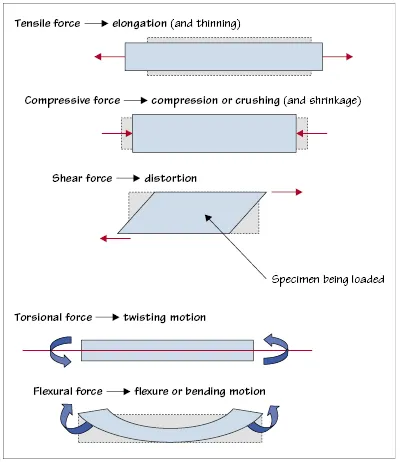
Figure 1.1 Applied forces and specimen deformations.
c1-fig-0001
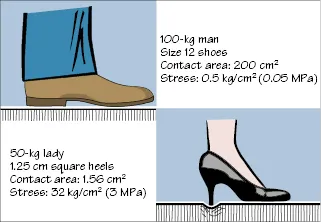
Figure 1.2 Load versus stress for feet.
c1-fig-0002
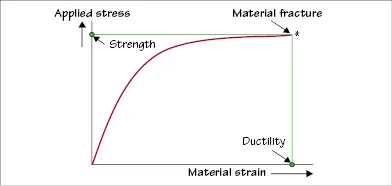
Figure 1.3 The stress–strain curve of a nonferrous metal.
c1-fig-0003
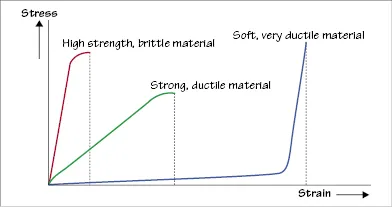
Figure 1.4 Stress–strain curves for brittle, elastic, and ductile materials.
c1-fig-0004
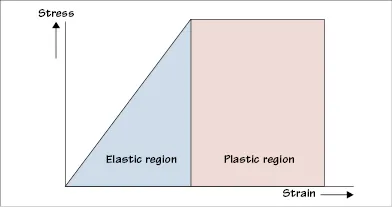
Figure 1.5 Elastic and plastic regions of a stress–strain curve.
c1-fig-0005
Box 1.1 Desirable properties of dental materials
Biocompatibility
Absence of toxicity
Aesthetic appearance
Strength and durability
Low solubility
Ease of manipulation
Long shelf life
Simple laboratory processing
Long working time
Rapid/snap set
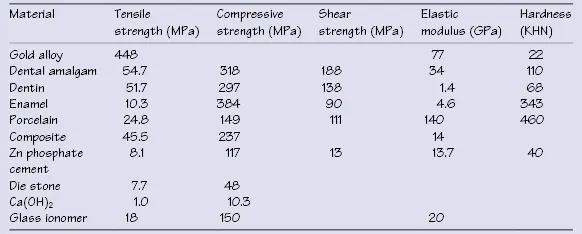
Table 1.1 Typical mechanical properties of dental biomaterials
c1-tbl-0001.webp
Dental biomaterials are used in laboratory procedures and for the restoration and replacement of teeth and bone. Material selection must consider function, properties, and associated risks, and all dental biomaterials must satisfy certain criteria (Box 1.1).
Mechanical properties are important since teeth and restorations must resist biting and chewing (masticatory) forces. Typical material properties are given in Table 1.1.
Biting forces vary with patient age and dentition, decreasing for restored teeth and when a bridge, removable partial denture (RPD), or complete denture is present. Effects vary with the type of applied force and its magnitude. Types of applied force, and the resulting deformations, are shown in Figure 1.1.
1 Stress: σ, force per unit cross-sectional area
  • Stress, the applied force and the area over which it operates, determines the effect of the applied load. For example, a chewing force of 72 kg (10 N) spread over a quadrant 4 cm2 in area exerts a stress of 18 kg/cm2 (1.76 MPa). However, the same force on a restoration high spot or a 1-mm2 hard food fragment produces a stress of 7200 kg/cm2 (706 MPa), a 400-fold increase in loading. This stress effect is one reason that occlusal balancing is essential in restorative dentistry. A more graphic example of the difference between applied force and stress is shown in Figure 1.2. This example also clearly indicates why it is more painful when a woman wearing high heels steps on you than when a man does!
2 Strength: The stress that causes failure
3 Ultimate strength: The maximum stress sustained before failure
4 Proportional limit: The maximum stress that the material can sustain without deviation from linear stress–strain proportionality
5 Elastic limit: Maximum stress that can be applied without permanent deformation
6 Yield strength: σY, stress at which there is a specified deviation from stress-to-strain proportionality, usually 0.1%, 0.2%, or 0.5% of the permanent strain
7 Strain: ε, ratio of deformation to original length, Ī”L/L; measures deformation at failure
8 Ductility: Percentage elongation, i.e. Ī”L/L Ɨ 100%
  • Ductile materials exhibit greater percentage elongation than brittle materials and can withstand greater deformation before fracture.
9 Burnishing index: Ability of a material to be worked in the mouth or burnished, expressed as the ratio of % elongation to yield strength
10 Poisson's ratio: ν, ratio of lateral to axial strain under tensile loading; denotes reduction in cross-section during elongation
  • Brittle materials have low ν values, i.e. little change in cross-section with elongation, whereas ductile materials show greater reduction in cross-section, known as specimen necking.
11 Elastic modulus: E, ratio of stress to strain, also known as modulus of elasticity or Young's modulus; denotes material stiffness and is determined as the slope of the elastic (linear) portion of the stress–strain curve
12 Stress–strain curves: Generated by applying a progressively increasing tensile force while measuring applied stress and material strain until fracture occurs
The shape of the stress–strain curve indicates the properties of the material (Figure 1.3 and Figure 1.4):
  • Nonferrous metals (e.g., gold and copper) show a continuous curve to failure whereas ferrous materials exhibit a ā€œkinkā€ in the curve, known as the yield point.
  • The intersection of a line parallel to the abscissa (strain) axis from the failure point to the ordinate (stress) axis is specimen strength whereas the vertical line from the failure point to the strain axis is the ductility.
  • High-strength, brittle materials show steep stress–strain curves with little strain at failure, e.g. ceramics.
  • Strong ductile materials, e.g. metals, show moderate slopes in the stress–strain curve but good extension until failure.
  • Soft ductile materials, e.g. elastomers, show long, shallow linear stress–strain behavior followed by a sharp rise in the curve when, with increasing applied force, the elastomer no longer extends linearly (or elastically) and failure occurs.
13 Resilience: Resistance to permanent deformation (i.e., energy required for deformation to the proportional limit); given by the area under the elastic portion of the stress–strain curve (Figure 1.5)
14 Toughness: Resistance to fracture (i.e., energy required to cause fracture); given by the total area (i.e., both the elastic and plastic regions) under the stress–strain curve (Figure 1.5)
15 Hardness: Resistance to penetration; a measure of scratch resistance
  • Hardness is measured by several techniques, including the Barcol, Bierbaum, Brinell, Knoop, Rockwell, Shore, and Vickers tests.
2323__perlego__chapter_divider...

Table of contents

  1. Cover
  2. Title page
  3. Copyright page
  4. Dedication
  5. Preface
  6. Part I: Fundamentals
  7. Part II: Laboratory materials
  8. Part III: Dental biomaterials
  9. Glossary
  10. Index