- Summarizes the diversity of views on ancient rock art from leading international scholars
- Includes new discoveries and research, illustrated with over 160 images (including 30 color plates) from major rock art sites around the world
- Examines key work of noted authorities (e.g. Lewis-Williams, Conkey, Whitley and Clottes), and outlines new directions for rock art research
- Is broadly international in scope, identifying rock art from North and South America, Australia, the Pacific, Africa, India, Siberia and Europe
- Represents new approaches in the archaeological study of rock art, exploring issues that include gender, shamanism, landscape, identity, indigeneity, heritage and tourism, as well as technological and methodological advances in rock art analyses
- English
- ePUB (mobile friendly)
- Available on iOS & Android
eBook - ePub
A Companion to Rock Art
About this book
This unique guide provides an artistic and archaeological journey deep into human history, exploring the petroglyphic and pictographic forms of rock art produced by the earliest humans to contemporary peoples around the world.
Information
CHAPTER 1
Research Issues and New Directions:
One Decade into the New Millennium
This Companion to Rock Art has been inspired by an efflorescence in rock art studies over the past decade. Advances in critical thinking, the explicit pursuit of methodological rigor, and improved technological capacity in the digital age have seen rock art studies move to center stage in a number of archaeological and, indeed, broader social contexts. Our mandate for this volume has been to define new research issues and directions and critique existing research paradigms, and we have explicitly sought theoretically pluralist approaches.
It has been more than a decade since an edited volume has explored various theoretical approaches or focused on technical and scientific advances (e.g., Conkey et al. 1997; Chippindale and Taçon 1998; Helskog 2001; Whitley 2001). It is similarly some time since any anthology has explored particular rock art thematics, such as landscapes (David and Wilson 2002; Chippindale and Nash 2004) or gender (Gero and Conkey 1991; Casey et al. 1998). There have been more recent collected works that have focused on the rock art of specific regions or on a particular topic (e.g., Loendorf et al. 2005; Bahn 2010; Goldhahn et al. 2010), but none in the past decade that has aimed to provide a comprehensive overview of different approaches from around the world and from a range of theoretical perspectives.
The resurgence in rock art research around the world has been spurred by national funding cycles, advances in technology, and, in many cases, the serendipitous coalition of different personalities and projects. For instance, in Australasia the Australian Research Council (ARC) has funded a number of major projects around the region – to the tune of several million dollars – over the past five years. The Picturing Change Project and the Canning Stock Route Project (see Chapters 24 and 31) are two such examples, and there are other ARC projects in the region where rock art has similarly received a significant injection of funds and research interest (for example, the Kimberley, East Timor, and Sulawesi). This is the first major national funding cycle explicitly targeting rock art since the late seventies, when the (then) Australian Institute of Aboriginal Studies and the Australian Heritage Commission funded a number of rock art research and rock art conservation projects (e.g., Ucko 1977; Rosenfeld 1985).
Rock art has recently been central to some of the greatest professional and ethical management conundrums of our time. At Foz Côa (Portugal) and Siega Verde (Spain) outdoor Paleolithic rock art was saved from the construction of a dam by an international campaign and subsequent World Heritage listing (www.arte-coa.pt, accessed March 2012). The discovery of open-air Paleolithic art created quite a stir, and a range of techniques was used to validate the assessment of this art’s significance; conversely, science was invoked to contradict the conclusions that were initially founded on stylistic analyses and interpretations (see Batarda Fernandes 2009; Bednarik 2009). Archaeological excavation has since demonstrated that open-air occupation deposits date to in excess of 30,000 years, providing a secondary line of evidence for the significant age of this rock art.
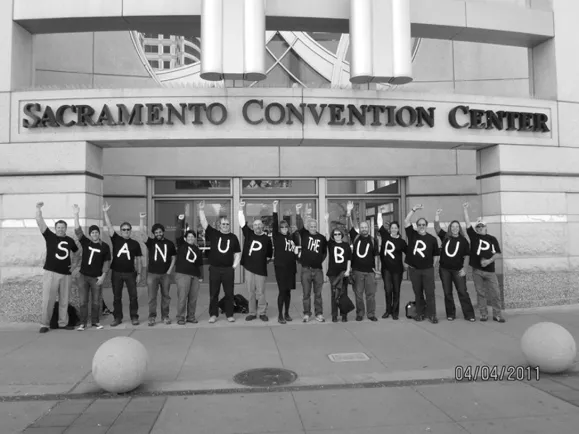
Similarly, protecting and managing the petroglyphs on the Dampier Archipelago (Murujuga) in Australia has inspired professional action from archaeologists and rock art associations alike in the face of continuing pressure from industrial development (Bednarik 2006; McDonald and Veth 2009). There is also a vibrant grassroots campaign (www.standupfortheburrup.com, accessed March 2012) which continues to agitate for increased protection and appropriate government recognition of this significant place (Figure 1.1). This rock art province has been National Heritage listed and is currently being assessed for its “outstanding universal values” as part of the World Heritage nomination process. More recently, there has been a push by individuals and various benefactor groups (see, for example, www.protectaustraliasspirit.com.au, accessed March 2012, and www.kimberleyfoundation.com, accessed March 2012) to seek public and corporate support for further research into Australian rock art.
Figure 1.1 “Stand Up for the Burrup”: roll call at the Society for American Archaeology 2011 Conference in Sacramento
(photo: Sue Smalldon).
Rock art is taught as a mainstream offering in undergraduate and graduate archaeology and cultural heritage programs throughout the world. In Australia, over the past two years, three rock art research centers have been created: at the University of Western Australia, the Australian National University, and Griffith University. In America, the SHUMLA School, in Comstock, Texas, is actively engaged in national and international research projects, education, and community outreach programs, taking annual field schools in recording techniques; and across Europe (Wales, Italy, and Spain, to name a few) there are annual field schools for rock art enthusiasts most of which can be accessed online.
The time was ripe for the conception of this volume. Rock art research has gained a level of theoretical maturity and disciplinary recognition that allows us to anticipate that the upsurge in good research will continue, while public interest in, and recognition of, rock art as a universal insight into humanity will only increase as more research is published.
RATIONALE FOR THIS VOLUME AND ITS STRUCTURE
The structure of the volume is tailored to the teaching of the next generation of rock art researchers. It has been designed to slot into a 13-week semester cycle, with 11 thematic sections, comprising a total of 37 chapters. This should allow for an orientation and introductory session on research issues and new directions, as outlined here and so eloquently and ably by Professor Meg Conkey in the Foreword, followed by 11 weeks based on each theme, with two to four chapters per week. The final week is thus allocated to a summation of the themes covered and exams or final essays. We have aimed to direct the reader through the full gamut of research possibilities in rock art from overtly theoretical stances to those that are more regional, methodological, technical, or applied in focus. Overall – as with all grounded work driven by behaviorally oriented inquiry – most chapters aim toward a robust integration of data and problematics.
For this volume, the solicited constellations of chapters around the 11 core themes cover current and new directions in rock art research. These themes fall broadly into the general descriptors of: explanatory frameworks; inscribed landscapes and seascapes; engendered, hermeneutic, and anthropological approaches; regional and contextualized studies; rock art as identity and as mediation between different social groups; the social and political context of management; and methodological advances in dating and digital heritage.
This volume provides a fresh look at rock art research one decade into the new millennium. The contributors include a number of well-known authorities who were invited to reflect on perceived orthodoxies in their own and other people’s research (for example, the uses and abuses of shamanism), but we have also targeted a number of earlier-career scholars. Significant departures in this volume include not only the explicit move toward archaeological mainstream analyses in many chapters, but also the collaborations that so many of these chapters represent. This is apparent in both the range and scope of many described case studies, and also in the number of co-authored chapters. Only half of the contributions to this volume are sole authored, compared to the volume edited by Chippindale and Taçon (1998, where only three of 16 chapters are co-authored) or that edited by Whitley (2011; where only two of 24 chapters are co-authored). There also seems to have been a shift in the gender balance of rock art researchers over the past decade. Twenty-three of the 38 offerings here are authored or co-authored by women from both hemispheres: contra Chippindale and Taçon (1998), where only six of the 22 authors are female, or Whitley (2011) where only four of the 25 authors are women.
We were interested in showcasing inter-regional and global comparative studies, as well as ensuring that there was a good quotient of scholars from non-English-speaking countries and study areas: 11 of the chapters are written by authors whose first languages are – and most of their publications have appeared in – French, Spanish, Swedish, or Polish (we are very grateful to Sebastien Lacombe and Kathleen Sterling for translating Chapter 21 into English). We were also interested in profiling how applied rock art research has become more embedded within broader discourses of heritage management: there are several chapters which look at World Heritage listing as a management regime, and still others that investigate how rock art management might mesh with national or Indigenous goals and a range of management strategies.
RESEARCH ISSUES AND NEW DIRECTIONS
There is a surfeit of research agendas now available for rock art studies worldwide. The themes canvassed throughout the volume demonstrate that these are (or can be) approached in a systematic, critical, and highly informed manner. Many of the polarities inherent in previous approaches (for example, informed versus formal; symbolic versus functional; ritual versus mundane; gendered versus ungendered) are now being unpacked in more nuanced analyses. These approaches are arguably based on a more thorough understanding of where archaeology fits between hard science and the humanities, but there is also more critical (and self-critical) use of ethnographic and ethnohistorical sources in ways that avoid analogic and teleological traps. A number of chapters demonstrate the use of pattern recognition and deploy statistical approaches in more sophisticated ways and ask questions at multiple scales. The continued refinements in dating technology and image enhancement set new benchmarks in how we approach the very basis of making sense of rock art. What are we looking at? How old is it? How do we record it?
The fact that rock art can signal information at many levels, and has agency between culture groups in the same time and space and intergenerationally, appears as a recurrent theme; as does its role in ideational, sensory, social organizational, religious, hierarchical, territorial, and economic domains. The information content of rock art, when viewed within its larger archaeological or anthropological context, can inform on multiple aspects of past behavioral systems; and we think this volume demonstrates that this is a watershed time in terms of rock art’s emergence into the archaeological mainstream: Meg Conkey’s comments in the Foreword reinforce this point.
It is clear that the division, defined so persuasively by Chippindale and Taçon (1998), between “informed” and “formal” approaches has in many cases become blurred as practitioners working within these frameworks move toward an approach which sees the contextualization of rock art as the primary goal. Rock art may be informed by ethnography, or it may require formal analysis to elucidate patterning where we have no analogy or ethnographic reference, but our hopes of understanding the rock art in any fundamental sense must be based on an understanding of its context. This is not a new revelation (Conkey 1987), but it is an insight which now has very different meaning when rock art is perceived as one of many lines of evidence in a collaborative project, and rock art researchers stop working in isolation and take a more explicitly archaeological approach. Of course, improvements in dating techniques, and the fact that more concrete conclusions can be made about art’s place in an archaeological sequence, has reduced the skepticism that mainstream archaeologists may have previously felt in their dismissal of rock art as having little scientific value.
As we now profile some of the key research themes to emerge from this edited volume, it is clear that many of the authors could have been asked to produce their chapters in more than one of the selected research themes. This is further demonstration of the more evolved approaches that many rock art researchers are applying to their studies.
Phenomenology
Phenomenology involves exploring the ways in which rock art was perceived, produced, positioned, and added to through time. It explores the original intention of rock art’s production (without presuming to know the intention of the artist), and considers the impact it might have had on observers as they witnessed its production or engaged with it more broadly by experiencing sites and their landscape settings. Rock art in its landscape context is explicitly explored here in a number of chapters: in ceremonial arenas in the Caribbean; in a range of topographic settings in the Andes; and positioned for viewing by a limited audience in megalithic Europe. Some of these studies demonstrate varying degrees of formal trait analysis, while others are more concerned with phenomenological approaches (sensu Tilley 1994).
Iain Davidson (Chapter 4) explores differences between late Pleistocene rock art from western Europe and the east Mediterranean. By examining assemblage variability in detail and exploring robust and plausible modeling, he concludes that ideological differences are at center stage. Variation in motif theme, and the relationships amongst these, and in the positioning of images within sites, indicate patterning in the rock art from these two regions which overall reflects the emergence of different ideologies in the Pleistocene at either end of the Mediterranean.
Inscribed landscapes – and seascapes (Chapter 5) – develop the phenomenological approach to consider the ways in which different social groups inscribe meaning and mark places across space and through time. The concept of “received heritage” finds expression in chapters from diverse areas (the Pacific, the Western Desert, and the Caribbean), but is also implicit in a number of other chapter (based on the Andes, Patagonia, and the Sydney Basin). The “meanings” that groups ascribe in these different case studies come from a variety of sources, including informed and formal approaches, Neo-Marxism, and structuration theory. The recurrent observation made is that both wide and narrow graphic vocabularies are found in very patterned ways and these have served as important signaling devices. The purpose may have been to create group cohesion and identity, to manipulate land and seascapes through ritual, to delineate new territories based on emerging elites, or to transform the landscape into places of activity and/or meaning (see Chapter 7 where, interestingly, rock is moved to create the place, then transformed by the production of rock art). There is no question that an inclusive landscape approach – which incorporates both synchronic and diachronic perspectives – provides a meaningful and varied approach to rock art studies and broader current archaeological discourse (e.g., David and Thomas 2009).
Phenomenological and neurological approaches are openly addressed in chapters focused on the issue and consequences of altered states of consciousness. J. David Lewis-Williams (Chapter 2) provides a review of his extensive publications on shamanism, suggesting that there has been misinterpretation and misuse of the concept and pointing out that this should merely be considered as one possible outcome of interpretative research. He stresses that many rock art assemblages are not shamanistic in their origin. Interestingly, Lewis-Williams contends that Thomas Dowson’s (2009) view that the shamanic elements in San rock art are simply part of a wider, more inclusive animistic ontology, does not invalidate the fact that multiple features and motifs of San rock art point directly to ethnographically attested features of San shamanic practices and experiences. He contends that animism is a broad context in which shamanism may, or may not, exist.
While early analyses interpreted the rock art of the Lower Pecos Canyonlands as shamanistic, Carolyn E. Boyd (Chapter 3) introduce...
Table of contents
- Cover
- The Blackwell Companions to Anthropology
- Title page
- Copyright page
- List of Plates
- List of Figures
- List of Tables
- Notes on Contributors
- Foreword: Redefining the Mainstream with Rock Art
- CHAPTER 1 Research Issues and New Directions
- PART I: Explanatory Frameworks: New Insights
- PART II: Inscribed Landscapes
- PART III: Rock Art at the Regional Level
- PART IV: Engendered Approaches
- PART V: Form, Style, and Aesthetics in Rock Art
- PART VI: Contextualizing Rock Art
- PART VII: The Mediating Role of Rock Art
- PART VIII: Rock Art, Identity, and Indigeneity
- PART IX: Rock Art Management and Interpretation
- PART X: Dating Rock Art: Technological Advances and Applications
- PART XI: Rock Art in the Digital Age
- Supplemental Images
- Index
Trusted by 375,005 students
Access to over 1.5 million titles for a fair monthly price.
Study more efficiently using our study tools.
Frequently asked questions
Yes, you can cancel anytime from the Subscription tab in your account settings on the Perlego website. Your subscription will stay active until the end of your current billing period. Learn how to cancel your subscription
No, books cannot be downloaded as external files, such as PDFs, for use outside of Perlego. However, you can download books within the Perlego app for offline reading on mobile or tablet. Learn how to download books offline
Perlego offers two plans: Essential and Complete
- Essential is ideal for learners and professionals who enjoy exploring a wide range of subjects. Access the Essential Library with 800,000+ trusted titles and best-sellers across business, personal growth, and the humanities. Includes unlimited reading time and Standard Read Aloud voice.
- Complete: Perfect for advanced learners and researchers needing full, unrestricted access. Unlock 1.5M+ books across hundreds of subjects, including academic and specialized titles. The Complete Plan also includes advanced features like Premium Read Aloud and Research Assistant.
We are an online textbook subscription service, where you can get access to an entire online library for less than the price of a single book per month. With over 1.5 million books across 990+ topics, we’ve got you covered! Learn about our mission
Look out for the read-aloud symbol on your next book to see if you can listen to it. The read-aloud tool reads text aloud for you, highlighting the text as it is being read. You can pause it, speed it up and slow it down. Learn more about Read Aloud
Yes! You can use the Perlego app on both iOS and Android devices to read anytime, anywhere — even offline. Perfect for commutes or when you’re on the go.
Please note we cannot support devices running on iOS 13 and Android 7 or earlier. Learn more about using the app
Please note we cannot support devices running on iOS 13 and Android 7 or earlier. Learn more about using the app
Yes, you can access A Companion to Rock Art by Jo McDonald, Peter Veth, Jo McDonald,Peter Veth in PDF and/or ePUB format, as well as other popular books in Social Sciences & Archaeology. We have over 1.5 million books available in our catalogue for you to explore.