Loop-shaping Robust Control
eBook - ePub

Loop-shaping Robust Control

  1. English
  2. ePUB (mobile friendly)
  3. Available on iOS & Android
eBook - ePub

Loop-shaping Robust Control

About this book

The loop-shaping approach consists of obtaining a specification in relation to the open loop of the control from specifications regarding various closed loop transfers, because it is easier to work on a single transfer (in addition to the open loop) than on a multitude of transfers (various loopings such as set point/error, disturbance/error, disturbance/control, etc.). The simplicity and flexibility of the approach make it very well adapted to the industrial context.
This book presents the loop-shaping approach in its entirety, starting with the declension of high-level specifications into a loop-shaping specification. It then shows how it is possible to fully integrate this approach for the calculation of robust and efficient correctors with the help of existing techniques, which have already been industrially tried and tested, such as H-infinity synthesis. The concept of a gap metric (or distance between models) is also presented along with its connection with the prime factors of a set of systems shaping a ball of models, as well as its connections with robust synthesis by loop-shaping, in order to calculate efficient and robust correctors. As H-infinity loop-shaping is often demanding in terms of the order of correctors, the author also looks at loop-shaping synthesis under an ordering constraint. Two further promising lines of research are presented, one using stochastic optimization, and the other non-smooth optimization. Finally, the book introduces the concept of correction with two degrees of freedom via the formalism of prime factorization.
Avenues for future work are also opened up by the author as he discusses the main drawbacks to loop-shaping synthesis, and how these issues can be solved using modern optimization techniques in an increasingly competitive industrial context, in accordance with ever more complex sets of functional specifications, associated with increasingly broad conditions of usage.
Contents

Introduction
1. The Loop-shaping Approach
2. Loop-shaping H-infinity Synthesis
3. Two Degrees-of-Freedom Controllers
4. Extensions and Optimizations
Appendix 1. Demonstrative Elements on the Optimization of Robust Stabilization with Order Constraint
Appendix 2. Establishment of Real LMIs for the Quasi-Convex Problem of Optimization of the Weighting Functions

About the Authors

Philippe Feyel is an R&D Engineer for the high-tech company Sagem Défense Sécurité, part of the defence and security business of the SAFRAN group, in Paris, France.

Frequently asked questions

Yes, you can cancel anytime from the Subscription tab in your account settings on the Perlego website. Your subscription will stay active until the end of your current billing period. Learn how to cancel your subscription.
No, books cannot be downloaded as external files, such as PDFs, for use outside of Perlego. However, you can download books within the Perlego app for offline reading on mobile or tablet. Learn more here.
Perlego offers two plans: Essential and Complete
  • Essential is ideal for learners and professionals who enjoy exploring a wide range of subjects. Access the Essential Library with 800,000+ trusted titles and best-sellers across business, personal growth, and the humanities. Includes unlimited reading time and Standard Read Aloud voice.
  • Complete: Perfect for advanced learners and researchers needing full, unrestricted access. Unlock 1.4M+ books across hundreds of subjects, including academic and specialized titles. The Complete Plan also includes advanced features like Premium Read Aloud and Research Assistant.
Both plans are available with monthly, semester, or annual billing cycles.
We are an online textbook subscription service, where you can get access to an entire online library for less than the price of a single book per month. With over 1 million books across 1000+ topics, we’ve got you covered! Learn more here.
Look out for the read-aloud symbol on your next book to see if you can listen to it. The read-aloud tool reads text aloud for you, highlighting the text as it is being read. You can pause it, speed it up and slow it down. Learn more here.
Yes! You can use the Perlego app on both iOS or Android devices to read anytime, anywhere — even offline. Perfect for commutes or when you’re on the go.
Please note we cannot support devices running on iOS 13 and Android 7 or earlier. Learn more about using the app.
Yes, you can access Loop-shaping Robust Control by Philippe Feyel in PDF and/or ePUB format, as well as other popular books in Technology & Engineering & Mechanical Engineering. We have over one million books available in our catalogue for you to explore.

Chapter 1

The Loop-shaping Approach

1.1. Principle of the method

1.1.1. Introduction

The term “loop-shaping specification” denotes the practice of specifying the open-loop response of a servo-loop on the basis of a specification relating to several closed-loop transfers. The reason why we do this is that it is easier to work on a single transfer (the open-loop response) than on a multitude of transfers (the various loops, e.g. reference/error, disturbance/error, disturbance/control, etc.). In addition, the internal stability of the servo-loop (i.e. the stability of all the internal loops) can be guaranteed if the open loop response has certain characteristics (e.g. the Nyquist locus of the open loop in relation to point -1 with a monovariable system, or examination of the characteristic loci in the multivariable case). Hence, we can see the advantage of synthesis methods directly based on the open loop response, the frequency shape of which enables us to give the desired characteristics to the different loops.

1.1.2. Sensitivity functions

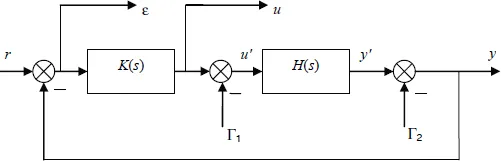
To illustrate the concept, the specification of the servo-loop’s performances can be based on the arrangement shown in Figure 1.1, which includes:
– the model’s input disturbances, Γ1;
– the model’s output disturbances, Γ2;
– the reference signal or measuring noise, r;
– the value to be controlled, y, for which we have a measurement;
– the measuring error ε;
– the command u created by the controller K(s), whose output disturbed by Γ2 is really applied to the transfer function system H(s).
Figure 1.1. General view of control system
Ch01-image001
The task of an automation engineer is then to determine a controller K(s) which, when looped with H(s), minimizes the error ε at the cost of “reasonable” commands, with the looping being subject to the external inputs r, Γ1 and Γ2.
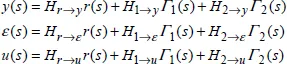
As regards the external inputs, the control and error signals are written as1:
Ch01-image002
Let us now detail the different transfers involved.

1.1.2.1. Output sensitivity functions

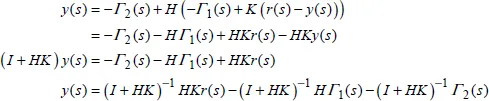
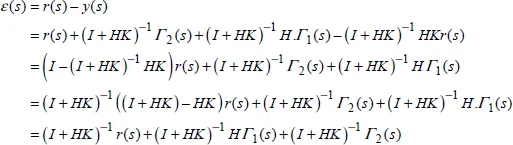
At the system’s output, we can write:
Ch01-image003
and:
Ch01-image004
In addition:
Ch01-image005
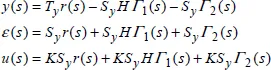
Denoting the output2 sensitivity functions as follows:
[1.1]
Ch01-image006
Thus we obtain:
Ch01-image007
As there is no reason for the product KH to be equal to HK in the MIMO case, we can obtain other expressions for the above signals.

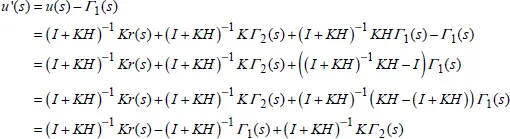
1.1.2.2. Input sensitivity functions

At the system’s input, we can write:
Ch01-image008
and:
Ch01-image009
Furthermore:
Ch01-image010
Finally:
Ch01-image011
By setting the following as input sensitivity functions3:
[1.2]
Ch01-image012
then:
Ch01-image013
Hence, finally, we obtain:
Ch01-image014
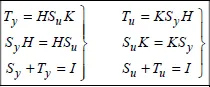
From this, we can draw the following fundamental relations:
[1.3]
Ch0-image015
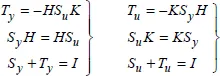
It should be noted that in the case of positive output feedback, we repeat all the previous steps, replacing r with -r and K with -K, from which we draw the following relations:
Ch01-image016
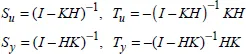
where:
Ch01-image017

1.1.3. Declination of performance objectives

In view of the previous developments, by frequency modeling only the direct (S) and complementary (T) sensitivity functions, we are therefore able to model all the closed-loop transfers, because they depend only on these functions. Thus, the work on many transfers can be assimilated to work on the two sensitivity functions S and T.
In ...

Table of contents

  1. Cover
  2. Table of Contents
  3. Title Page
  4. Copyright Page
  5. Introduction
  6. Chapter 1: The Loop-shaping Approach
  7. Chapter 2: Loop-shaping H∞ Synthesis
  8. Chapter 3: Two Degrees-of-Freedom Controllers
  9. Chapter 4: Extensions and Optimizations
  10. APPENDICES
  11. Bibliography
  12. Index