eBook - ePub
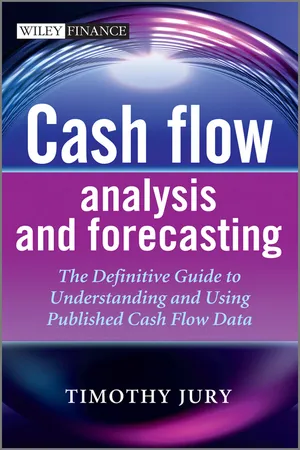
Cash Flow Analysis and Forecasting
The Definitive Guide to Understanding and Using Published Cash Flow Data
- English
- ePUB (mobile friendly)
- Available on iOS & Android
eBook - ePub
Cash Flow Analysis and Forecasting
The Definitive Guide to Understanding and Using Published Cash Flow Data
About this book
This book is the definitive guide to cash flow statement analysis and forecasting. It takes the reader from an introduction about how cash flows move within a business, through to a detailed review of the contents of a cash flow statement. This is followed by detailed guidance on how to restate cash flows into a template format. The book shows how to use the template to analyse the data from start up, growth, mature and declining companies, and those using US GAAP and IAS reporting. The book includes real world examples from such companies as Black and Decker (US), Fiat (Italy) and Tesco (UK). A section on cash flow forecasting includes full coverage of spreadsheet risk and good practice. Complete with chapters of particular interest to those involved in credit markets as lenders or counter-parties, those running businesses and those in equity investing, this book is the definitive guide to understanding and interpreting cash flow data.
Section One
Historic Cash Flow Analysis
1
Understanding How Cash Flows in a Business
INTRODUCTION
This chapter is designed to enable those with less direct experience of the operation of businesses to grasp the fundamental financial and economic logic that governs how successful businesses operate. It represents the starting point for our journey through the landscape of cash flow analysis. In order to gain benefit from this chapter no prior knowledge of either cash flow or business is required.
We start our journey by developing a model of how the cash flows in a simple business work. We then develop our knowledge of cash flows by incrementally adding complexity to this model.
Whilst developing this model based on the cash flows of a business we also introduce some fundamental logic about what different types of business must do in order to be successful.
THERE IS NOTHING NEW ABOUT BUSINESS
Humans have been engaging in trade for thousands of years, initially through some sort of barter process. Archaeologists have discovered ancient manufactured goods such as pottery and metal objects that have travelled vast distances from their point of manufacture. There are numerous examples of early Greek and Roman shipwrecks being discovered in many different parts of the Mediterranean dating back 2000 years or more. In the 1960s evidence was finally discovered that proved that the Vikings were the first Europeans to discover America some 500 years before Columbus. The remains of a Norse settlement at L’Anse aux Meadows on the northern tip of Newfoundland have been authenticated and dated to around 1000AD. During the excavation of the site over 100 objects of European manufacture were unearthed.
A more recent development in human history was the introduction of money in the form of coinage and, later, notes. Whilst there is much debate about what should be recognised as the first coin, a good candidate would be a small lump of electrum (a natural alloy of gold and silver) stamped with a design and minted around 600BC in Lydia, Asia Minor (now known as Turkey). Paper money seems to have emerged in China at about the same time.
This innovation, together with many others such as agriculture, settlements, the wheel and writing led to the modern, technologically based world economy we have today. Trade or business, in one form or another, has probably been part of the human condition from our earliest origins.
UNDERSTANDING MONEY IN BUSINESS
We are going to start with two simple examples of business activity. The first one represents one of the simplest forms of business. (More complex business examples follow over the next few pages.)
The Simplest Form of Business
Newspaper vending, by which I mean the activity of selling newspapers to passers-by on a street corner, is a good example of a really simple business. The vendor, or businessman, buys the newspapers from the publisher or a wholesaler and then retails them to passers-by for a price that gives him a margin over the cost of purchasing the newspapers.
A second example of a really simple business is an antique dealer, someone who buys and sells old objects. We will work with this example from now on.
The Debate About the Purpose and Objectives of a Business
The varying cultures around the world place different emphasis on how the benefits generated by a successful business should be shared amongst its stakeholders. I do not propose to examine the merits or otherwise of these views. There is considerable literature on what measures should be used to assess success or failure in business. Both growth and profit increase look like good candidates but fail as measures of success if the improvement in growth or profits is achieved by investing disproportionate amounts of cash. I do not propose to go much further with this debate other than to say that increasing the value of a business over time is now considered the most appropriate measure of success. This is achieved by continually improving the present and future cash flows of a business on an ongoing basis.
So, at this point in my explanation, I am assuming that the business I am describing is being run with the objective of wealth maximisation for the owners. For the purposes of this book I define that as maximising the future cash flows of the business.
The Objective of Being in Business is to Generate More Cash
It is important to introduce the purpose of a business here because specifying the objective of the business defines the task of the business person, entrepreneur, manager or other business controller (which is to get more cash). In both the business examples introduced so far we have a trader or dealer who buys and sells, typically without changing or modifying the items traded in any way. This is the simplest form of business.
The trader’s objective is to generate more cash than they started with. (Note that I have not used the terms profit or gain as we are developing a model containing only items that represent the cash flows in a business. What we mean by profit is actually quite an abstract concept. This is dealt with in more detail in Chapter 11.)
How Does a Trading Business Add Value?
An initial observation might be that these businesses make money by buying things for less than they can sell them. While this is an accurate observation of what a successful trading business does, this fails to explain why or how the business is able to achieve this beneficial outcome.
What is the key skill for an antique dealer? Is it knowledge of the antiques traded in? Whilst this may help, much of this information is available from books. Is it renovation skills? Again this may or may not add value to the items being renovated depending on consumer taste at the time. The key skill is probably, knowing where to buy cheaply and where to sell expensively. Here is an example of what I mean.
For many years the typical vehicle of choice for a British antique dealer has been the Volvo estate, which is used to travel to distant parts of Scotland and Wales so that the dealer can purchase furniture and other antiques from remote house sales and auctions where they are often sold cheaply. The goods purchased are then transported to London where they can be auctioned through the major auction houses...
Table of contents
- Cover
- Series
- Title Page
- Copyright
- Dedication
- Introduction
- Section One: Historic Cash Flow Analysis
- Section Two: Forecasting Cash Flows
- Index
Trusted by 375,005 students
Access to over 1.5 million titles for a fair monthly price.
Study more efficiently using our study tools.
Frequently asked questions
Yes, you can cancel anytime from the Subscription tab in your account settings on the Perlego website. Your subscription will stay active until the end of your current billing period. Learn how to cancel your subscription
No, books cannot be downloaded as external files, such as PDFs, for use outside of Perlego. However, you can download books within the Perlego app for offline reading on mobile or tablet. Learn how to download books offline
Perlego offers two plans: Essential and Complete
- Essential is ideal for learners and professionals who enjoy exploring a wide range of subjects. Access the Essential Library with 800,000+ trusted titles and best-sellers across business, personal growth, and the humanities. Includes unlimited reading time and Standard Read Aloud voice.
- Complete: Perfect for advanced learners and researchers needing full, unrestricted access. Unlock 1.5M+ books across hundreds of subjects, including academic and specialized titles. The Complete Plan also includes advanced features like Premium Read Aloud and Research Assistant.
We are an online textbook subscription service, where you can get access to an entire online library for less than the price of a single book per month. With over 1.5 million books across 990+ topics, we’ve got you covered! Learn about our mission
Look out for the read-aloud symbol on your next book to see if you can listen to it. The read-aloud tool reads text aloud for you, highlighting the text as it is being read. You can pause it, speed it up and slow it down. Learn more about Read Aloud
Yes! You can use the Perlego app on both iOS and Android devices to read anytime, anywhere — even offline. Perfect for commutes or when you’re on the go.
Please note we cannot support devices running on iOS 13 and Android 7 or earlier. Learn more about using the app
Please note we cannot support devices running on iOS 13 and Android 7 or earlier. Learn more about using the app
Yes, you can access Cash Flow Analysis and Forecasting by Timothy Jury in PDF and/or ePUB format, as well as other popular books in Business & Managerial Accounting. We have over 1.5 million books available in our catalogue for you to explore.