- English
- ePUB (mobile friendly)
- Available on iOS & Android
Equine Veterinary Nursing
About this book
The breadth and depth of expertise essential for equine veterinary nursing today is provided in this definitive textbook. Ā Thoroughly revised and updated in its second edition, and now fully illustrated in colour.Ā This book covers the content of the ever-expanding equine nursing syllabus, while still succinctly covering all the basics that veterinary nurses specialising in other species need to know. The key subjects included are: basic equine management, medical and surgical equine nursing, nutrition, reproduction and foal care, emergency first aid, and the theory underpinning these and other important topics.
Equine Veterinary Nursing Second Edition is presented in a clear and user-friendly manner, appropriate for all those involved in equine nursing. A practical approach is used throughout and procedures are illustrated with a large number of line diagrams and clinical photographs. It is an essential manual for all student and qualified equine veterinary nurses and all those involved in the care of horses.
KEY FEATURES
- Includes a new chapter on the equine nurse's professional responsibilities
- Major revisions to the chapters on diagnostic imaging and surgical nursing to reflect advances in technology and techniques
- All information on health and safety management updated in keeping with new regulations
- Authors include both vets and experienced equine nurses
- Endorsed by the British Equine Veterinary Association
"With the increasing demands of equine practice has come the need for well trained and competent equine nurses. There have been significant improvements in and expansion of the equine Veterinary Nurse training syllabus over the past few years to meet these demands. This new and updated edition of Equine Veterinary Nursing covers all aspects of the new syllabus with well written and illustrated chapters from a wide range of knowledgable and experienced authors. The British Equine Veterinary Association is pleased to endorse this text as a 'must have' for all trainee equine veterinary nurses and their training practices." -Ā Deidre M Carson BVSc(Syd) MRCVS
Immediate Past President, BEVA
Frequently asked questions
- Essential is ideal for learners and professionals who enjoy exploring a wide range of subjects. Access the Essential Library with 800,000+ trusted titles and best-sellers across business, personal growth, and the humanities. Includes unlimited reading time and Standard Read Aloud voice.
- Complete: Perfect for advanced learners and researchers needing full, unrestricted access. Unlock 1.4M+ books across hundreds of subjects, including academic and specialized titles. The Complete Plan also includes advanced features like Premium Read Aloud and Research Assistant.
Please note we cannot support devices running on iOS 13 and Android 7 or earlier. Learn more about using the app.
Information
1
Basic Equine Management
General Horse Behaviour

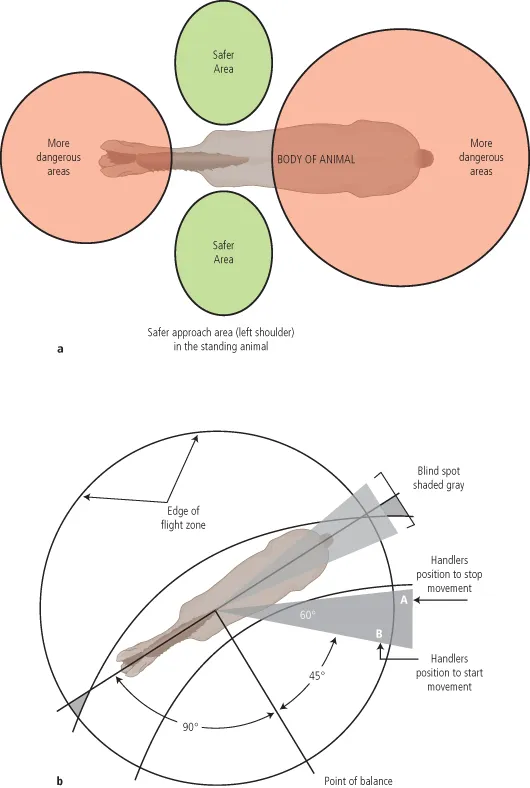
Box 1.1 The Flight Zone
- The flight zone can be thought of as a horseās āpersonal spaceā. Movement into this area is likely to make a horse move away.
- The size of the flight zone depends primarily on the familiarity of the horse with the handler. With frequent handling, the flight zone decreases in size and may even disappear.
- A horse that is approached head-on has a larger flight zone than if it is approached from the side. A head-on approach by another horse or human is considered threatening.
- The edge of the flight zone can be determined by slowly walking up to the horse. The point at which the horse begins to move away is the edge of the flight zone.
- When working with a horse, there is a point-of-balance for moving the horse backward or forward. The point-of-balance is at the shoulder, perpendicular to the length of the body. If you want the horse to move backwards, start in front of the point-of-balance and move into the horseās flight zone. If you want the horse to move forward, move into the horseās space from behind the point-of-balance.
- If a handler enters the flight zone suddenly, the horse will either bolt and run away or turn back and run over the person.
- It is important to be aware of the flight zone and the horseās response to the handler within and near the flight zone. This will help to ensure safety at all times for the handler.
Vices, Stereotypies and Redirected Behaviour

Table of contents
- Cover
- Table of Contents
- Title
- Copyright
- List of contributors
- Foreword
- Preface to the second edition
- Abbreviations and Acronyms
- 1 Basic equine management
- 2 Anatomy and physiology
- 3 Genetics
- 4 Reproduction
- 5 Nutrition
- 6 Clinical nutrition
- 7 Basic first aid
- 8 General nursing
- 9 Safety management in the practice
- 10 The equine nurseās professional responsibilities
- 11 Medicines and their management
- 12 Laboratory diagnostics
- 13 Fluid therapy
- 14 Medical nursing
- 15 Foal nursing
- 16 Equine orthopaedic nursing
- 17 Diagnostic imaging
- 18 General surgical nursing
- 19 Theatre practice
- 20 Anaesthesia
- Index
- End User License Agreement