![]()
PART 1
Storage Requirements Characteristics of Secondary Batteries Examples of Use
![]()
Chapter 1
Breakdown of Storage Requirements
1.1. Introduction
Electrochemical electricity storage has been in use for as long as electricity has been industrially used. The earliest secondary battery was introduced by Gaston Planté in 1859, i.e. between the first laboratory primary battery created by Alessandro Volta in 1800 and the industrial dynamo from Zénobe Gramme in 1869.
1.2. Domains of application for energy storage
Energy storage systems are used in many fields of application. Each of these domains is characterized by specific operational profiles and, consequently, different types and technologies of secondary batteries. They are described below.
Of the major domains of application, we might cite:
– traction batteries and on-board batteries;
– stationary deep cycle batteries (batteries for storage in decentralized microgrids with photovoltaic generation, for grid support, etc.);
– standby power batteries (batteries for uninterruptible power supply, for safeguarding information, etc.);
– and, more recently, batteries for mobile devices: portable computers and mobile telephones – in billions of units produced each year – digital cameras, audio and video players, camcorders, PDAs (Personal Digital Assistants), etc.
1.2.1. Starter batteries
Better known as “SLI” batteries (for “Start, Lighting and Ignition”), these batteries are used to fire up internal combustion engines (in cars and trucks but also tractors, electrogen groups, or even boats or airplanes, etc.) as well as to provide lighting and many other functions. These batteries have an average specific energy1 and a low cost.
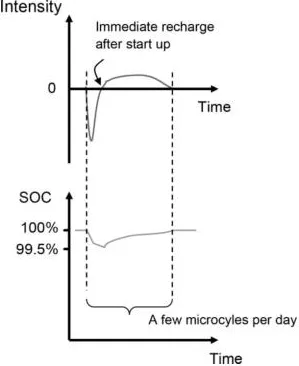
The profile of the current entering2 into an SLI battery, and the evolution of the state of charge (SOC, defined in section 2.4.2) are shown qualitatively below (Figure 1.1). Typically, car batteries have a nominal voltage of 12 V. Their capacity is usually between 40 and 80 Ah. Start currents can reach up to several hundred amperes.3 Measured values are given in section 3.1.1.
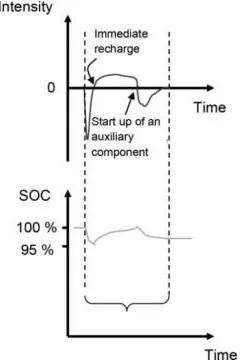
In a car with a combustion engine, the battery only supplies energy when the engine is not running, or is running at a slowed speed. When the vehicle is moving, it is the alternator which supplies the demands. When the battery is supplying energy, it is usually quickly recharged by the alternator, and is therefore subjected only to a microcycle. Conversely, in certain trucks, the battery may have to supply certain functions such as the raising/lowering of an unloading tailgate, a refrigeration group, a crane, etc. The battery is then subject to deeper discharges (Figure 1.2).
Figure 1.1. Car SLI battery: profile of the current flowing into the battery and change in its SOC
Figure 1.2. SLI battery for a truck with auxiliary functions: profile of current entering into the battery and evolution of its SOC
1.2.2. Traction batteries
Traction batteries are used in forklift trucks, handling and lifting machines, wheelchairs, electrically assisted pedal cycles (EAPCs), electric vehicles (EVs) or hybrid electric vehicles (HEVs), golf buggies, etc. These applications require power to be supplied to the engine but also need sufficient energy to deliver a range (capacity for autonomous operation) which is compatible with their usage.
1.2.2.1. Vehicle batteries without brake energy recovery
The slow speed of certain electrically-motorized vehicles means that, even if the electric power chain is capable of it, kinetic energy is not recovered during braking. Such is the case with many handling and lifting machines, wheelchairs, EAPCs, etc.4
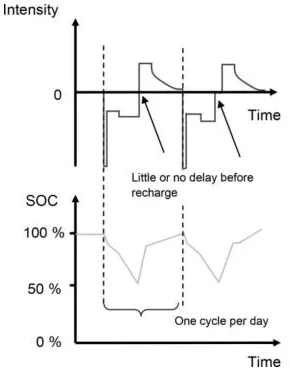
For these vehicles, the profile of current running into the battery and the evolution of the SOC are shown in Figure 1.3. They are used in a simple cycle: a discharge of greater or lesser depth, followed by a complete charge. The periods of discharging and charging are thus clearly distinct.
EAPCs have batteries of 24, 36 or 48 V and a capacity of around ten Ah. The batteries used for wheelchairs are generally 12 or 24 V, with capacities of up to a few tens of Ah (usually 20–40 Ah). For handling vehicles such as forklift trucks, several 6 or 12 V batteries are connected in series, with unitary capacities of several hundred Ah.
For this type of application, the technology needs to be adapted: we favor electrode/electrolyte interfaces which offer the largest possible exchange surfaces so as to be able to supply and receive a significant peak power. However, for each application, there is a compromise to be found between the peak power and the stored energy (an explanation of the difference between “energy” batteries and “power” batteries is given in section 5.2.2).
Figure 1.3. Traction battery: profile of current entering into the battery and evolution of its SOC
1.2.2.2. Vehicle batteries with brake energy recovery
Electric or hybrid cars use batteries whose sizing and design are appropriate to supply the power and/or energy needs to respond to the different usage profiles. In contrast to the applications discussed above, energy is recovered by the battery on braking. Current peaks appear during the phases of braking. The same is true of golf buggies, electric karts, etc. To set these apart from the previous uses, we sometimes find the term “on-board batteries”.
Three usage profiles can be defined for operation in a hybrid vehicle, a hybrid plug-in vehicle (i.e. a rechargeable hybrid) or a pure electric vehicle.
1.2.2.2.1. Hybrid vehicle batteries
Generally speaking, the batteries fitted to a hybrid vehicle tend to be sized for power, because they need to be capable of providing peaks of power during acceleration and being recharged with high intensities during braking. They play the role of an energy buffer between the primary energy source – the combustion engine – and the vehicle’s running needs. The excursion of the depth of discharge (DOD, see section 2.4.1) is therefore very limited. In order to prevent too high or too low a state of charge (SOC, see section 2.4.2), which may be damaging for the NiMH batteries used, the charge oscillates by a few % around an average state of charge between 40 and 80% (54-56% for the Toyota Prius 2001 in hybrid operation5) (Figure 1.4). In the Toyota Prius and the Honda Insight, even with fully electrical operation, the battery management syst...