- English
- ePUB (mobile friendly)
- Available on iOS & Android
Pesticide Risk Assessment for Pollinators
About this book
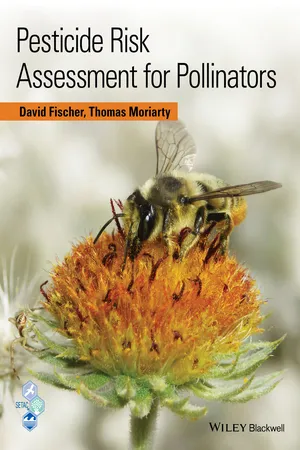
Pollinators play a vital role in ecosystem health and are essential to ensuring food security. With declines in both managed and wild pollinator populations in recent years, scientists and regulators have sought answers to this problem and have explored implementing steps to protect pollinator populations now and for the future. Pesticide Risk Assessment for Pollinators focuses on the role pesticides play in impacting bee populations and looks to develop a risk assessment process, along with the data to inform that process, to better assess the potential risks that can accompany the use of pesticide products.
Pesticide Risk Assessment for Pollinators opens with two chapters that provide a biological background of both Apis and non- Apis species of pollinators. Chapters then present an overview of the general regulatory risk assessment process and decision-making processes. The book then discusses the core elements of a risk assessment, including exposure estimation, laboratory testing, and field testing. The book concludes with chapters on statistical and modeling tools, and proposed additional research that may be useful in developing the ability to assess the impacts of pesticide use on pollinator populations.
Summarizing the current state of the science surrounding risk assessment for Apis and non- Apis species, Pesticide Risk Assessment for Pollinators is a timely work that will be of great use to the environmental science and agricultural research communities.
- Assesses pesticide risk to native and managed pollinators
- Summarizes the state of the science in toxicity testing and risk assessment
- Provides valuable biological overviews of both Apis and non- Apis pollinators
- Develops a plausible overall risk assessment framework for regulatory decision making
- Looks towards a globally harmonized approach for pollinator toxicity and risk assessment
Frequently asked questions
- Essential is ideal for learners and professionals who enjoy exploring a wide range of subjects. Access the Essential Library with 800,000+ trusted titles and best-sellers across business, personal growth, and the humanities. Includes unlimited reading time and Standard Read Aloud voice.
- Complete: Perfect for advanced learners and researchers needing full, unrestricted access. Unlock 1.4M+ books across hundreds of subjects, including academic and specialized titles. The Complete Plan also includes advanced features like Premium Read Aloud and Research Assistant.
Please note we cannot support devices running on iOS 13 and Android 7 or earlier. Learn more about using the app.
Information
1
Introduction
CONTENTS
- 1.1 Workshop Balance and Composition
- design and identify testing protocols to estimate potential exposure of bees to pesticide residues in pollen and nectar, as well as exposure through other routes;
- design and identify testing protocols to measure the effects of pesticides on developing brood and adult honey bees at both the individual and the colony levels;
- propose a tiered approach for characterizing the potential risk of pesticides to pollinators; and
- explore the applicability of testing protocols, used for honey bees (Apis bees), to measure the effects of pesticides and pesticide risk to other non-Apis bee species.
1.1 WORKSHOP BALANCE AND COMPOSITION
- Chapters 2ā6 provide background and overview of key elements such as bee biology, ecological risk assessment, and protection goals.
- Chapters 7ā10 capture recommendations by the Workshop on the elements of exposure assessment, effects assessment (laboratory and field testing), and risk assessment.
- Chapters 11ā14 capture discussion around statistical analysis, modeling, risk management, and research needs.
NOTES
2
Overview of the Honey Bee
CONTENTS
- 2.1 Overview of Honey Bee Biology
2.1 OVERVIEW OF HONEY BEE BIOLOGY
Table of contents
- Cover
- Cronology
- Titlepage
- Copyright
- Series
- Dedication
- Acknowledgments
- About the Editors
- Workshop Participants
- Pellston Workshop Series
- 1 Introduction
- 2 Overview of the Honey Bee
- 3 Overview of Non-Apis Bees
- 4 Overview of Protection Goals forĀ Pollinators
- 5 Overview of the Pesticide Risk Assessment and the Regulatory Process
- 6 Problem Formulation for an Assessment of Risk to Honey Bees from Applications of Plant Protection Products to Agricultural Crops
- 7 Assessing Exposure of PesticidesĀ to Bees
- 8 Assessing Effects Through Laboratory Toxicity Testing
- 9 Assessing Effects Through Semi-Field and Field Toxicity Testing
- 10 Overview of a Proposed Ecological Risk Assessment Process for Honey bees (Apis mellifera) and Non-Apis Bees
- 11 Ecological Modeling for Pesticide Risk Assessment for Honey Bees and Other Pollinators
- 12 Data Analysis Issues
- 13 Risk Mitigation and Performance Criteria
- 14 Recommendations for Future Research in Pesticide Risk Assessment for Pollinators
- Appendix 1: Elements for a Chronic Adult Oral Toxicity Study
- Appendix 2: Elements of a Larval Study
- Appendix 3: Elements of Artificial Flower Test
- Appendix 4: Elements of the Visual Learning Test
- Appendix 5: Foraging Behavior with Radio Frequency Identification
- Appendix 6: Detailed Description ofĀ the Proposed Overall Risk Assessment Scheme
- Glossary of Terms
- Index
- End User License Agreement