![]()
1
Embryology in Medicine
What is Embryology?
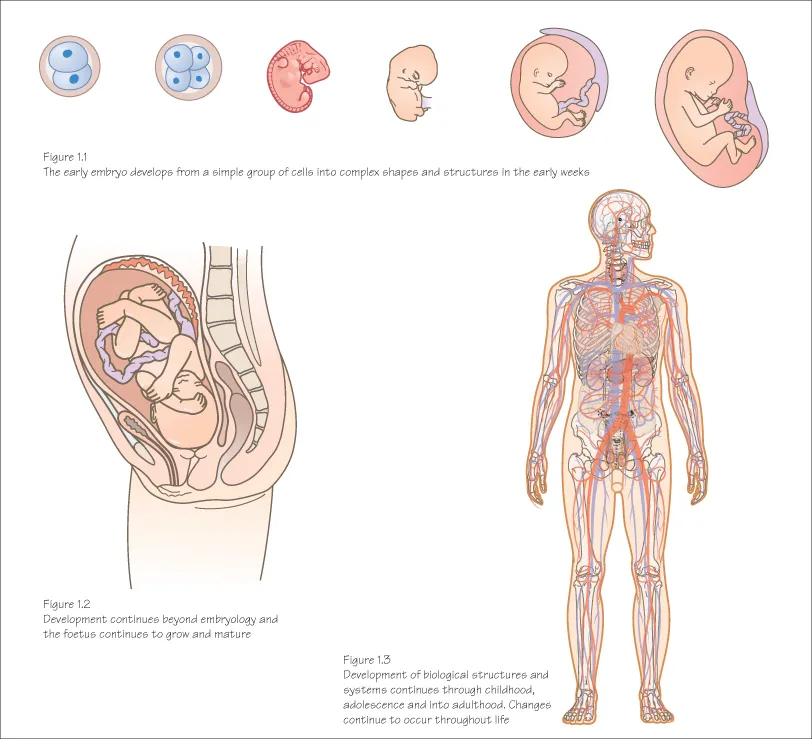
Animals begin life as a single cell. That cell must produce new cells and form increasingly complex structures in an organised and controlled manner to reliably and successfully build a new organism (Figures 1.1 and 1.2). As an adult human may be made up of around 100 trillion cells this must be an impressively well-choreographed compendium of processes.
Embryology is the branch of biology that studies the early formation and development of these organisms. Embryology begins with fertilisation, and we have included the processes that lead to fertilisation in this text. The human embryonic period is completed by week 8, but we follow development of many systems through the foetal stages, birth and, in some cases, describe how changes continue to occur into infancy, adolescence and adult life (Figure 1.3).
Aims and Format
This book aims to be concise but readable. We have provided a page of text accompanied by a page of illustrations in each chapter. Be aware that the concise manner of the text means that the topic is not necessarily comprehensive. We aim to be clear in our descriptions and explanations but this book should prepare you to move on to more comprehensive and detailed texts and sources.
Why Study Embryology?
Our biological development is a fascinating subject deserving study for interest’s sake alone. An understanding of embryological development also helps us answer questions about our adult anatomy, why congenital abnormalities sometimes occur and gives us insights into where we come from. In medicine the importance of an understanding of normal development quickly becomes clear as a student begins to make the same links between embryology, anatomy, physiology and neonatal medicine.
The study of embryology has been documented as far back as the sixth century BC when the chicken egg was noted as a perfect way of studying development. Aristotle (384–322 BC) compared preformationism and epigenetic theories of development. Do animals begin in a preformed way, merely becoming larger, or do they form from something much simpler, developing the structures and systems of the adult in time? From studies of chickens’ eggs of different days of incubation and comparisons with the embryos of other animals Aristotle favoured epigenetic theory, noting similarities between the embryos of humans and other animals in very early stages. In a chicken’s egg, a beating heart can be observed with the naked eye before much else of the chicken has formed.
Aristotle’s views directed the field of embryology until the invention of the light microscope in the late 1500s. From then onwards embryology as a field of study was developed.
A common problem that students face when studying embryology is the apparent complexity of the topic. Cells change names, the vocabulary seems vast, shapes form, are named and renamed, and not only are there structures to be concerned with but also the changes to those structures with time. In anatomy, structures acquire new names as they move to a new place or pass another structure (e.g. the external iliac artery passes deep to the inguinal ligament and becomes the femoral artery). In embryology, cells acquire new names when they differentiate to become more specialised or group together in a new place; structures have new names when they move, change shape or new structures form around them. With time and study students discover these processes, just as they discover anatomical structures.
Embryology in Modern Medicine
If a student can build a good understanding of embryological and foetal development they will have a foundation for a better understanding of anatomy, physiology and developmental anomalies. For a medical student it is not difficult to see why these subjects are essential. If a baby is born with ‘a hole in the heart’, what does this mean? Is there just one kind of hole? Or more than one? Where is the hole? What are the physiological implications? How would you repair this? If that part of the heart did not form properly what else might have not formed properly? How can you explain to the parents why this happened, and what the implications are for the baby and future children? A knowledge of the timings at which organs and structures develop is also important in determining periods of susceptibility for the developing embryo to environmental factors and teratogens.
Why Read This Book?
We appreciate that the subject of embryology still induces concern and despair in students. However, if it helps you in your profession you should want to dig deep into the wealth of understanding it can give you. We also appreciate that you have enough to learn already and so this book hopes to represent embryology in an accessible format, as our podcasts try to do.
One thing that has not changed with the development of embryology as a subject is that the more information that is gathered, the more numerous are the questions left unanswered. For example, we barely mention the molecular aspects of development here. Should your interest in embryology and mechanisms of development be aroused by this book, we hope that you will seek out more detailed sources of information to consolidate your learning.
![]()
2
Language of Embryology
Time Period: Day 0–266
Introduction
The language used to describe the embryo and the developmental processes that mould it is necessarily descriptive. It is similar to anatomical terminology, but there are some common differences that the reader should be aware of.
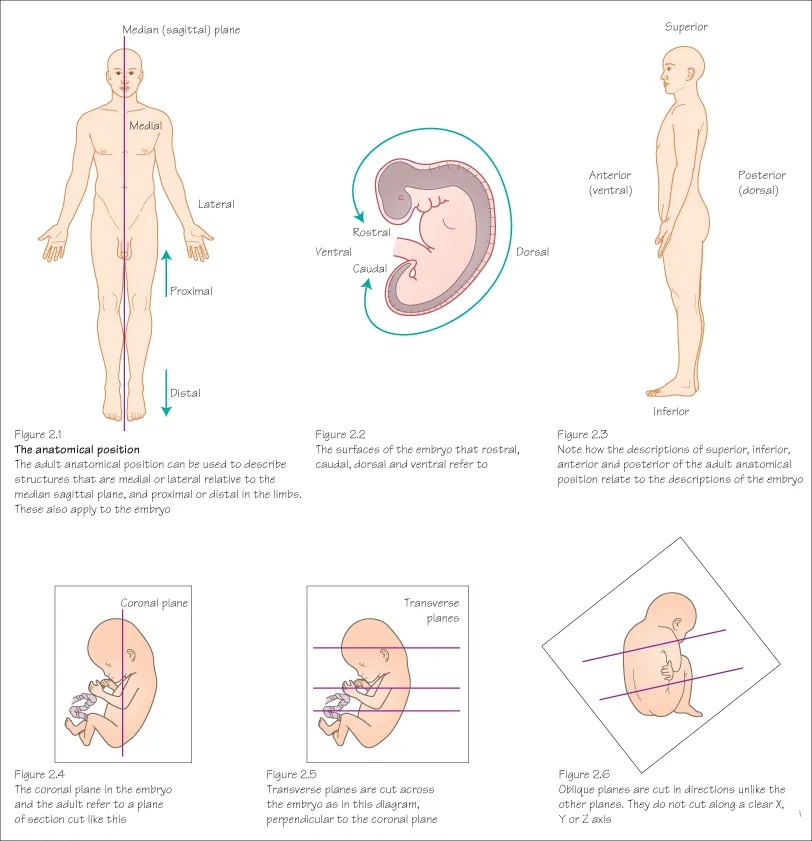
The embryo does not, and for most of its existence cannot, take on the anatomical position. The embryo is more curved and folded than the erect adult. The adult anatomical position is described as the body being erect with the arms at the sides, palms forward and thumbs away from the body (Figure 2.1). The anatomical relationships of structures are described as if in this position, so for the embryo we need to rethink this a little.
Cranial–Caudal
Anatomically speaking, you may interchangeably use cranial or superior, and caudal or inferior. Cranial clearly refers to the head end of the embryo and caudal (from the Latin word cauda, meaning ‘tail’) refers to the tail end (Figure 2.2). If you imagine the early sheet of the embryo with the primitive streak (see Chapter 13) showing us the cranial and caudal ends, you can imagine that it can be clearer to use these terms rather than superior and inferior.
The term ‘rostral’ may also be used in place of cranial. Rostral is derived from the Latin word rostrum, meaning ‘beak’.
Dorsal–Ventral
The dorsal surface of the embryo and the adult is the back (Figure 2.2). Dorsal also refers to the surface of the foot opposite to the plantar surface, the surface of the tongue covered with papillae, and the superior surface of the brain, so some care is needed.
The ventral surface of the embryo is the front or anterior of the embryo, opposite the dorsal surface.
Medial–Lateral
As with adult anatomy, structures nearer to the midline sagittal plane are more medial, and structures further from the midline are more lateral (Figure 2.3). This also helps us describe the left–right axis of the embryo.
Proximal–Distal
Proximal and distal are a little different from medial and lateral, but similarly describe structures near to the centre of the body (proximal) and further from the centre (distal) (Figure 2.1). These terms are typically used to describe limb structures. The hand is distal to the elbow, for example.
Sections
Often, to show the parts of the embryo being described, illustrations must be of a section of the embryo or a structure. These sections may be transverse, median, coronal or oblique. You can see these planes of sections in the illustrations on the opposite page (Figures 2.4–2.6).
![]()
3
Introduction to Development
Time Period: Day 0 to Adult
Development
Development, in this book, describes our journey from a single cell to a complex multicellular organism. Development does not end at birth, but continues with childhood and puberty to early adulthood.
We must describe how a cell from the father and a cell from the mother combine to form a new genetic individual, and how this new cell forms others, how they become organised to form new shapes, specialised interlinked structures, and grow. With this knowledge we become able to understand how these processes can be interfered with, and how abnormalities arise.
Growth
Growth may be described as the process of increasing in physical size, or as development from a lower or simpler form to a higher or more complex form.
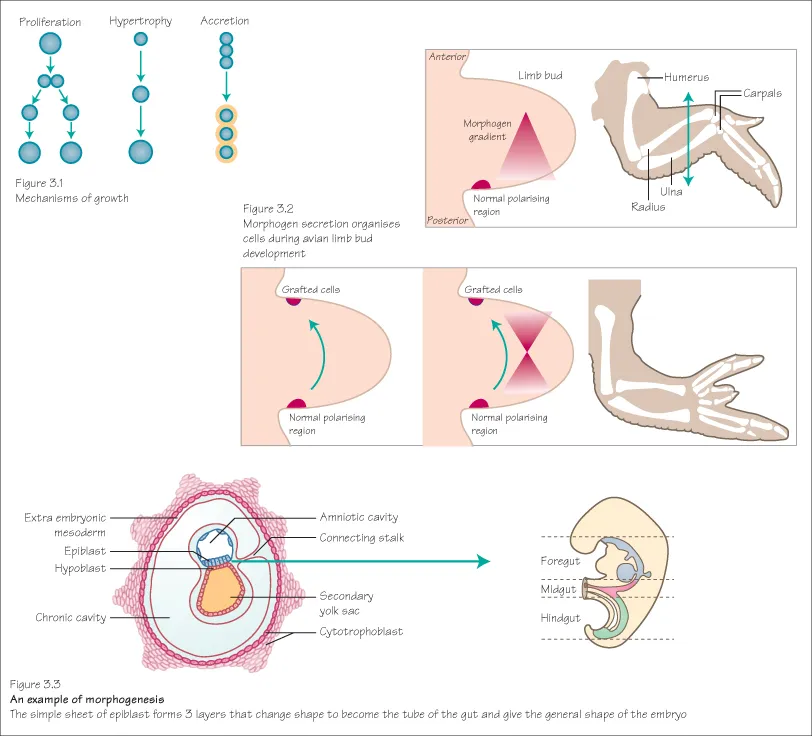
In embryology, growth with respect to a change in size may occur through an increase in cell number, an increase in cell size or an increase in extracellular material (Figure 3.1).
Increasing cell number occurs by cells dividing to produce daughter cells by proliferation. Proliferation is a core mechanism of increasing the size of a tissue or organism, and is also found in adult tissues in repair or where there is an expected continual loss of cells such as in the skin or gastrointestinal tract. Stem cells are particularly good at proliferating.
An increase in cell size occurs by hypertrophy. In adults, muscle cells respond to weight training by hypertrophy, and this is one way in which muscles become larger. During development, hypertrophy of cartilage cells during endochondral ossification is an importan...