Extrusion is by far the most important and the oldest processing and shaping method for thermoplastic polymers. This process concerns almost all synthetic polymers, as well as elastomers or food materials. Single-screw extrusion is mainly used nowadays to manufacture finished goods or semi-finished products. More than 90 million tons of thermoplastics are therefore processed every year. Twin-screw extrusion may be divided into two systems: contra-rotating systems used within the context of PVC extrusion, for the manufacture of pipes or profiles; and co-rotating systems experiencing nowadays a very significant development, because of their significant adaptability and flexibility, which enables the manufacture of specific materials (polymer alloys, thermoplastic elastomers, filled polymers, nanocomposites). Extrusion is carried out by passing molten polymer through a tool called die that will give the product its final shape (films and sheets, rolled products, and electric cables). Thanks to the design of dies, we obtain at the output a product with controlled dimensions, uniform speeds and homogeneous temperatures. The book will discuss the same production types, but only in the case of coextrusion flows, i.e. multilayer stratified products. First of all, we will present in this book the physics of the mechanisms at stake, then propose more or less complex models in order to describe these mechanisms and then go forward in the interpretation of results and the control of condition flows.
Continuum Mechanics, Rheology and Heat Transfer Overview
The aim of this chapter is to provide the readers with the basics of continuum mechanics, rheology and heat transfer, which will be of fundamental importance throughout the remainder of this book. We will keep this presentation as concise as possible by avoiding unnecessarily detailed mathematical manipulations, and referring interested readers to other pertinent references in the literature.
1.1. Continuum mechanics
1.1.1. Strain
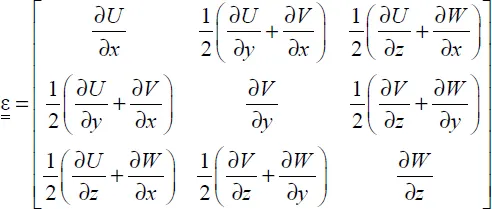
Let us consider the deformation of a continuous medium defined by the displacement vector field of components: U(x,y,z), V(x,y,z), W(x,y,z). The corresponding strain (provided that it is small) can be described by a symmetric tensor
as follows [SAL 88, AGA 14]:
[1.1]
Hereafter, a symmetric tensor will be considered as a square matrix, involving six independent terms:
– the diagonal terms (εxx,εyy ,εzz) correspond to uniaxial deformations of traction or compression;
– the symmetric terms (εxy = εyx,εyz = εzy,εxz =εzx) correspond to shear deformations.
1.1.2. Strain rate
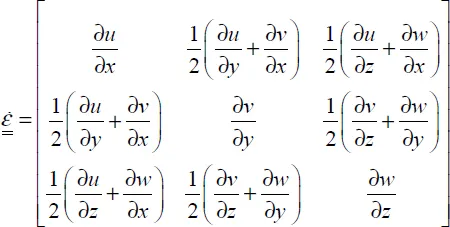
We will now consider the velocity field u(x, y, z), v(x, y, z), w(x, y, z) which is associated with the aforementioned strain. Just like the strain tensor, the strain rate tensor can be defined by:
[1.2]
Unlike the strain tensor, defined by relation [1.1] for small deformations, the strain rate tensor is defined in a general manner. It is, therefore, well adapted to the description of fluid flows, for which the deformations are always very large. Just like
, the terms for the strain-rate tensor have a particular meaning:
– the diagonal terms are elongation rates, often referred to, below, as
;
– the symmetric terms are shear rates, often referred to, below, as
.
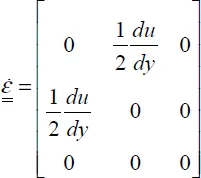
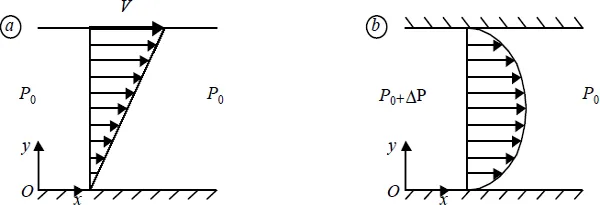
EXAMPLE 1.1.– Let us consider two elementary flows, which we will come across often in the remainder of this book. The first flow is a planar shear flow between two plates (see Figure 1.1(a)). The bottom plate is immobile, whereas the top plate is mobile with a velocity V. The velocity field is, a priori, in the following form: u = u(y), v = 0 and w = 0. The strain rate tensor is reduced to:
[1.3]
The second flow occurs between two immobile plates under a pressure drop (Figure 1.1(b)). This is called a Poiseuille flow. The velocity field has the same form as above, i.e. u = u(y), v = 0 and w = 0.
Figure 1.1.Flow between parallel plates: a) simple shear flow and b) Poiseuille flow
Consequently, the strain rate tensor will also have the same expression. All flows which give rise to this type of tensor (a single symmetric non-zero term) are called simple shear flows. In the corresponding Cartesian coordinate system, Ox is the shear direction, Oxy is the shear plane and du/dy is the shear rate.
1.1.3. Stress
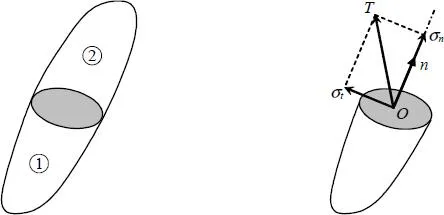
Let us consider a small surface ds upon which a force dF is exerted (Figure 1.2). By definition, the stress vector
at point O of this surface is the limit dF / ds as ds tends toward zero. This vector is projected:
– on the normal
to the surface at point O : σn =
.
is the normal stress, traction or compression;
– on the tangent plane: σt is the shear stress.
Figure 1.2.Stress applied on a surface
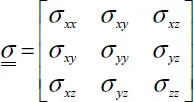
The stress vector cannot define a general state of stress, since it is associated with the orientation of the surface on which it is exerted. It is the stress tensor which will define this general state. As with the tensors mentioned above, it is a symmetric tensor written as:
[1.4]
As with the previous tensors, there are six terms involved:
– the diagonal terms, corresponding to normal stresses (along axes x, y and z), of traction or compression;
– the symmetric terms, corresponding to the shear stresses (in the planes xy, xz and yz).
From the stress tensor, the stress vector at any normal point
can be calculated using the following equation:
[1.5]
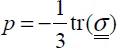
For any stress state, the hydrostatic pressure can be defined by the following equation:
[1.6]
where tr
is the trace of the stress tensor, i.e. the sum of the diagonal terms: tr
= σxx + σyy + σzz.
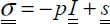
This allows the stress tensor to be broken down into the sum of the hydrostatic pressure and the traceless tensor, called the deviator:
[1.7]
where
is...
Table of contents
Cover
Table of Contents
Title Page
Copyright
Introduction
Chapter 1: Continuum Mechanics, Rheology and Heat Transfer Overview
Chapter 2: Calculation Methods
Chapter 3: Single-Screw Extrusion
Chapter 4: Co-rotating Twin-Screw Extrusion
Chapter 5: Profile Extrusion
Chapter 6: Production of Films and Sheets
Chapter 7: Wire Coating and Cable Insulation
Index
Trusted by 375,005 students
Access to over 1.5 million titles for a fair monthly price.
Study more efficiently using our study tools.
Frequently asked questions
Yes, you can cancel anytime from the Subscription tab in your account settings on the Perlego website. Your subscription will stay active until the end of your current billing period. Learn how to cancel your subscription
No, books cannot be downloaded as external files, such as PDFs, for use outside of Perlego. However, you can download books within the Perlego app for offline reading on mobile or tablet. Learn how to download books offline
Perlego offers two plans: Essential and Complete
Essential is ideal for learners and professionals who enjoy exploring a wide range of subjects. Access the Essential Library with 800,000+ trusted titles and best-sellers across business, personal growth, and the humanities. Includes unlimited reading time and Standard Read Aloud voice.
Complete: Perfect for advanced learners and researchers needing full, unrestricted access. Unlock 1.5M+ books across hundreds of subjects, including academic and specialized titles. The Complete Plan also includes advanced features like Premium Read Aloud and Research Assistant.
Both plans are available with monthly, semester, or annual billing cycles.
We are an online textbook subscription service, where you can get access to an entire online library for less than the price of a single book per month. With over 1.5 million books across 990+ topics, we’ve got you covered! Learn about our mission
Look out for the read-aloud symbol on your next book to see if you can listen to it. The read-aloud tool reads text aloud for you, highlighting the text as it is being read. You can pause it, speed it up and slow it down. Learn more about Read Aloud
Yes! You can use the Perlego app on both iOS and Android devices to read anytime, anywhere — even offline. Perfect for commutes or when you’re on the go. Please note we cannot support devices running on iOS 13 and Android 7 or earlier. Learn more about using the app
Yes, you can access Polymer Extrusion by Pierre G. Lafleur, Bruno Vergnes, Pierre G. Lafleur,Bruno Vergnes in PDF and/or ePUB format, as well as other popular books in Technology & Engineering & Mechanical Engineering. We have over 1.5 million books available in our catalogue for you to explore.