![]()
Chapter 1
An Introduction to Dinosaurs
It is necessary to begin with a straightforward, if not pedantic, question: what is a dinosaur? In popular parlance a dinosaur is often anything that is old, big, or frightening. Any kindergartner could identity Tyrannosaurus or Triceratops as dinosaurs, and they would be correct, but newspapers will often sloppily use the term “dinosaur” to refer to flying reptiles (pterosaurs), marine reptiles (plesiosaurs, ichthyosaurs, etc.), or even large mammals (such as the woolly mammoth). “Dinosaur” has become a cultural and political idiom as well: out-of-touch politicians or washed-up celebrities are often mockingly ridiculed as “dinosaurs,” a synonym for lethargy, obsolescence, and inevitable extinction.
Although the term “dinosaur” is firmly established in the popular lexicon, it is also a scientific term that refers to a specific group of organisms that shared particular anatomical features and lived during a certain period of time. While the popular definition of “dinosaur” is amorphous, the scientific definition is precise. We will get to that definition in a moment, but first it is necessary to review exactly where dinosaurs fit in the tree of life – when they evolved, what they evolved from, and who their closest relatives are – so it is easier to comprehend the explicit distinction between dinosaur and non-dinosaur. Some of the following discussion may seem elementary to more advanced readers, and I intentionally use a more conversational tone in this introduction to appeal to non-specialists and younger students. It is important, however, to set the stage for this book by first painting in broad strokes, before progressing to a more nuanced discussion of dinosaur anatomy, ecology, behavior, and function.
Dinosaurs: A Brief Background
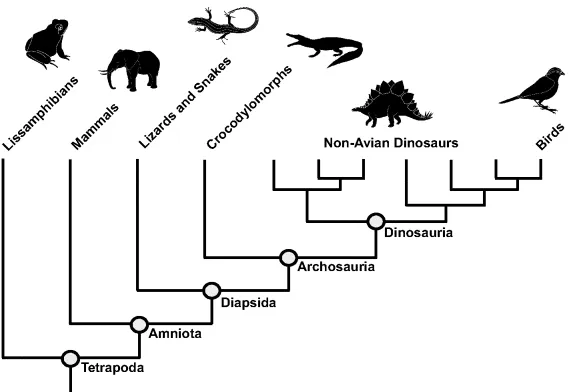
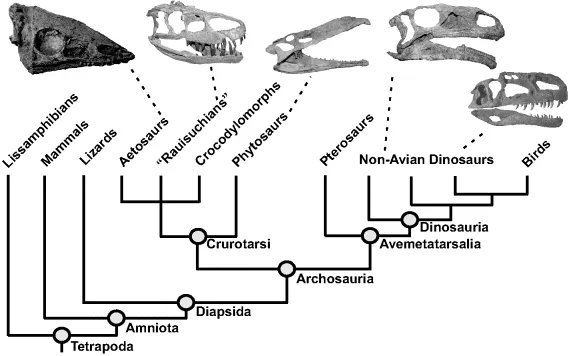
Dinosaurs are one of the best-known, most intensively studied, and most successful groups of tetrapods: animals with a backbone that have limbs with digits (fingers and toes) (Fig. 1.1). Within the tetrapod group, dinosaurs are members of a speciose subgroup of reptiles called the Archosauria, which literally means “ruling reptiles” in Greek (Cope, 1869; Romer, 1956; Carroll, 1988; Benton, 2005) (Figs 1.1). This is a fitting moniker, as archosaurs have been a major component of terrestrial ecosystems since the early Mesozoic, and for large swaths of time have been ecologically dominant and incredibly diverse (Benton, 1983; Fraser, 2006). Living archosaur subgroups include two major clades, birds and crocodylomorphs, which are among the most familiar and successful groups of extant vertebrates (note that a “clade” refers to a group of animals that includes an ancestor and all of its descendants; Fig. 1.5) (Gauthier, 1986; Sereno, 1991a; Nesbitt, 2011). However, the great majority of archosaur diversity is extinct, and the two main living groups merely represent two highly aberrant body types (fliers and semiaquatic sprawlers) that were able to endure several mass extinction events that pruned most other lineages on the archosaur family tree. Dinosaurs, without a doubt, are the most familiar of these extinct archosaurs.
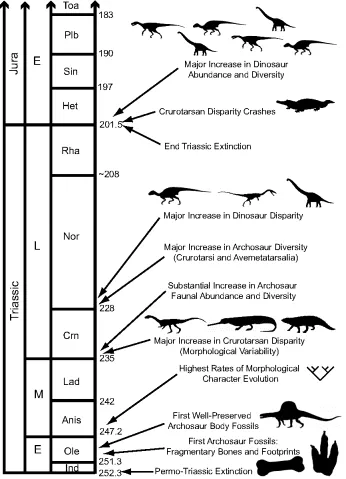
The archosaur clade is an ancient group that originated approximately 250 million years ago (Nesbitt, 2003, 2011; Brusatte et al., 2010a, 2011a; Nesbitt et al., 2011). Some of the closest archosaur relatives are known from the Late Permian (e.g. Dilkes, 1998; Nesbitt et al., 2009a), and archosaurs themselves arose within the first few million years after the devastating Permo-Triassic mass extinction, the largest instance of mass death in earth history, estimated to have eradicated 75–95% of all species (Raup, 1979; Stanley and Yang, 1994; Benton, 2003; Erwin, 2006; Clapham et al., 2009). The Permo-Triassic extinction interval was a time of death and destruction on a massive scale, but its aftermath was a time of equally large-scale rebirth: ecosystems were reshuffled, organisms that were once overshadowed had the freedom to flower, and entirely new groups originated and diversified in the barren, post-extinction landscape (Benton et al., 2004; Sahney and Benton, 2008). Among these entirely new groups were “modern” lineages such as turtles, mammals, lepidosaurs (lizards and their relatives), lissamphibians (frogs and salamanders), and archosaurs. It is no wonder that the Triassic Period is often called the “birth of modern ecosystems,” as so many of today's most distinctive and successful clades originated during this time.
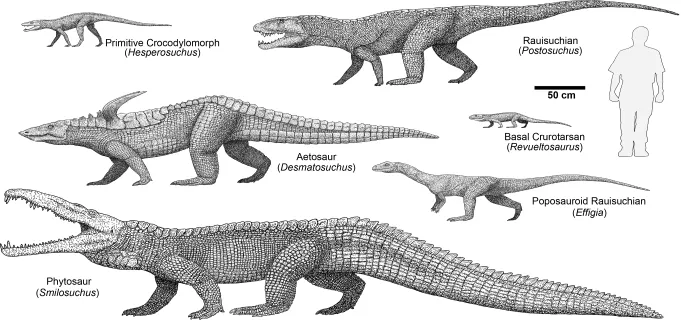
The archosaur clade diversified rapidly after its origination, as most of the major archosaur subclades and body plans were established by the end of the Early Triassic, a mere 5 million years after the mass extinction (Brusatte et al., 2011b) (Fig. 1.4). The oldest unequivocal archosaur body fossil with a well-constrained age and phylogenetic position is Xilousuchus, from the late Olenekian/early Anisian (c.247–248 million years ago) of China (Nesbitt et al., 2011). This species is a derived member of the “crocodile line” of archosaur phylogeny, which is properly referred to as Crurotarsi (also sometimes called Pseudosuchia). Crurotarsi includes crocodylomorphs and their closest extinct relatives, whereas the other half of the archosaur clade, the “bird-line” group Avemetatarsalia (sometimes also called Ornithodira), includes birds, dinosaurs, and pterosaurs (the familiar flying reptiles) (Gauthier, 1986; Sereno, 1991a; Benton, 1999, 2004; Irmis et al., 2007a; Brusatte et al., 2010a, 2011b; Nesbitt, 2011) (Fig. 1.5). Because Xilousuchus is a member of the crocodile lineage, then the bird line (but not true birds themselves) must have also been present by approximately 248 million years ago, because these two lineages are each other's closest relative, and the presence of one implies the contemporary existence of the other (see Norell, 1992, 1993 for details of such “ghost lineages,” which will be discussed later in the text).
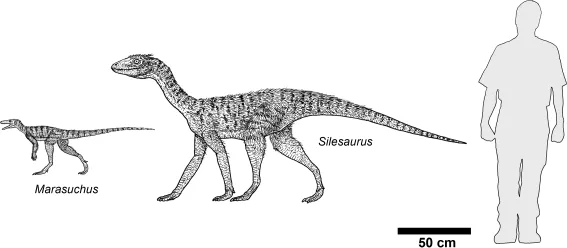
Although the bird lineage, of which dinosaurs are a part, must have been present by the Early Triassic, the first body fossils of truly dinosaur-like animals are not known until the late Anisian (c.243–244 million years ago) (Nesbitt et al., 2010). These fossils do not belong to true dinosaurs, as will become clear below, but are among the handful of closest relatives to dinosaurs, and likely resembled and behaved like their more famous cousins (
Fig. 1.6). More properly, they are members of the “dinosaur stem clade,” technically known as Dinosauromorpha (Sereno, 1991a; Benton, 1999, 2004; Ezcurra, 2006; Brusatte et al., 2010a; Nesbitt, 2011). Among the best known species are
Lagerpeton (Sereno and Arcucci, 1993),
Marasuchus (Sereno and Arcucci, 1994),
Dromomeron (Irmis et al., 2007a),
Silesaurus (Dzik, 2003), and
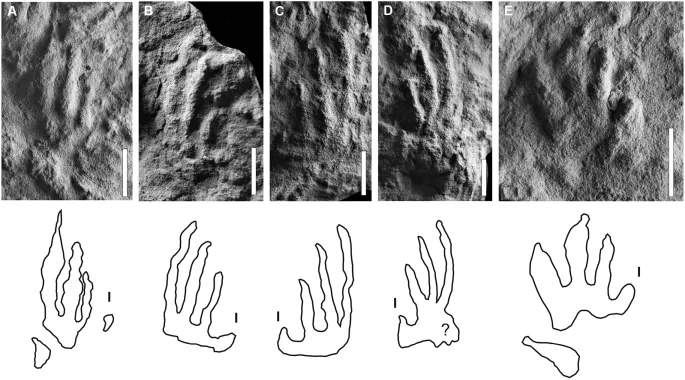
Asilisaurus (Nesbitt et al., 2010). Middle to Late Triassic dinosauromorphs were small animals, no bigger than a small dog, and were incredibly rare in their ecosystems. The tiny fragile footprints of some of these close dinosaur cousins are known from several fossils sites in the western United States (Peabody, 1948) and Europe (Haubold, 1999; Ptaszy
ski, 2000; Klein and Haubold, 2007; Brusatte et al., 2011a), and these are remarkably scarce compared with the footprints of other characteristic Triassic animals, especially crocodile-line archosaurs (
Fig. 1.7). It seems therefore that these dinosaur stem taxa were small, rare, only represented by a few species, and overshadowed by other contemporary reptiles. From such a humble beginning came the dinosaurs.
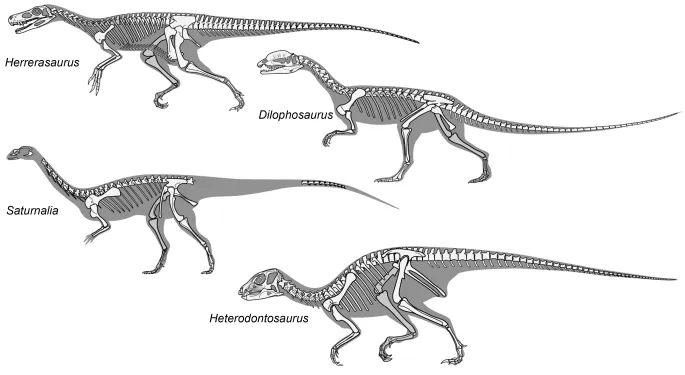
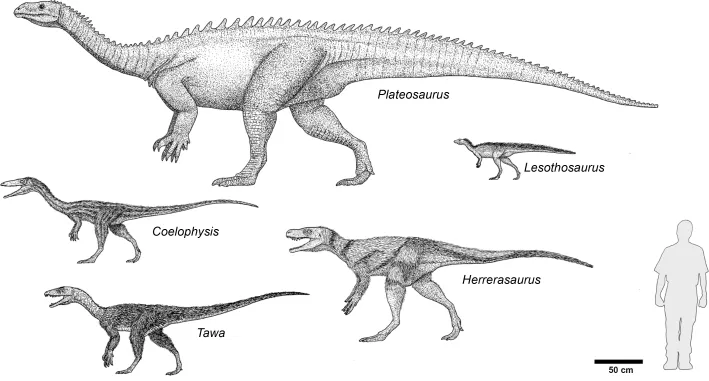
True dinosaurs likely originated some time in the Middle Triassic, although it is difficult to pinpoint the exact time. The first dinosaur body fossils are known from rocks that were deposited in Argentina at approximately the Carnian–Norian boundary (c.228 million years ago) (Rogers et al., 1993; Shipman, 2004; Brusatte et al., 2010b; Ezcurra, 2010a; Langer et al., 2010; Martinez et al., 2011) (Figs 1.8 and 1.9). However, it is almost certain that dinosaurs arose several million years earlier. First, the closest relatives of dinosaurs were clearly present by at least 243 million years ago, as outlined above, and it is reasonable to hypothesize that dinosaurs originated around this time (Nesbitt et al., 2010). Second, there are a number of provocative footprints, which closely match the feet of primitive dinosaurs, that have recently been described from the Ladinian (c.242–235 million years ago) of Europe and South America (Gand and Demathieu, 2005; Melchor and de Valais, 2006). Regardless of the exact timing of dinosaur origins, which will surely become clearer as new fossils are found, it is undeniable that dinosaurs began to diversify quickly once they originated. By the time the first dinosaur body fossils appear in the fossil record, representatives of the three major subgroups of dinosaurs – the carnivorous theropods, long-necked sauropodomorphs, and herbivorous and often armored or crested ornithischians – are already present (Sereno and Novas, 1992; Sereno et al., 1993; Langer et al., 1999, 2010; Butler et al., 2007; Martinez and Alcober, 2009; Brusatte et al., 2010b; Ezcurra and Brusatte, 2011; Martinez et al., 2011).
Therefore, by the Late Triassic, the Age of Dinosaurs was in full swing, and over the course of the next 50 million years dinosaurs would continue to diversify into new species and body types, before ultimately becoming the dominant mid-to-large size vertebrates in terrestrial ecosystems globally in the Early Jurassic, about 176 million years ago (Benton, 1983; Brusatte et al., 2008a, 2008b, 2010b) (Fig. 1.4). From this point on, throughout the remainder of the Jurassic and the Cretaceous, from approximately 175 to 65 million years ago, dinosaurs truly were “ruling reptiles” in every sense of the phrase. They lived in all corners of the globe, including the Arctic highlands, and reached some of the most stupendous sizes ever seen in land-living animals. Some species developed absurdly long necks, others extravagant horns and armor that would make a medieval knight blush, and yet others grotesque skulls, longer than an average man is tall and packed with dagger-like teeth, perfect for delivering bone-crunching bites. This fantastic array of dinosaurs –predators and herbivores, dwarves and 50-m long behemoths and all sizes in between – continued to evolve in concert with the slow drift of the continents and the roller-coaster wiggles of climate change, until an unexpected visitor from outer space smashed into the planet 65 million years ago, snuffing out the Age of Dinosaurs and permitting the survival of only one marginal, aberrant dinosaur subgroup: the birds.
The Scientific Definition of Dinosaurs
The above review liberally used terms like “true dinosaur” and “close dinosaur cousin.” Vague terminology like this can often be maddening, and can sadly obstruct communication between scientists. Thankfully, however, there is an explicit definition of what constitutes a dinosaur (the “true dinosaurs”). Dinosaurs are defined by scientists as “members of the least inclusive clade containing Triceratops horridus and Passer domesticus (the living house sparrow)” (Padian and May, 1993; Sereno, 1998; Sereno et al., 2005). At first this definition may seem confusing, and perhaps even counterintuitive, but in fact it is quite straightforward.
Most modern biologists define groups of organisms, such as dinosaurs or mammals or birds, based on ancestry, not on the possession of certain characteristics (e.g. de Queiroz and Gauthier, 1990, 1992; Sereno, 2005). An animal is a dinosaur if it falls in a certain place on the family tree of life, in this case that group of organisms that includes Triceratops, the living sparrow (Passer), and all descendants of their common ancestor. This hypothetical common ancestor can be visually traced on a family tree (properly called a cladogram, or a phylogeny) of reptiles: simply find Triceratop...