The at a Glance series is popular among medical students and junior doctors for its concise and simple approach and excellent illustrations.
Each bite-sized chapter features colour diagrams and tip boxes, accompanied by explanatory text. Covering a wide range of topics, books in the at a Glance series are ideal as introductory subject texts or for revision purposes, and are useful throughout medical school and beyond.
Everything you need to know about The Situational Judgement Test⦠at a Glance!
The Situational Judgement Test at a Glance provides a sound introduction to the SJT and details ways you can prepare before the assessment. It includes worked case examples based on real-life scenarios which have been reviewed by experienced clinicians and examiners. The book draws out key aspects of professional practice relevant to the role of a junior doctor. This is based on the nine domains as outlined by the ISFP (Improving Selection to Foundation Programme), who detailed the behaviours necessary to be a competent Foundation Doctor.
The overall aim of The Situational Judgement Test at a Glance is not to spoon feed hundreds of practice questions or reams of guidelines, but to steer you towards a logical way of approaching best medical practice ā and therefore the SJT ā with many examples of doctors' personal experiences along the way.
Challenging scenarios are analysed using guidelines from the General Medical Council and research interviews with patients, lab staff and healthcare professionals. All examples in the book are worked in a test-style apparatus, with questions on one side and detailed answers over the page so you can understand the reasoning behind the material.
Frequently asked questions
Yes, you can cancel anytime from the Subscription tab in your account settings on the Perlego website. Your subscription will stay active until the end of your current billing period. Learn how to cancel your subscription.
At the moment all of our mobile-responsive ePub books are available to download via the app. Most of our PDFs are also available to download and we're working on making the final remaining ones downloadable now. Learn more here.
Perlego offers two plans: Essential and Complete
Essential is ideal for learners and professionals who enjoy exploring a wide range of subjects. Access the Essential Library with 800,000+ trusted titles and best-sellers across business, personal growth, and the humanities. Includes unlimited reading time and Standard Read Aloud voice.
Complete: Perfect for advanced learners and researchers needing full, unrestricted access. Unlock 1.4M+ books across hundreds of subjects, including academic and specialized titles. The Complete Plan also includes advanced features like Premium Read Aloud and Research Assistant.
Both plans are available with monthly, semester, or annual billing cycles.
We are an online textbook subscription service, where you can get access to an entire online library for less than the price of a single book per month. With over 1 million books across 1000+ topics, weāve got you covered! Learn more here.
Look out for the read-aloud symbol on your next book to see if you can listen to it. The read-aloud tool reads text aloud for you, highlighting the text as it is being read. You can pause it, speed it up and slow it down. Learn more here.
Yes! You can use the Perlego app on both iOS or Android devices to read anytime, anywhere ā even offline. Perfect for commutes or when youāre on the go. Please note we cannot support devices running on iOS 13 and Android 7 or earlier. Learn more about using the app.
Yes, you can access The Situational Judgement Test at a Glance by Frances Varian,Lara Cartwright in PDF and/or ePUB format, as well as other popular books in Medicine & Medical Education. We have over one million books available in our catalogue for you to explore.
Mike, GPāRecognise where your personality is and try to understand what you are like and how you get job satisfaction; in the end work in that area ⦠youāll feel like youāre under far less pressure if you do thatā
This book lends insight into the kinds of scenario that a foundation doctor encounters. However, before we dive in to discuss life on the wards, letās take some time to consider your unique approach to the role of an FY1. SJT questions require you to think about what you should do, i.e. how to handle a situation most appropriately. First though, consider what you most likely would do. Gaining insight into this discrepancy will be helpful in approaching the SJT and, more importantly, in continuing your professional development.
Considering what you most likely would do requires an understanding of your own characteristics and behaviour. This helps you to:
Work with colleagues who might behave differently to you.
Communicate effectively with team members, patients and their families.
Evaluate your response to working under pressure.
Work out how to best define your priorities.
Interpret feedback in relation to your performance.
Monitor your well-being at work.
Perform your best in selection processes: from the SJT through to specialty training.
Personality
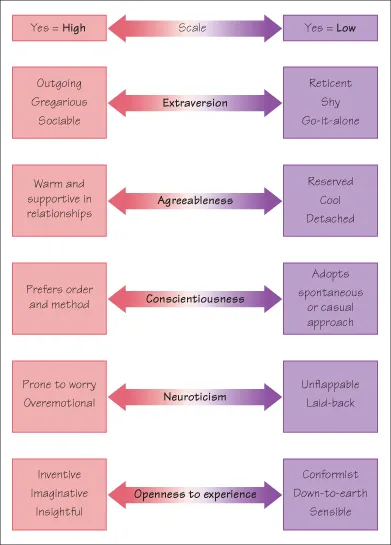
People behave in different ways, depending on the circumstances or the people they are with. However, it is widely accepted that some aspects of personality stay stable and, over the years, personality testing has evolved to measure these domains. You do not have to take a formal personality test, but understanding a little about personality theory can help you to understand yourself in relation to the role of an FY1. There are five widely recognised domains along which personality is measured, known as āthe Big Fiveā. These are shown in Figure 1.1.
Figure 1.1 The āBig Fiveā
It is helpful to see each of the ābig fiveā as a continuum, with most people coming out somewhere in the middle rather than being able to be labelled as one thing or another. Research has shown that domains are relevant across cultural boundaries (McCrae et al. 2005).
Openness and neuroticism can be used as examples to show how people respond differently to taking a test like the SJT. If you think you are on the high side of the neurotic scale, and the thought of the SJT stresses you out, you may find the wealth of practice material in this book invaluable in calming your nerves. If you are more of a conformist on the openness scale, you might find the checklists of good practice and procedures to your liking.
Different personality types can do the same job equally well. They just bring their own unique stamp to the way they do it. However, different personality traits can result in different individual experiences and challenges in relation to the same job. Here are some examples with respect to the domains covered by the SJT.
Professionalism
If you are high on the extraversion scale, you might find it more difficult to rein yourself in on social networking sites and resist talking in an unguarded way.
Conversely, if you are low on this scale, you might find it harder to challenge the actions of others and speak out when you see bad practice.
If you are highly conscientious, you might find it easier to maintain punctuality.
If you are highly neurotic, you might find it particularly hard to switch off from stressful days.
Pressures and Prioritisation
Being highly conscientious and only mildly neurotic will make it easier to work under pressure and remain calm and in control.
If you are highly open to new experiences, you will have an advantage when it comes to managing rapidly changing situations.
Conversely, when following protocols, being low on openness may stand you in good stead.
If you are high in agreeableness you may tend to seek help from others naturally; a key factor in some of the SJT questions.
Effective Communication and Patient Focus
Introverts may find relating to patientsā concerns a more difficult aspect of the FY1 role.
If you are highly neurotic you must remember not to relay your anxieties to the patient; having confidence in your skills as a doctor is an important aspect of the doctorāpatient relationship.
Being highly agreeable lends itself to good communication with relatives; if you are at the other end of the scale, you may have to work harder to empathise with others.
Teamwork
If you tend to āthink outside the boxā when problems occur, your openness to experience may puzzle or even frustrate your more cautious colleagues.
If you are high in agreeableness, you may find your priority is to promote harmony within your team. This may also mean that you find it more difficult to challenge colleagues who do not pull their weight.
Being high in conscientiousness will be appreciated by your colleagues
Teamwork is so fundamental to the FY1 role; it is examined in more depth in Chapter 6.
How Is This Relevant?
Bear in mind the different personality traits when you test yourself during the course of this book, especially when you compare what you would do to what you should do (i.e. the right answer). When there are discrepancies, ask yourself why they exist. Is it, for example, because you donāt like asking for help? Reflect on your personality and behaviour and consider how you could improve your performance. This is an important skill which will prove fruitful to your future development as a doctor. Finally, it is important that you seek out feedback on your non-technical skills in addition to your clinical competencies throughout your clinical attachments. This is part and parcel of continuing professional growth.
The questions in Figure 1.2 will help to guide you towards one side of a particular trait or the other. Although Figure 1.2 does not constitute a formal personality test, if you answer āyesā easily to one set of prompts, it will give you an indication of which end of the scale you gravitate towards. If you wish for a more formal assessment, most commercially available personality tests include some measurement of these...