![]()
Part One
Understanding the World
![]()
1
You, the Discoverer
All truths are easy to understand once they are discovered; the point is to discover them.
—Galileo Galilei
First of all, I would like to congratulate you. The reason that you are reading this book must be that you are learning about scientific method. This should open up possibilities for a variety of interesting professional tasks in the future. Scientific method can be said to be an approach for breaking a complex problem down into its essential components, investigating these components through relevant data and critical thinking, and finally solving the main problem by putting the components back together. Being familiar with scientific method makes it easier to handle complex problems, wherever we encounter them. This is of course useful in various branches of scientific research, where the method was developed, but complex problems occur in many situations. It does not harm policy makers, managers, or technical experts, for example, to be skilled critical thinkers, creative problem solvers, and to be able to draw relevant conclusions from data.
As conveyed by its title, this book is written for experimenters. Experiments are made in a wide variety of research and development tasks, to test ideas and to find out how things work. The book grew out of a need to teach research students general research skills. This means that it is mainly directed towards Ph.D. students, but it is likely also that others working with research and development will find it useful. Having worked with technical development myself, I know that planning, conducting and interpreting experiments are crucial for engineers too. I hope that no one will feel excluded by the way the text addresses research students because most of the contents are very generally applicable. Most readers will probably be found in various parts of the natural, engineering and medical sciences. The reason why I think that the book is relevant across so many disciplines is that the experimental method is such a general approach to finding things out.
Experiments are our most efficient method of discovery. They are based on interfering with something to see how it reacts and find out how it works. The alternative to this is passive observation – standing back, watching and waiting for something interesting to happen. Passive observers obtain large amounts of data, but it may be difficult for them to isolate the information that is relevant to a particular research problem. Experimentation, on the other hand, provides us with data that are tailored to our problem. This means that experimenters have to spend less effort sorting out irrelevant information.
1.1 Venturing into the Unknown
Research studies are a voyage into the unknown in at least two respects. Firstly, as a Ph.D. student you will often find yourself at the borders of our current knowledge, spying out into the uncharted territories beyond. Secondly, research studies involve learning in ways that are unfamiliar compared to the previous stages of your education. As will be explained in later sections, this is because research studies are focused on acquiring skills in addition to knowledge.
Science is probably the most remarkable enterprise that humankind has ever undertaken. During the couple of hundred thousand years that our species has existed, almost all the knowledge we have about the world we live in has been established during the last couple of hundred years – a mere thousandth of our history. We have been intelligent and curious for eons but only learned to understand Nature once science was invented. This says something of how powerful this idea is. Besides the knowledge it has brought with it, science has also fundamentally changed our living conditions. Scientific progress has found applications in technology and medicine, and these have opened up new avenues of applied research. Science is so integrated in the progress of society that, today, it is all but impossible to imagine an existence without it. This is probably one reason that science is held in such high esteem and that scientists have such high credibility among people.
I would like to clarify that the word science, in this book, refers to the natural sciences in a broad sense. This is not to say that other branches of research are of lesser value, but the methods of science differ between disciplines and the definition has simply been chosen to fit the audience. Many methods of natural science are shared between the natural, engineering and medical sciences. The word “science” itself has Latin roots and originally means knowledge, but it is generally used in a wider sense to include both scientific research and the knowledge that results from it.
With a bit of poetic license you could say that science is a state of mind. Of course, it consists of various facts and methods, but it is also an attitude to the world around us. Scientists act from the presumption that the world is understandable. They try to look beyond the apparent disorder and search for patterns. From these they identify the underlying, general rules that govern the world. This attitude is the basis of scientific discovery.
Do not be fooled into believing that there are no more discoveries to be made. Even relatively simple questions may direct us to fascinating insights about the world. Have you ever wondered why the sky is blue or why the grass is green? The blue sky is now well understood, thanks to the nineteenth century discovery of a phenomenon called Rayleigh scattering. We will return to it in Chapter 10, in connection with a nice experiment about how an African dung beetle finds its way at twilight. The color of the grass, on the other hand, is not so well understood. There is, of course, the obvious reason that grass contains chlorophyll, which absorbs sunlight for the photosynthesis. But it seems odd that chlorophyll should be green because this means that it reflects light in the green wavelength region, where the sun's radiation contains most energy. A black plant, absorbing all visible wavelengths, would extract more energy from the sunlight than a green one. Why do plants reject the sun's energy where it is most abundant? When asking biologists about this, they usually embark on long, interesting discussions about photosynthesis in various organisms before wrapping it up with “So, it's really a good question!” The fact seems to be that we simply do not know.
When you start doing research you will find that there are plenty of unanswered questions in your field as well. Towards the end of this book we will discuss how you may go about finding, approaching and answering them. There are probably more unanswered questions in research today than ever before. As our knowledge grows, the boundaries of knowledge grow too. This means that many discoveries remain to be made, and some of them are waiting for you.
1.2 Embarking on a Ph.D.
To take a systematic approach to discovery you need to acquire new skills as well as new knowledge. Undertaking a Ph.D. will, hopefully, be one of the most developing periods in your life. In all fairness, it will be challenging too. You are likely to work alone a good part of the time. Another challenge is that you will be learning in a completely new way. It may be a shock to discover that high grades from previous studies do not necessarily help you now. The educational system often tends to assess our ability to learn facts and techniques rather than our actual problem solving skills, and research studies require more than having a good head for studying. When you embark on a Ph.D. you go from being a consumer of knowledge to a producer of knowledge; this requires a new set of talents. You do not obtain a Ph.D. for what you know but for what you can do. In other words, research education is largely about acquiring skills and this is why it takes time.
Undertaking a Ph.D. involves a more holistic approach to learning than your previous studies did. Schoolteachers often tend to teach their subjects separately. In high school, for example, it took my fellow students and I a good while to understand that calculus could be used to solve physics problems because it was taught without any hints to applications in other subjects. Little did we know that calculus had been developed by physicists in order to solve physics problems! This tradition of teaching often continues at university. The title of my undergraduate statistics book, for instance, announced that it was written for scientists and engineers. Despite this it did not contain a single example from science or engineering. I often wonder how students are expected to be able to apply subjects that are taught devoid of a relevant context. It is like teaching carpentry by handing out toolboxes and waiting for the students to discover how to use them.
From this point on, things will be different. During your research studies, you will acquire skills by engaging in real research tasks under the supervision of a professional researcher. This is similar to how carpentry is actually taught: if you are to learn how to build a house, you build a house to learn it. Although supervision and textbooks are required, skills can only be learned through hands-on experience. As a research student you will learn about research methods, measurement techniques, and statistical analyses by applying them to real research problems.
1.3 The Art of Discovery
Methods and techniques are all very well but good research involves more than that. As previously stated, science is also an attitude to the world. Professional researchers need to have a scientific mindset. When graduating you should be able to identify and formulate new research questions, develop your own approaches to answering them, and independently conduct research that meets the accepted quality standards of your field. In other words, you should master the scientific method to the point that you are able to make your own contribution to science.
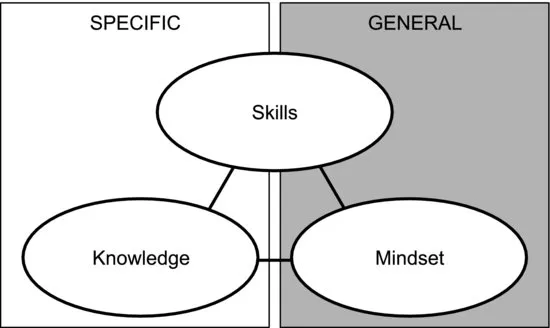
To do this, you need a competency that is made up of several components. One of them is knowledge. In order to identify interesting research questions, you must have broad knowledge within your field as well as deep knowledge within the limited part where you are conducting your research. Another component is skills, meaning that you need to master a number of methods and techniques. Some of these will be quite general while others will be specific to your field, such as biochemical laboratory techniques or thermodynamic analyses in engineering. The final component is the one we started this chapter with: the scientific mindset.
You are expected to acquire these three components in different ways. The knowledge part mostly comes by reading books and scientific papers. Skills are often acquired by “on-the-job” training, in a laboratory or in the field. We frequently expect the mindset to be transferred, as it were, by molecular diffusion or some similar process. The hope is that you will crack the code just by being around researchers in a professional setting. Remarkably, this actually seems to work in many cases, but one purpose of this book is to make the process easier.
Figure 1.1 aims to illustrate that researchers use these three competencies in parallel. It also shows that they can be divided into competencies that are specific to a certain field of research and more general ones. Understanding the scientific approach is a general competency that should be shared by all researchers. The same is true of skills in applying general statistical methods, understanding how to plan and conduct experiments, knowing how to interpret data and so on. It is too common that the research education focuses on specific competencies, like subject matter knowledge and specific laboratory techniques, while neglecting the general aspects. This is probably because they are more difficult to define than the specific ones. Another reason is that the research system is designed in a way that does not naturally engage these competencies in Ph.D. students. Senior researchers tend to plan projects and students tend to work in the laboratory producing data. The aim of this book is to fill this gap in the research education.
1.4 About this Book
This book grew out of a need to teach general research competencies. As a Ph.D. student you need to understand how research differs from other activities. If you are working in an experimental field, you need to understand how experimentation differs from other forms of scientific investigation. It is also important to understand the general aspects of collecting and analyzing data. Finally, it is central to understand the scientific process: how to identify research problems, how to approach them, and how to communicate the results in the scientific community. There are good books that cover at least some of these aspects but it would be useful to introduce them in parallel, I thought, between the same pair of covers. It is often difficult for students to fit the pieces together after taking separate courses in the philosophy of science and statistics, for example, especially when the teachers are not experimental researchers themselves. Of course, a single book cannot provide a comprehensive treatment – especially not one as brief as this – but it can serve as a starting point.
The book is organized in two parts. The first part explains different aspects of scientific thinking and the second addresses general methods and techniques that are important to experimenters. The second part often refers to the first, but they can in principle be read separately. It may even be a good idea to skip back and forth between them. Whatever works for you will be fine.
The first part is called “Understanding the World”. It contains five chapters, of which you are halfway through the first. The next chapter introduces some central concepts from the philosophy of natural science. It explains that different approaches to scientific exploration result in different types of knowledge, and discusses the connection between observation and theory in science. Chapter 3 very briefly describes how science was invented and how it evolved into its modern form. There is also a discussion about how science has impacted on our civilization. After this, Chapter 4 takes a first look at experiments. It uses Galileo's pioneering experiment on the inclined plane to discuss some interesting aspects of the experimental method. The final chapter of the first part aims to demarcate between research and development, as this is an important distinction for students in applied research fields. There is a discussion about what we mean by theories and how they are developed. It also touches upon creativity, an important aspect of research that is often neglected. Discussing science and experimentation from different perspectives, this part of the book aims to give a better understanding of their essential characteristics.
The second part is called “Interfering With the World” as this is the very basis of the experimental method. It begins with a discussion about what distinguishes experimentation from passive observation. An important message is that observational studies only reveal correlations, whereas experiments can provide evidence for causation. It also explains under which conditions experiments may provide explanatory knowledge. After this, Chapters 7 and 8 cover statistical concepts and techniques that are useful in the collection and analysis of data...