- A generously-illustrated collection of newly-commissioned essays which provides a comprehensive introduction to the history of British art
- Combines original research with a survey of existing scholarship and the state of the field
- Touches on the whole of the history of British art, from 800-2000, with increasing attention paid to the periods after 1500
- Provides the first comprehensive introduction to British art of the eighteenth, nineteenth, and twentieth centuries, one of the most lively and innovative areas of art-historical study
- Presents in depth the major preoccupations that have emerged from recent scholarship, including aesthetics, gender, British art's relationship to Modernity, nationhood and nationality, and the institutions of the British art world
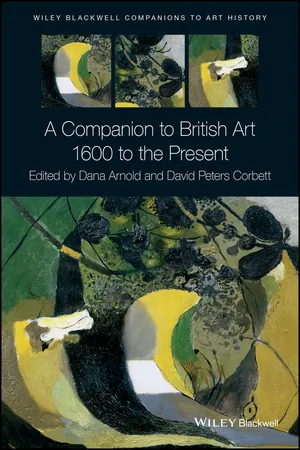
eBook - ePub
A Companion to British Art
1600 to the Present
- English
- ePUB (mobile friendly)
- Available on iOS & Android
eBook - ePub
A Companion to British Art
1600 to the Present
About this book
This companion is a collection of newly-commissioned essays written by leading scholars in the field, providing a comprehensive introduction to British art history.
Information
Part 1

Editors’ Introduction
Editors’ Introduction
A Companion to British Art: 1600 to the Present is a collection of new essays written by leading scholars in the field. Over the past two decades, British art of the eighteenth, nineteenth, and twentieth centuries has been one of the most lively and innovative areas of art-historical study. A series of important monographs, essay collections, exhibitions, and articles has expanded and deepened our understanding of British art of these centuries, raising it from an undertaught and understudied aspect of the history of art to one that is increasingly on syllabuses for undergraduate and MA students. This growth in scholarly depth and interest has made it important to provide a working collection for teachers and their students as an introduction to the field. This book is therefore offered as a text that can be used in multiple ways to approach the rich and varied material of British art.
A word about the nature of the book and how it is organized. The volume concentrates on painting for reasons of space. The reader will find there is some reference to architecture but little to sculpture or graphic art. It is emphatically not a survey and does not attempt to review or cover the whole history of art in Britain. Even if that were possible, we do not think it would be desirable to provide some information about everything at the expense of detailed study of nothing. Instead, the volume is designed for a different task, one that seems to us to be much more important and timely. The book is a selection of substantial essays – partly reporting on existing scholarship and the state of the field, partly original research – which have been designed and written specifically for an undergraduate audience. It is organized and imagined thematically and does not attempt to cover either the full chronological range or some notional list of high points. Instead it is intended to provide teachers of the subject who need to introduce undergraduates to British art with material that they will find substantial and stimulating in a classroom situation. Our hope is that teachers of the subject will find here a rich and diverse set of approaches to some of the important themes and areas that have emerged in the study of the subject, and that they will find it easy to tailor and adapt the groups of essays we have organized in order to answer particular needs. We do not wish to promote any particular reading of the material here, and the collection has been envisaged primarily as a stimulating way into what, for many students, will be an unfamiliar subject.
In commissioning essays for the book we have selected four themes, together with a broader “general” section at the start, each of which provides the center of gravity for one of the main sections of the volume. “Institutions,” “Nationhood,” “Landscape,” and “Men and Women” are ways of identifying and organizing some of the major preoccupations that have emerged from recent scholarship. They are not meant to seem exclusive, compulsory, or constraining, and the essays in each of the sections have been written and conceived to be diverse and to pursue similar material in distinct ways over the chronological range of the book. Tutors reading through the volume in order to consider how they wish to use the material will see that each thematic section can be used as a whole, can be dismantled and recombined with essays from other sections, or can be reduced to one or two of the contributions in order to pursue specific interests. It is this openness and malleability that we have worked to achieve in designing the volume, and that we hope tutors and students will find in the organization. It is, however, worth offering here some thoughts about the constitution of the individual sections and their themes, continuities, and divergences. The essays are meant to delve in stimulating and useable ways into aspects of their material; they are not conceived as surveys or as exhaustive accounts of all the significant dimensions of their subject matter. For instance, the very extensive work that has recently appeared on the Royal Academy means that the reader will not find, in the section called “Institutions,” any separate detailed discussion of the founding and constitution of the Royal Academy after 1768 (although she or he will find it discussed in Colin Trodd’s essay in the section and in Cynthia Roman’s in the “Nationhood” section). They will, however, find the nature of the art world between the 1760s and 1820s defined, since this is a subject which has had little presence in the literature to date. The reverse of this medal is the decision to provide a constellation of essays – by Sam Smiles, Tom Williamson, and Michael Charlesworth – in the “Landscape” section that consider the work of Constable as part of wider studies of landscape art as it evolved over the period between about 1760 and the mid-nineteenth century. Taken together, this group of essays provides a multiple and multi-directional set of perspectives on one of the central subjects to any study of British art in this key period of its history. Our hope is that tutors and students will find this multiplicity a stimulating way into the issues and meanings of the subject and that “Landscape” in this way can serve as a case study for classroom use that will allow students to use the book to deepen their knowledge of an important aspect of British art and work with it across a range of opinions and approaches.
The volume opens with the “General” section. It contains a trio of essays that deal, in distinct ways, with three of the most important questions which seem to us to be of wide relevance to the field. Mark Cheetham begins the volume with a detailed and scholarly discussion of the ways in which nationhood – “Englishness” – and ideas of and about art have intersected between the early eighteenth century and the present day. In a muscular and comprehensive argument that ranges widely – from Hogarth to the early twentieth century vorticists, to the contemporary artist, Yinka Shonibare, MBE – Cheetham explores how far we might legitimately think of “English” art as a unity, and what it implies to do so. The question of nationhood and nationality in art – the subject of one of the later thematic sections – is lucidly broached and analysed here. In the second essay of the “General” section, Andrew Ballantyne takes up the question of the British and modernity, an attribute they have often been accused of lacking, or at least adopting a skeptical and probably evasive view toward. British art seemed to many commentators in the twentieth century to opt out of the most exciting art of the moment, modernism, an art that claimed for itself a direct relationship with the expression of modern life. Ballantyne traces the idea of modernity from antiquity to the late twentieth century and concentrates on the ways in which architecture in Britain has, at certain key moments from the eighteenth century onwards, become the focus of debate and concern about the modernity of the times and their expression. He reveals that the British attitude to these vital but contested issues has been more complex and more pervasive than has often been acknowledged. Finally, British culture has been a modern, even a modernist, one, but quietly and without fanfare, however saturated in these qualities it might now seem. In the final essay of the “General” section, Janet Wolff considers with a precise, analytic, probe, another key question: how far is “English” or British art to be valued in aesthetic terms. As with modernism and modernity, earlier commentators often considered British art aesthetically inferior to what were seen as the more central national schools, France and Italy above all. Wolff takes on this question directly. Beginning with a discussion of a significant intervention by the important historian of British art, Charles Harrison, she considers the recent “re-evaluation” of the worth and importance of the art produced in Britain, especially in the early twentieth century when France and America have seemed to lead the field. Wolff not only provides a lucid guide to the debates, she also ranges widely across recent political and social theory in seeking to provide the reader with a firm place to stand and make a judgement about both the issues at stake in seeking to value and the value we might attribute to British art. Focusing on the work of Gwen John and the Bloomsbury artists of the early twentieth century, she argues for a “principled aesthetics” that will allow us both to assess the value of British art on its own terms, and to place it in wider art-historical and social contexts.
“Institutions” contains five essays. In “‘Those Wilder Sorts of Painting’: The painted interior in the age of Antonio Verrio,” Richard Johns considers the ways in which the emergent art world of the 50 years or so between the 1670 s and the 1720 s – a period that has still been little researched – came together through the decorative history painting practiced by James Thornhill and others. Considering both the architectural settings of such paintings and the ways in which the period and its art can be conceptualized, Johns offers a reading of this art that allows us to understand both its place in a complex network of politics and patronage, and to see it as exemplary of the ways in which we can newly read neglected periods of British art in new and illuminating ways. Johns’ discussions of the concept of the Baroque, of the relationship between architecture and painting, and of the historiography of his period all provide a way into the period for the classroom. In the second essay, Colin Trodd offers a detailed and meticulous account of the art institutions of nineteenth-century Britain. Beginning with some comments on the Royal Academy, Trodd traces the way in which art institutions in the period, including the National Gallery, the Royal Academy, and the Victoria and Albert Museum, fought to make space for themselves in a changing society and “battled to make themselves into durable, distinctive and original places of knowledge and venues of value.” He concludes that these were fluid and mobile ways of organizing artistic activity, and that we must pay attention not only to the way in which they organized themselves, but to the pressures to which they were obliged to respond. David Peters Corbett takes up another aspect of the institutional construction of art history in the section’s third essay, “Crossing the Boundary: British Art across Victorianism and Modernism.” Corbett looks at the conventional division in studies of early twentieth-century British art between the Victorian and modernist eras and, drawing on detailed examples, argues that it is misleading to make such a division. The fourth essay in the section, “British Pop Art and the High/Low Divide,” sees Simon Faulkner discussing the ways in which Pop Art in Britain found a role within the institutions of British culture by resisting rather than celebrating the popular cultural forms of its subject matter, as the most common critical opinion has it. Discussing artists including Richard Hamilton, Peter Phillips, Peter Blake, Derek Boshier, and Richard Smith, Faulkner marks out the ways in which the specific imagery of British Pop plays a role within the institutions of its culture. The “Institutions” section concludes with an essay by Jo Applin that looks at the ways in which British art “became subject to a range of formal and conceptual pressures in London during the 1960s.” Focusing on the London art schools of the sixties and the reception of American modernism in which they were at the forefront, St Martin’s and the Royal College of Art are examined as institutions where the understanding and usability of new artistic and conceptual forms was received, debated, and given a British cast during a crucial decade of reformulation and expansion in the British art world. One of Applin’s central concepts in her discussion is “antagonism,” and it is clear from all the essays collected in this section of the volume, that institutions are more than mere repositories for conventional wisdom and attitudes. Instead, the institutions of British art are mobile, changeable sets of cultural practice in which key changes in the constitution of both the art world and the wider culture are aired and decided upon, not by individuals as much as by and through the fluidity and capacity to change and morph of the institutions themselves. Art schools, museums, national institutions like the Royal Academy or the National Gallery, the structures in which imagery is described and recirculated, all these crucial aspects of the way in which art works and takes part in the wider culture are examined and opened for consideration in this section.
The second thematic section of the book is concerned with “Nationhood.” Five essays consider how this central question can be understood within selected moments of the history of British art. The first essay, by Cynthia Roman, deals with “Art and Nation in Eighteenth-Century Britain.” Building on a vivid tradition of scholarship in this area, Roman demonstrates that in this period “narratives about fine art and those about national identity were inextricably intertwined as the visual arts both reflected and mediated constructions of nationhood.” Discussing artists including James Barry, Benjamin West, and John Singleton Copley, as well as the print-seller John Boydell, Roman traces this intertwining through the Royal Academy and shows how it is manifested in portraiture as well as history painting, and in the accessible medium of prints as well as in grand manner painting on the Academy’s walls. “International Exhibitions: Linking Culture, Commerce, and Nation” by Julie Codell takes up a nineteenth-century subject, looking at international exhibitions around 1851. Drawing on ideas from the study of cultural geography, Codell considers the Great Exhibition of 1851 and other international exhibitions as maps that point to the imperial and colonial substructure of the societies of which they are a part. Analyzing the visual and material culture of these exhibitions, Codell traces the complication of national identities that emerged from the breaking of established boundaries between nations through the operations of art and commerce in this period. She shows that as art came to take up the role of expressing national pride at such events, it forced an increasingly permeable and open character on the nation and its rivals. In the following essay, Ben Highmore considers the nature of an international art form – Surrealism – once it crosses the Channel and takes root in a characteristically British soil. “Itinerant Surrealism: British Surrealism Either Side of the Second World War” allows him to evaluate the nature of nationality in art movements and the ways in which transformations and adaptations occur in a particular context. In “55˚ North 3˚ West: a Panorama from Scotland,” Tom Normand looks at some of the consequences for identity of the fact that four nations inhabit Britain. “The fascinating geography of British art” stems in part from this foundational political and social reality. By focusing on the period after the Second World War, Normand is able to follow the fortunes of “Scottishness” in its complex relationship both to “Britishness” and to other nations and nationalisms. The 1987 Scottish National Gallery of Modern Art’s exhibition “The Vigorous Imagination – New Scottish Art” is seen as an exemplary and telling moment in this history, prompting Normand to look back into the nineteenth century to the career of the artist David Wilkie for the formation of modern Scottish artistic identity, before returning to the contemporary in order to trace the working out of that identity in the context of a new internationalism. Normand finds in the Scottish example a way that internationalism and national tropes continue to mix and refer in the twenty-first century. The final essay in the “Nationhood” section, Dorothy Rowe’s “Retrieving, Remapping, and Rewriting Histories of British Art: Lubaina Himid’s Revenge,” considers the way contemporary black British artists have been involved in “the re-visualization of the borders of nationalism, identity and nationhood in British art.” Rowe’s analysis of Himid’s work allows her to make a strong and politically conscious case for attention to “the visual and aesthetic legacies of artworks produced by black and Asian women artists who have been active in Britain since the 1980s but whose contributions to the re-mapping of British art’s histories during the last 30 years are still being realized,” so that the structures and institutions of “British art,” its meanings and range, are questioned and reformulated as they are, from other perspectives, in the essays by Cheetham, Wolff, and others in the collection. Nationhood, identity, and meaning are all raised and explored in this section of the book’s essays.
One of the most influential and important artistic genres to have flourished in the art of the British Isles is landscape, and this forms the subject that the five essays in the third section of the volume all, from diverse positions, address. The section opens with a wide-ranging survey and consideration of definitions by Anne Helmreich, which orientates the reader and touches on several of the topics raised in subsequent essays. Michael Charlesworth in “Theories of the Picturesque” considers one of the most important moments in the formation of the genre. Dealing with the eighteenth-century theorists William Gilpin and Richard Payne Knight, Charlesworth sets out the character of the picturesque and relates it to those of the beautiful and the sublime. Charlesworth traces the popularity of the concept through its literary and theoretical manifestations and into the visual, including architecture and landscape gardening. An extended analysis of the work of John Constable takes the story into painting and then to Ruskin’s use of the idea. Concluding with a look at the twenty-first century relevance of the term, Charlesworth is able to assess the importance of the picturesque for any understanding of British visual and literary culture since the eighteenth century. Two very different and complementary considerations of landscape art across the late eighteenth and early nineteenth centuries follow. Tom Williamson offers a precise, historical, and social study of the conditions in which landscape imagery of the period was nurtured and in which it served its function in the culture as a whole. Williamson places a salutary emphasis on the need to understand these aspects of artistic production and on the value and importance of studies of the physical realities of the “real” landscape and of how its meanings are worked into and upon in the realm of visual representation. Sam Smiles, meanwhile, offers a definition of landscape and a consideration of it in the period based on scrupulous and precise attention to four examples. Intended to be exemplary and telling, rather than to exhaust the subject, Smiles’ choices – Stubbs, Turner, Constable, and Palmer – are revealed as significant engagements with British culture at a time of exceptionally intense social and economic transformation. Taken together, these three essays, together with that by Helmreich, all of which consider aspects of the work of Constable among other elements in the period, allow a facetted and informative set of perspectives on a central moment for the study of British art and its meanings. To close the section, Dana Arnold’s fifth essay extends the study of landscape in this period by considering the relationship between the Phoenix Park in Dublin and building and landscape design in London. Drawing on a number of theoretical perspectives, and presenting some detailed historical material about the making of the park, Arnold’s essay acts as a bridge as well to the section on nationhood and the making of national visual cultures.
The final section is called “Men and Women” and deals in four essays about gender from the Elizabethan Miniature to Edwardian genre painting. Dympna Callaghan considers questions of representation, identity, and ideology in the Elizabethan genre of portrait miniatures, concluding that it “epitomizes both the ideological and technical problems” posed at the time. Two essays deal with the eighteenth century. Kate Retford provides a focus and revealing analyses of the representation of female chastity in eighteenth-century portraiture, while, in a matching pair to Retford’s essay, Whitney Davis considers the painting of men and offers a sophisticated and nuanced reading of the epistemological issues at stake in this moment. Finally, Pamela Fletcher examines Victorian and Edwardian painting in order to show how gender could provide narratives that organized and structured knowledge for the audience, and how the investigation of such visual practices can lead us into an understanding of both the pleasures and oppositional character of representations of this sort.
Part 2
General
1
The “Englishness” of English Art Theory1
This article examines the intertwining of art theory, national identity, and art in England from the early eighteenth century to the present. We are used to the conjunction of art and nationality because generations of artists, art historians, and the public have typically defined art by its national origin. Students study French and Italian and Dutch art; museums habitually display works by national school or have the mandate to exhibit the art of their nation.2 While art historians commonly think of art production in terms of national schools, art theory is usually held to transcend accidental particulars. To address the “Englishness of English Art Theory” seems odd because the philosophical bent of art theory (aesthetics) urges us to abjure the specifics of place, gender, race, and nation.3 A central argument in this essay is that art theory and art practice are not so ...
Table of contents
- Cover
- WILEY-BLACKWELL COMPANIONS TO ART HISTORY
- Title page
- Copyright page
- List of Illustrations
- Acknowledgements
- Notes on Contributors
- Part 1: Editors’ Introduction
- Part 2: General
- Part 3: Institutions
- Part 4: Nationhood
- Part 5: Landscape
- Part 6: Men and Women
- Index
Trusted by 375,005 students
Access to over 1.5 million titles for a fair monthly price.
Study more efficiently using our study tools.
Frequently asked questions
Yes, you can cancel anytime from the Subscription tab in your account settings on the Perlego website. Your subscription will stay active until the end of your current billing period. Learn how to cancel your subscription
No, books cannot be downloaded as external files, such as PDFs, for use outside of Perlego. However, you can download books within the Perlego app for offline reading on mobile or tablet. Learn how to download books offline
Perlego offers two plans: Essential and Complete
- Essential is ideal for learners and professionals who enjoy exploring a wide range of subjects. Access the Essential Library with 800,000+ trusted titles and best-sellers across business, personal growth, and the humanities. Includes unlimited reading time and Standard Read Aloud voice.
- Complete: Perfect for advanced learners and researchers needing full, unrestricted access. Unlock 1.5M+ books across hundreds of subjects, including academic and specialized titles. The Complete Plan also includes advanced features like Premium Read Aloud and Research Assistant.
We are an online textbook subscription service, where you can get access to an entire online library for less than the price of a single book per month. With over 1.5 million books across 990+ topics, we’ve got you covered! Learn about our mission
Look out for the read-aloud symbol on your next book to see if you can listen to it. The read-aloud tool reads text aloud for you, highlighting the text as it is being read. You can pause it, speed it up and slow it down. Learn more about Read Aloud
Yes! You can use the Perlego app on both iOS and Android devices to read anytime, anywhere — even offline. Perfect for commutes or when you’re on the go.
Please note we cannot support devices running on iOS 13 and Android 7 or earlier. Learn more about using the app
Please note we cannot support devices running on iOS 13 and Android 7 or earlier. Learn more about using the app
Yes, you can access A Companion to British Art by David Peters Corbett, David Peters Corbett,Dana Arnold, Dana Arnold, David Peters Corbett in PDF and/or ePUB format, as well as other popular books in Art & Art General. We have over 1.5 million books available in our catalogue for you to explore.