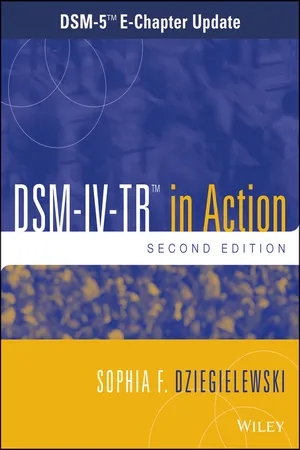
The DSM-5 E-chapter Update bridges the gap between the DSM-IV-TR and the DSM-5. This chapter outlines the changes in the DSM-5 while using the original treatment information from the second edition of the book. The DSM-5 E-chapter Update allows the current information to be used to support the practitioner with current application principles relating psychopathology to clinical mental health practice. This chapter allows instructors to be able to use and transition to the DSM-5 while still teaching the DSM-IV-TR. What makes this "in action" text unique is that it not only breaks down the criteria for the diagnostic categories but it helps the practitioner directly apply it. The DSM-5 E-chapter Update will follow a similar format as the treatment outlined in the current edition is still quite valuable and should not change much with the full book revision. The chapter provides a bridge to the information still relevant and current in the book such as the application of the diagnostic assessment found in today's behavioral-based biopsychosocial field of practice. This chapter includes the DSM-5 categories that correspond to each chapter in the second edition. Since instructors and practitioners alike, will need the information in the DSM-IV-TR and DSM-5 for a short time knowledge and application of both books will be essential. The existing cases and applications will remain helpful. What remains unique about this chapter is that it will allow for the joining of the second edition with the new changes in the DSM-5. The teacher and practitioner will be able to synthesize the information from both versions of the DSM to complete a diagnostic assessment that goes beyond the DSM-5 including current evidence and competency-based skill development in the resulting practice strategy.
- English
- ePUB (mobile friendly)
- Available on iOS & Android
eBook - ePub
About this book
Information
Chapter 1
DSM-5™ Update to DSM-IV-TR™ in Action, Second Edition
Introduction
Formulating and completing a diagnostic assessment is embedded in the use of supporting texts, often referred to as the “bibles” of mental health, such as the Diagnostic and Statistical Manual of Mental Disorders, Fourth Edition, Text Revision (DSM-IV-TR ™) and the International Classification of Diseases, Ninth Edition (ICD-9). These two versions outlining diagnostic standards for mental health practice have represented state-of-the-art assessments for over a decade. Therefore, it should come as no surprise to mental health professionals that presentation of the new edition of the Diagnostic and Statistical Manual of Mental Disorders, Fifth Edition (DSM-5 ™) and expected utilization for insurance billing of International Classification of Diseases, Tenth Edition (ICD-10) with its latest mandatory requirement for usage in October 2014, will bring forth what some consider earth-shaking changes. For example, the committee responsible for the DSM-5 made the decision early on to eliminate the roman numeral from the title, changing it from the expected DSM-V to DSM-5. It is also expected that the revisions will follow a similar pattern with the first edition titled DSM-5 and each subsequent revision followed by a DSM-5.1, DSM-5.2, and so on.
The purpose of this chapter is to update, and in some cases reintroduce, the reader to the core concepts of the diagnostic assessment applying the DSM-5 as the primary means for mental health assessment. This book, supported by this last chapter with the DSM-5 updates, is to continue to be used as the foundation to support behavior-based practice strategy and treatment planning. It is also expected to identify and provide updates relative to APA's newest version of the DSM and explain how these changes will relate to the diagnostic assessment and subsequent treatment efforts.
The DSM and the ICD: The Bibles of Mental Health
The DSM-IV-TR (2000) was the standard for assessment until the revision to this edition (DSM-5) was released in May, 2013. The DSM-IV-TR and DSM-5 state clearly that these books are designed to be used in a wide variety of settings, including inpatient and outpatient settings as well as consultation and liaison work. Furthermore, the latest versions of the DSM remain designed to be used by professionals and are not to be used as self-help books for the lay public. Paris (2013) questions this, however, stating that clients have a right to know their own diagnosis and the more they know the more they can become empowered to participate in self-help strategy. Also, with the Internet and other forms of information so readily accessible, clients become active in gathering information related to their own mental health. Clients should not be kept in isolation of their diagnosis and the criteria that contributes to it, as doing so creates a disservice that forces them to be passive consumers of their own health care. Arguments that the DSM is very complex and could overwhelm a client unfamiliar with the technical jargon have been questioned and active participation on the part of the client has become expected (Paris, 2013).
Similar to previous versions of the DSM, DSM-5 suggests the book is for use by professional practitioners such as psychiatrists and other physicians, psychologists, social workers, occupational and rehabilitation therapists, and other health and mental health professionals (APA, 2000, 2013). Because these professionals can all have very different training and expertise, particular attention to following the diagnostic criteria is expected, coupling this with clinical skill and judgment designed to achieve similar determinations. Before putting the DSM-5 into practice, professionals will need to be trained in how to use categorical and dimensional approaches, as well as being aware of the potential for misuse. When using any diagnostic system, care and consideration should always be given to protect the rights of the patients being served.
In the United States, the DSM is often used to classify mental health disorders. True to its historical roots, the most current version of the DSM supports this purpose by stating that it is to be used for statistical and assessment purposes as well as educational support. This makes the DSM an important reference for students, researchers, and clinicians. For clinicians, it provides the starting point for determining the nature of a client's problem. It also provides supportive information on prevalence rates within the larger population that have been gathered to inform policy decisions. What remains consistent among all versions of the DSM is that it does not suggest treatment approaches. Therefore, other supportive books, as well as the previous chapters of this text that suggest treatment strategy, remain relevant for achieving comprehensive, efficient, and effective care.
The International Classification of Diseases (ICD) is said to have its origins in the 1850s. When completing diagnostic assessment, the importance of the ICD cannot be underestimated. The World Health Organization (WHO), after assuming responsibility for the ICD, was credited as the first official international classification system for mental disorders. This began with the first edition (ICD-6) published in 1948, under the auspices of WHO. Following this early publication of the ICD, the APA published its first edition of the DSM in 1952. Originally, the APA developed the DSM for statistical, epidemiological, and reporting purposes, whereas the ICD was developed to reflect clinical approaches to diagnosis and training (Sorensen, Mors, & Thomsen, 2005). This is probably why the ICD remains the global standard for diagnostic classification and why it is recognized for service reimbursement. After the World Health Assembly adopted the nomenclature outlined by WHO, use of the ICD for mortality and morbidity statistics was adopted by all member states in 1967. The ICD is a classification system that creates a global linkage and allows for disorders across the world to be viewed at one point in time; therefore, scientific progress ultimately requires revision and updates (Sartorios, 1992). Similar to the DSM, the ICD has gone through many changes and updates. The latest version of the ICD is ICD-10, which replaced ICD-9-CM (WHO, 1979, 1990). Subsequently, it is expected that ICD-11 will be released in 2015.
The ICD-10 was originally released in 1990 and received full endorsement by WHO in 1994. In 2002, it was published in 42 languages and in 1999, the United States implemented it for mortality (death certificates). Currently, it consists of three volumes. Volume 1 has tabular lists that contain cause of death titles and the codes that accompany the cause of death titles; Volume 2 has description guidelines and coding resources; and Volume 3 provides an alphabetical index to diseases and the nature of injury, external causes of injury, and table of drugs and chemicals (see Quick Reference 1). ICD-10 hosts more than 141,000 codes with many different diagnostic categories compared to the 17,000 codes present in the ICD-9-CM (AAPC, 2013).
Quick Reference 1
Websites for General ICD-10 Information
ICD-10-CM files, information related to diseases, functioning, and disability
http://www.cdc.gov/nchs/icd/icd10.htm
ICD-9-CM files related to diseases, functioning and disability
http://www.cdc.gov/nchs/icd/icd9cm.htm
The DSM-IV-TR is similar to the ICD in terms of diagnostic codes and the billing categories. Concern has been voiced that although the codes are listed for both the ICD 9-CM followed by the codes for ICD-10-CM, the criteria needed for the diagnosis may not match what has been updated in DSM-5. Similar to what happened in the late 1980s with DSM-III, some professionals fear that once again the diagnostic and billing categories won't match. Since these two books need to go hand-in-hand, categories with criteria listed in one book that are not listed in the other can be extremely problematic for proper coding and reimbursement. These two books have to work together and when clinicians use the ICD for billing while referring to the DSM for clarity of the diagnostic criteria, both books need to have similar matching criteria. Although the APA states clearly that the categories are general enough to match the categories in the ICD, ensuring clarity and uniformity between the two texts may o...
Table of contents
- Cover
- Title Page
- Copyright
- Chapter 1: DSM-5 ™ Update to DSM-IV-TR ™ in Action, Second Edition
Trusted by 375,005 students
Access to over 1.5 million titles for a fair monthly price.
Study more efficiently using our study tools.
Frequently asked questions
Yes, you can cancel anytime from the Subscription tab in your account settings on the Perlego website. Your subscription will stay active until the end of your current billing period. Learn how to cancel your subscription
No, books cannot be downloaded as external files, such as PDFs, for use outside of Perlego. However, you can download books within the Perlego app for offline reading on mobile or tablet. Learn how to download books offline
Perlego offers two plans: Essential and Complete
- Essential is ideal for learners and professionals who enjoy exploring a wide range of subjects. Access the Essential Library with 800,000+ trusted titles and best-sellers across business, personal growth, and the humanities. Includes unlimited reading time and Standard Read Aloud voice.
- Complete: Perfect for advanced learners and researchers needing full, unrestricted access. Unlock 1.5M+ books across hundreds of subjects, including academic and specialized titles. The Complete Plan also includes advanced features like Premium Read Aloud and Research Assistant.
We are an online textbook subscription service, where you can get access to an entire online library for less than the price of a single book per month. With over 1.5 million books across 990+ topics, we’ve got you covered! Learn about our mission
Look out for the read-aloud symbol on your next book to see if you can listen to it. The read-aloud tool reads text aloud for you, highlighting the text as it is being read. You can pause it, speed it up and slow it down. Learn more about Read Aloud
Yes! You can use the Perlego app on both iOS and Android devices to read anytime, anywhere — even offline. Perfect for commutes or when you’re on the go.
Please note we cannot support devices running on iOS 13 and Android 7 or earlier. Learn more about using the app
Please note we cannot support devices running on iOS 13 and Android 7 or earlier. Learn more about using the app
Yes, you can access DSM-IV-TR in Action by Sophia F. Dziegielewski in PDF and/or ePUB format, as well as other popular books in Psychology & Psychopathology. We have over 1.5 million books available in our catalogue for you to explore.