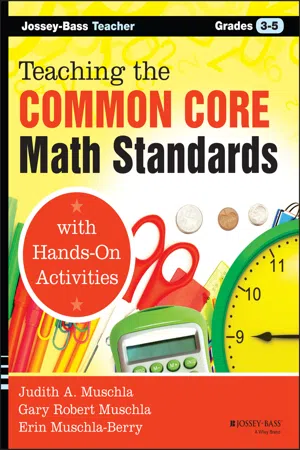
Teaching the Common Core Math Standards with Hands-On Activities, Grades 3-5
eBook - ePub

Teaching the Common Core Math Standards with Hands-On Activities, Grades 3-5

  1. English
  2. ePUB (mobile friendly)
  3. Available on iOS & Android
eBook - ePub

Teaching the Common Core Math Standards with Hands-On Activities, Grades 3-5

About this book

Helping teachers prepare elementary students to master the common core math standards

With the common core math curriculum being adopted by forty-three states, it is imperative that students learn to master those key math standards. Teaching the Common Core Math Standards with Hands-On Activities, Grades 3-5 is the only book currently available that provides activities directly correlated to the new core curriculum for math. This text assists teachers with instructing the material and allows students to practice the concepts through use of the grade-appropriate activities included.

Students learn in different ways, and Teaching the Common Core Math Standards with Hands-On Activities, Grades 3-5 acknowledges that fact through the inclusion of suggestions for variations and extensions of each concept to be used for students with different abilities and learning styles. The activities and lessons are as diverse as the students in your classroom. Inside Teaching with Common Core Math Standards With Hands-On Activities Grades 3-5, you will find:

  • Clear instructions to help you cover the skills and concepts for the new math core curriculum
  • Engaging activities that enforce each core math standard for your students
  • Various suggestions for ways to instruct the concepts to reach the diverse learning styles of your students
  • Complete coverage of mathematical calculations, mathematical reasoning, and problem-solving strategies appropriate for grades 3-5

Teaching the Common Core Math Standards with Hands-On Activities, Grades 3-5 prepares students to achieve success in the important area of mathematics. As your students gain an understanding of the common core standards, they will build confidence in their ability to grasp and manipulate mathematical concepts as they move forward to the next level.

Frequently asked questions

Yes, you can cancel anytime from the Subscription tab in your account settings on the Perlego website. Your subscription will stay active until the end of your current billing period. Learn how to cancel your subscription.
No, books cannot be downloaded as external files, such as PDFs, for use outside of Perlego. However, you can download books within the Perlego app for offline reading on mobile or tablet. Learn more here.
Perlego offers two plans: Essential and Complete
  • Essential is ideal for learners and professionals who enjoy exploring a wide range of subjects. Access the Essential Library with 800,000+ trusted titles and best-sellers across business, personal growth, and the humanities. Includes unlimited reading time and Standard Read Aloud voice.
  • Complete: Perfect for advanced learners and researchers needing full, unrestricted access. Unlock 1.4M+ books across hundreds of subjects, including academic and specialized titles. The Complete Plan also includes advanced features like Premium Read Aloud and Research Assistant.
Both plans are available with monthly, semester, or annual billing cycles.
We are an online textbook subscription service, where you can get access to an entire online library for less than the price of a single book per month. With over 1 million books across 1000+ topics, we’ve got you covered! Learn more here.
Look out for the read-aloud symbol on your next book to see if you can listen to it. The read-aloud tool reads text aloud for you, highlighting the text as it is being read. You can pause it, speed it up and slow it down. Learn more here.
Yes! You can use the Perlego app on both iOS or Android devices to read anytime, anywhere — even offline. Perfect for commutes or when you’re on the go.
Please note we cannot support devices running on iOS 13 and Android 7 or earlier. Learn more about using the app.
Yes, you can access Teaching the Common Core Math Standards with Hands-On Activities, Grades 3-5 by Judith A. Muschla,Gary Robert Muschla,Erin Muschla-Berry in PDF and/or ePUB format, as well as other popular books in Education & Teaching Mathematics. We have over one million books available in our catalogue for you to explore.

Information

Publisher
Jossey-Bass
Year
2014
Print ISBN
9781118710333
eBook ISBN
9781118835524
Edition
1

Section 1

Standards and Activities for Grade 3

Operations and Algebraic Thinking: 3.OA.1

ā€œRepresent and solve problems involving multiplication and division.ā€
1. ā€œInterpret products of whole numbers, e.g., interpret
s01-math-0001
as the total number of objects in 5 groups of 7 objects each.ā€

Background

When items in equal-sized groups are combined, multiplication can be used to find the total number of items. For example, hamburger rolls are sold in packages of 8 rolls. If 3 bags are purchased, you can multiply to find the total number of rolls. Three packages (groups) of 8 rolls can be expressed as
s01-math-0002
The product is 24 rolls. Note also that
s01-math-0003
but in this case there are 8 groups of 3 items per group.
1
Activity: Combining Groups
Working in pairs or groups of three, students will generate ways that groups of items can be represented in real-world situations. They will then draw an illustration of the groups and write a description and a related multiplication sentence.
Materials
Drawing paper; crayons; colored pencils for each pair or group of students.
Procedure
1. Ask your students to think about the ways things are grouped so that each group has the same number of items. Present the example of the hamburger rolls that was provided in the Background section. You may suggest other examples, such as sports (the number of starting players per team), board games (4 cards per person), shopping (6 cupcakes per package), school (5 books per student), and so on. Encourage your students to brainstorm other possible groups.
2. Explain that students are to select an equal-sized group and then decide the number of groups they wish to represent. They are to draw a picture that illustrates their groups. For example, if they chose the packages of hamburger rolls, as noted in the Background section, they would draw 3 packages of hamburger rolls with 8 rolls per package.
3. Explain that after they complete their drawings, they are to write a description of their groups and a multiplication sentence.
Closure
Discuss and display students' drawings, descriptions, and multiplication sentences.

Operations and Algebraic Thinking: 3.OA.2

ā€œRepresent and solve problems involving multiplication and division.ā€
2. ā€œInterpret whole-number quotients of whole numbers, e.g., interpret
s01-math-0004
as the number of objects in each share when 56 objects are partitioned equally into 8 shares, or as a number of shares when 56 objects are partitioned into equal shares of 8 objects each.ā€

Background

Division is the process of separating a quantity into equal groups. It is the inverse (opposite) of multiplication, which is the process of combining equal groups.
1
Activity: Breaking into Groups
Working in pairs or groups of three, students will find the number of groups that can be formed from a class of 30 students. They will represent their groups on graph paper.
Materials
Two to three sheets of graph paper; 30 counters for each pair or group of students.
Procedure
1. Present this situation to your class: Mr. Smith has a class of 30 students. How many different-sized groups can he form?
2. Explain that because Mr. Smith's class has 30 students, 1 counter represents 1 student.
3. Instruct your students to divide their counters into equal groups to represent the students of Mr. Smith's class. They must find how many groups are possible and then sketch the groups on graph paper. Finally, have students write division sentences that represent their sketches.
Closure
Discuss your students' answers.
Answers
1 group of 30; 2 groups of 15; 3 groups of 10; 5 groups of 6; 6 groups of 5; 10 groups of 3; 15 groups of 2; 30 ā€œgroupsā€ of 1

Operations and Algebraic Thinking: 3.OA.3

ā€œRepresent and solve problems involving multiplication and division.ā€
3. ā€œUse multiplication and division within 100 to solve word problems in situations involving equal groups, arrays, and measurement quantities, e.g., by using drawings and equations with a symbol for the unknown number to represent the problem.ā€

Background

Diagrams and equations may be used with the operations of multiplication and division to solve word problems. Letters are commonly used to represent unknown numbers in equations.
1
Activity: It's a Match
Working in groups, students will match word problems with equations, diagrams, and answers.
Ma...

Table of contents

  1. Cover
  2. Title Page
  3. Copyright
  4. Jossey-Bass Teacher
  5. Other Math Books by the Muschlas
  6. About this Book
  7. About the Authors
  8. Acknowledgments
  9. Section 1: Standards and Activities for Grade 3
  10. Section 2: Standards and Activities for Grade 4
  11. Section 3: Standards and Activities for Grade 5
  12. Index