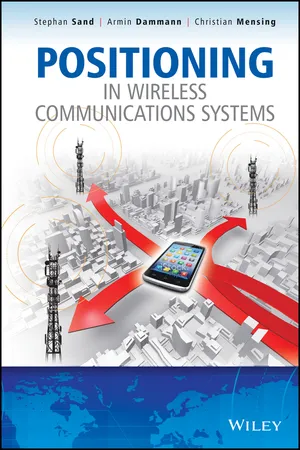
Positioning in Wireless Communications Systems explains the principal differences and similarities of wireless communications systems and navigation systems. It discusses scenarios which are critical for dedicated navigation systems such as the Global Positioning System (GPS) and which motivate the use of positioning based on terrestrial wireless communication systems.
The book introduces approaches for determination of parameters which are dependent on the position of the mobile terminal and also discusses iterative algorithms to estimate and track the position of the mobile terminal. Models for radio propagation and user mobility are important for performance investigations and assessments using computer simulations. Thus, channel and mobility models are explored, especially focussing on critical navigation environments like urban or indoor scenarios.
Positioning in Wireless Communications Systems examines advanced algorithms such as hybrid data fusion of satellite navigation and positioning with wireless communications and cooperative positioning among mobile terminals.. The performance of the discussed positioning techniques are explored on the basis of already existing and operable terrestrial wireless communication systems such as GSM, UMTS, or LTE and it is shown how positioning issues are fixed in respective standards.
Written by industry experts working at the cutting edge of technological development, the authors are well placed to give an excellent view on this topic, enabling in-depth coverage of current developments.
Key features • Unique in its approach to dealing with a heterogeneous system approach, different cell structures and signal proposals for future communications systems • Covers hybrid positioning investigating how GNSS and wireless communications positioning complement each other • Applications and exploitation of positioning information are discussed to show the benefits of including this information in several parts of a wireless communications system
The determination of position is an art that has fascinated scientists for centuries. First positioning methods were probably developed several millennia ago when people realized the necessity of knowing their position for systematic travel. Orientation at natural landmarks such as mountains, rivers, or coastlines are straightforward methods for that purpose. Early man made landmarks were trails and ways that were often built for trading, for example, the famous Silk Road, which has its origins around 500 B.C., and connected Europe and Eastern Asia. Other man made landmarks are lighthouses. They provide orientation in monotonous environments even at night, for example, for ships relatively close to the coastline. On the high seas, however, landmarks are missing. Keeping track of a journey by measuring direction and velocity, called the dead reckoning method, was the straightforward approach used by early ocean navigators. Celestial navigation is another method that utilizes well-known objects as position references. Measuring the angle of the pole star above the horizon directly provides the latitude. The major problem for a long time has been the determination of the longitude directly related to the exact measurement of time due to the Earth's rotation. As the Earth rotates around
each day, a deviation of 4 s in time keeping results in a position error of
that is 1 nautical mile or 1.852 km at the equator. At that time, the longitude problem was so severe that several prizes were offered for the development of more precise longitude determination methods. In 1714 the British government rewarded £10 000 for a method capable of determining the longitude within a range of 60 nm (nautical miles), £15 000 for a deviation of 40 nm and £20 000 for 30 nm during a six week journey to the West Indies. Famous scientists like Isaac Newton and Edmond Halley proposed and promoted the use of astronomic methods, that is, predictable astronomic occurrences, for time determination. The ‘lunar distance’ relative to a fixed star or the ecliptic of Jupiter's moons are such ideas. The invention of chronometers with sufficient accuracy solved the problem and made astronomical methods needless. In 1761 John Harrison's H.4 marine chronometer, constructed in 1759, showed a time deviation of 5 s during a five-week journey to Jamaica. All methods that at least partially rely on visual observations require clear sight. This limits the usability of these methods to certain times of a day or to good weather conditions. The discovery of radio waves in the late nineteenth century opened the door for the field of radio navigation. Radio beacons take the role of man made landmarks. Radio frequency bands provide a propagation range exceeding that of visible light. Dependent on the frequency band, radio waves are able to travel through clouds or fog, or even propagate as ground waves over a long distance. This solved the range problem even for ground based radio navigation systems. Nowadays, satellite navigation systems provide global coverage with accuracy in the range of meters. Some of the positioning principles, however, remain the same as for traditional landmark or celestial navigation. In particular these are angular methods, where the angle of arrival of radio waves are determined. Today, radio navigation is mainly based on radio propagation time measurements, by which the knowledge of propagation speed (speed of light) provides distance measures related to the radio beacons.
The civil availability of accurate satellite navigation together with chip-sets and navigation receivers for consumer applications have formed the basis of a rapidly growing navigation market in recent years. Indicated by this market growth, the availability of position information will play an increasingly important role in current and future mobile information systems. Information about the position of a user or a mobile terminal (MT) can be exploited in a multiplitude of ways. Navigation services for both the consumer and professional market are probably the most well-known applications for positioning systems. Such services can be classified into the following categories:
Positioning: Determining solely the location of a person or object.
Tracking: Monitoring the movement of a person or object.
Navigation: Routing and guidance from an origin to a destination.
These categories are listed regarding increasing usage of auxiliary information and mutual dependency. As an example, tracking requires position determination of a target but usually also incorporates the movement history and a movement prediction of that target in order to achieve a more accurate estimation of...
Table of contents
Cover
Title Page
Copyright
About the Authors
Preface
Acknowledgements
List of Abbreviations
Chapter 1: Introduction
Chapter 2: Positioning Principles
Chapter 3: Measurements and Parameter Extraction
Chapter 4: Position Estimation
Chapter 5: Position Tracking
Chapter 6: Scenarios and Models
Chapter 7: Advanced Positioning Algorithms
Chapter 8: Systems
Chapter 9: Applications
References
Index
End User License Agreement
Trusted by 375,005 students
Access to over 1.5 million titles for a fair monthly price.
Study more efficiently using our study tools.
Frequently asked questions
Yes, you can cancel anytime from the Subscription tab in your account settings on the Perlego website. Your subscription will stay active until the end of your current billing period. Learn how to cancel your subscription
No, books cannot be downloaded as external files, such as PDFs, for use outside of Perlego. However, you can download books within the Perlego app for offline reading on mobile or tablet. Learn how to download books offline
Perlego offers two plans: Essential and Complete
Essential is ideal for learners and professionals who enjoy exploring a wide range of subjects. Access the Essential Library with 800,000+ trusted titles and best-sellers across business, personal growth, and the humanities. Includes unlimited reading time and Standard Read Aloud voice.
Complete: Perfect for advanced learners and researchers needing full, unrestricted access. Unlock 1.5M+ books across hundreds of subjects, including academic and specialized titles. The Complete Plan also includes advanced features like Premium Read Aloud and Research Assistant.
Both plans are available with monthly, semester, or annual billing cycles.
We are an online textbook subscription service, where you can get access to an entire online library for less than the price of a single book per month. With over 1.5 million books across 990+ topics, we’ve got you covered! Learn about our mission
Look out for the read-aloud symbol on your next book to see if you can listen to it. The read-aloud tool reads text aloud for you, highlighting the text as it is being read. You can pause it, speed it up and slow it down. Learn more about Read Aloud
Yes! You can use the Perlego app on both iOS and Android devices to read anytime, anywhere — even offline. Perfect for commutes or when you’re on the go. Please note we cannot support devices running on iOS 13 and Android 7 or earlier. Learn more about using the app
Yes, you can access Positioning in Wireless Communications Systems by Stephan Sand,Armin Dammann,Christian Mensing in PDF and/or ePUB format, as well as other popular books in Technology & Engineering & Mobile & Wireless Communications. We have over 1.5 million books available in our catalogue for you to explore.