The Chemistry of Contrast Agents in Medical Magnetic Resonance Imaging
eBook - ePub

The Chemistry of Contrast Agents in Medical Magnetic Resonance Imaging

  1. English
  2. ePUB (mobile friendly)
  3. Available on iOS & Android
eBook - ePub

The Chemistry of Contrast Agents in Medical Magnetic Resonance Imaging

About this book

Magnetic Resonance Imaging (MRI) is one of the most important tools in clinical diagnostics and biomedical research. The number of MRI scanners operating around the world is estimated to be approximately 20,000, and the development of contrast agents, currently used in about a third of the 50 million clinical MRI examinations performed every year, has largely contributed to this significant achievement.

This completely revised and extended second edition: 

  • Includes new chapters on targeted, responsive, PARACEST and nanoparticle MRI contrast agents.
  • Covers the basic chemistries, MR physics and the most important techniques used by chemists in the characterization of MRI agents from every angle from synthesis to safety considerations.
  • Is written for all of those involved in the development and application of contrast agents in MRI.
  • Presented in colour, it provides readers with true representation and easy interpretation of the images. 

A word from the Authors:

Twelve years after the first edition published, we are convinced that the chemistry of MRI agents has a bright future. By assembling all important information on the design principles and functioning of magnetic resonance imaging probes, this book intends to be a useful tool for both experts and newcomers in the field. We hope that it helps inspire further work in order to create more efficient and specific imaging probes that will allow materializing the dream of seeing even deeper and better inside the living organisms.

Reviews of the First Edition:

"...attempts, for the first time, to review the whole spectrum of involved chemical disciplines in this technique..."—Journal of the American Chemical Society

"...well balanced in its scope and attention to detail...a valuable addition to the library of MR scientists..."—NMR in Biomedicine

Frequently asked questions

Yes, you can cancel anytime from the Subscription tab in your account settings on the Perlego website. Your subscription will stay active until the end of your current billing period. Learn how to cancel your subscription.
No, books cannot be downloaded as external files, such as PDFs, for use outside of Perlego. However, you can download books within the Perlego app for offline reading on mobile or tablet. Learn more here.
Perlego offers two plans: Essential and Complete
  • Essential is ideal for learners and professionals who enjoy exploring a wide range of subjects. Access the Essential Library with 800,000+ trusted titles and best-sellers across business, personal growth, and the humanities. Includes unlimited reading time and Standard Read Aloud voice.
  • Complete: Perfect for advanced learners and researchers needing full, unrestricted access. Unlock 1.4M+ books across hundreds of subjects, including academic and specialized titles. The Complete Plan also includes advanced features like Premium Read Aloud and Research Assistant.
Both plans are available with monthly, semester, or annual billing cycles.
We are an online textbook subscription service, where you can get access to an entire online library for less than the price of a single book per month. With over 1 million books across 1000+ topics, we’ve got you covered! Learn more here.
Look out for the read-aloud symbol on your next book to see if you can listen to it. The read-aloud tool reads text aloud for you, highlighting the text as it is being read. You can pause it, speed it up and slow it down. Learn more here.
Yes! You can use the Perlego app on both iOS or Android devices to read anytime, anywhere — even offline. Perfect for commutes or when you’re on the go.
Please note we cannot support devices running on iOS 13 and Android 7 or earlier. Learn more about using the app.
Yes, you can access The Chemistry of Contrast Agents in Medical Magnetic Resonance Imaging by Andre S. Merbach,Lothar Helm,Éva Tóth in PDF and/or ePUB format, as well as other popular books in Physical Sciences & Spectroscopy & Spectrum Analysis. We have over one million books available in our catalogue for you to explore.

Information

Chapter 1

General Principles of MRI

Bich-Thuy Doan,1 Sandra Meme,2 and Jean-Claude Beloeil3
1CNRS, Chimie-Paristech, Université Paris Descartes, Paris, France
2Centre de Biophysique Moléculaire, CNRS, Orléans, France

1.1 Introduction

Magnetic Resonance Imaging (MRI) derives directly from the phenomenon of Nuclear Magnetic Resonance (NMR [1–4]), which is widely used by chemists to determine molecular structure. The word “nuclear” was dropped in the switch to imaging to avoid alarming patients as NMR has nothing to do with radioactivity. This book is intended mainly for chemists, who are generally familiar with the NMR spectra. After a brief overview of the technique explaining the notion of relaxation time and saturation transfer used in MRI, we will describe localization techniques, which are less well-known in chemistry. The purpose of this short chapter is not to provide a complete theory of MRI [5–8], but to understand the rest of the book concerning the action of contrast agents. We will not go into the theoretical background of the phenomena, and while it is important to have some understanding of quantum mechanics, it is not our purpose to develop this aspect. This is a “nuts and bolts” description of MRI. Whenever possible, we refer to chemists' knowledge of NMR (for example, “2D NMR”).

1.2 Theoretical basis of NMR

1.2.1 Short description of NMR

In most cases, MRI focuses on one type of atomic nucleus, that of hydrogen in H2O. We will therefore only use this nucleus, termed the “1H proton.”
The physical phenomenon of NMR lies at the boundary between “conventional” and “quantum” treatment due to the small transition energies involved. Traditionally, the 1H proton can be considered as a charged sphere rotating with a magnetic moment and collinear angular momentum (in quantum mechanics, these two entities are quantified as magnetic quantum number and spin quantum number (or spin)). Like a spinning top precessing in the Earth's gravitational field, the nucleus 1H precesses in the static magnetic field B0 of the spectrometer magnet. This precession will occur at a frequency (ν0) dictated by the nature of the nucleus and the strength of the magnetic field of the magnet (ν0 = −(γ/2π)B0) (Larmor frequency). There are two possible precessions (parallel and antiparallel to B0) corresponding to two energy states in the presence of a strong magnetic field. According to the Boltzmann equation, there are more 1H protons in the lower level (parallel to B0) than in the upper level. There will be total magnetization (M0) of the sample, parallel to B0 (by definition, the z axis) (Figure 1.1). The whole process of obtaining a spectrum is summarized in Figure 1.1.
Figure 1.1 NMR experiment: (a) net magnetization M0 at equilibrium when the spins are placed in a permanent magnetic field B0; (b) a radio frequency (RF) pulse, induced by a perpendicular B1 magnetic field created by an RF coil, flips the magnetization into the xy plane; (c) the magnetization M precesses around the z axis and the signal decreases in the xy plane; for example, the magnetization is recorded from the y axis and converted by an analog-to-digital converter to an FID (Free Induction Decay); (d) FID: the recorded signal is a damped sinusoid; (e) NMR spectrum produced by a Fourier transform.
c1f001
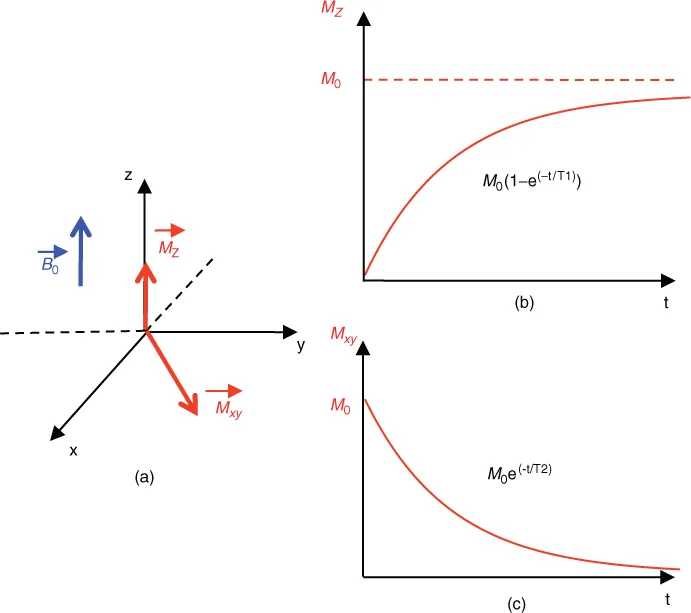
In an NMR experiment, the sample is subjected to the action of an oscillating electromagnetic field (B1) (frequency: ν1) perpendicular to B0 (Figure 1.1); if we place ourselves within a rotating frame around the z axis at frequency ν11 close to ν0), it is as if the magnetization M0 precesses around the magnetic field B1, which is stationary within this frame. The duration of the B1 field (pulse) is calculated for a M0 tilt of 90°, or, more generally, of a flip angle α. At the end of the RF pulse, the system then returns to equilibrium, the magnetization in the xy plane decreases exponentially with time constant T2, and the magnetization rises exponentially on axis z with a time constant T1 (T2 < T1) (Figure 1.2). If we put a receiver coil in the xy plane, an electric current is induced in the coil and a signal is obtained after analog/digital conversion into a damped sinusoid called Free Induction Decay (FID).
Figure 1.2 (a) Return to equilibrium of the magnetization, (b) return to equilibrium on the z axis: (Mz = M0 (1-exp−t/T1)), (c) return to equilibrium in the xy plane (My = M0 exp−t/T2).
c1f002
This signal corresponds to a temporal frequency. The Fourier transform (FT) of this signal (Figure 1.1) provides a spectrum of frequencies contained in the signal; in this case just one because we are only interested in H2O. The signal intensity is proportional to the quantity of 1H protons and therefore the amount of H2O in the sample. In NMR, it is observed that we have a temporal frequency (FID) and that the FID and spectrum are a Fourier pair (Scheme 1.1).
Scheme 1.1
c1f003

1.2.2 Relaxation times

Unlike other spectroscopic techniques, the energy difference between the excited state and steady state is too low to allow spontaneous relaxation, and therefore relaxation needs to be stimulated. The longitudinal relaxation time T1 (Figure 1.2b) is characteristic of the return to equilibrium of the magnetization (Figure 1.2a) along z (Mz = M0 (1−e−t/T1)); this phenomenon corresponds to the enthalpic interaction of the excited nucleus with its environment, and in particular with the magnetic active agents of this environment (1H protons, unpaired electrons e). The movement of nuclear magnetic moments of other molecules (or unpaired e) creates a distribution of frequencies within which one can find the resonance frequency of the excited nucleus, and a stimulated relaxation may then occur. Therefore, for this mechanism to work, there must be a movement of the molecules (Brownian motion). T1 relaxation time will depend on the mobility of these entities and therefore on the viscosity of the environment.
The T2 transversal relaxation time is characteristic of the disappearance of the signal in the xy plane (Figure 1.2c). It is an entropy phenomenon that corresponds to spin dephasing in the xy plane. T2 is always below T1. A parameter often used in MRI is the relaxation time T2*, which contains both T2 and the contribution of all magnetic field inhomogeneities and therefore those that are characteristic of the sample. T2* is thus linked to specific properties of the tissue under study and is very useful in medical MRI.

1.2.3 Saturation transfer

The saturation phenomenon is used in NMR to identify hydrogens in conformational or chemical exchange. It is easy to obtain saturati...
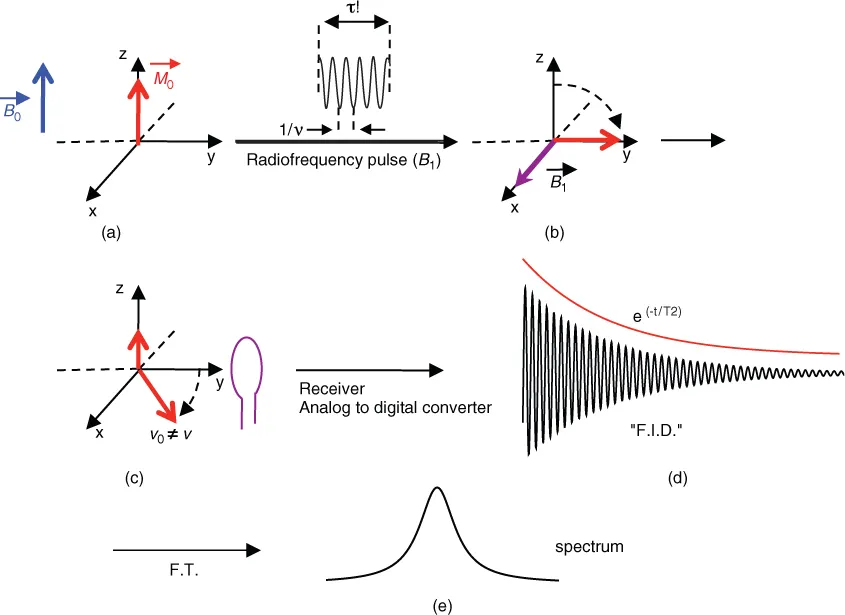
Table of contents

  1. Cover
  2. Title Page
  3. Copyright
  4. List of Contributors
  5. Preface
  6. Chapter 1: General Principles of MRI
  7. Chapter 2: Relaxivity of Gadolinium(III) Complexes: Theory and Mechanism
  8. Chapter 3: Synthesis and Characterization of Ligands and their Gadolinium(III) Complexes
  9. Chapter 4: Stability and Toxicity of Contrast Agents
  10. Chapter 5: Structure, Dynamics, and Computational Studies of Lanthanide-Based Contrast Agents
  11. Chapter 6: Electronic Spin Relaxation and Outer-Sphere Dynamics of Gadolinium-Based Contrast Agents
  12. Chapter 7: Targeted MRI Contrast Agents
  13. Chapter 8: Responsive Probes
  14. Chapter 9: Paramagnetic CEST MRI Contrast Agents
  15. Chapter 10: Superparamagnetic Iron Oxide Nanoparticles for MRI
  16. Chapter 11: Gd-Containing Nanoparticles as MRI Contrast Agents
  17. Index