Cultural Change and Leadership in Organizations discusses ways in which organizations are able to implement successful strategic change; inspirational and conceptual material is combined with practical examples and concrete interventions for planning and implementing cultural change within organizations. Cultural Change and Leadership in Organizations is targeted toward professionals, including organizational psychologists, consultants, senior managers, and human resources professionals, as well as advanced-level business school courses.
eBook - ePub
Cultural Change and Leadership in Organizations
A Practical Guide to Successful Organizational Change
- English
- ePUB (mobile friendly)
- Available on iOS & Android
eBook - ePub
Cultural Change and Leadership in Organizations
A Practical Guide to Successful Organizational Change
About this book
Information
Part 1
Cultural Change in Organizations
Introduction
Essence of this Part
This part describes how successful businesses regard their organizational culture and the motives for them to change their culture. Many businesses regard culture as the identity of their organizations. This view of culture that developed 30 years ago still has value today. Businesses also see culture as a learning process. In recent years, there is also awareness for differentiated cultural values as a source of conflict. These tensions between existing cultural values may be a source for renewal and innovation. This new perspective regards conflict as a source of radical renewal. The culture of organizations is inextricably connected to the strategy, structure and systems of the organizations. More than ever, the meaning for customers is the key element. Leaders who choose for strategic and cultural change in organizations choose a change process in which the values for customers, employees and external partners are increasingly clear. Leaders play an essential role in this process of value creation and giving of meaning.
This part is interesting because it sheds light on different ways of looking at organizational culture. This multiple view helps leaders, managers and employees to choose how they want to work on their own organizational culture. The thinking about cultural change in organizations has changed over the past 50 years, and this too is discussed here. And finally, this part is worthwhile because it describes eight reasons for cultural change encountered in the nineteen organizations that participated in the study on which this book is based. It shows that a crisis situation is not a prerequisite for cultural change, as is often claimed.
Structure of this Part
Chapter 1 presents a brief description of how thinking about organizational culture and cultural change has changed in 50 years. In this chapter, I describe organizational culture from five perspectives. Culture as the identity of the organization, as a learning process, as source of conflict, as value creation for customers and as business idea for the organization. The most recent view is that organizational culture is connected inextricably to everything that an organization stands by and goes for. Chapter 2 gives eight reasons for organizations to get to work on their organizational culture. These eight reasons are linked together and form related trajectories for cultural change in organizations. In all successful businesses, an increase in customer value is linked to cultural change.
This first part is an orientation in existing theories about organizational culture and takes thinking about changing organizational culture a step forward. The subsequent parts deal with choosing a suitable approach to change, the role of leaders in cultural change and interventions for cultural change. These parts provide practical handholds for changing the culture of organizations.
1
Perspectives on Organizational Cultures
In this chapter I lay the foundation for the subsequent parts that examine how leaders in organizations work on successful cultural change. Thinking about organizational culture is not new. We can discern four periods in the way we think about organizational culture. In the 1950s, culture in organizations was discovered. In the following decades, much effort was subsequently put into identifying and understanding the culture of organizations. During this period, culture was a phenomenon you could use to explain why organizations found it difficult to change. In the 1980s, it was about the issue of whether managers could make use of the company culture to gain a competitive advantage. The results of that endeavour were meagre. Twenty years further on, businesses renewed their interest in organizational culture. The question then was how leaders could contribute to a culture that tied in with the mission and the meaning of the organization. Culture was no longer isolated as a separate phenomenon nor was it any longer an instrument of management. Culture is inextricably connected to everything that an organization stands by and goes for. This brings culture into the picture as a point of special attention for leaders who want to qualify their company for the future.
Developments in Thinking about Organizational Cultures
The German economist and sociologist Max Weber1 wanted to understand social conduct in organizations. In 1920, he already opposed the arbitrariness and abuse of power that was common in factories and offices at that time. He formulated three core values against these situations of abuse: legal equality, legal certainty and justice. He exposed actions that adhered to tradition and entrenched habits, and formulated new values that were intended to be guiding. He also translated these new values into concrete behaviour. The rules for behaviour especially became well known and criticized in later times. Bureaucracy is discussed derisively, but often people forget that the rules for bureaucratic organizations were drawn up in a time of feudal labour relations with exploitation and arbitrariness. For that matter, Weber proposed an organization based on fairness, and he was also the first person to warn about the drawback of rationalization pushed to extremes because it would imprison people in an iron cage of rules and control. In the same period, Henri Fayol2 emphasized the importance of unity of direction and “esprit de corps”. In an organization, everybody has to aim at the same target and good team spirit is conducive to harmony and solidarity, and essential for reaching those goals. Barnard,3 too, emphasized the enterprise as a cooperative system. He was the first to write about the organization as a personality that employees can identify with. Barnard was an entrepreneur and manager himself, and he tried to use community spirit to improve the collaboration between managers and employees and prevent conflicts.
In the 1950s, Elliot Jacques4 studied organizations as cultural units. He showed that values give guidance to behaviour in organizations and that those values are not directly related to the technical production process itself. He also made evident that a social system can withstand changes due to subconscious fear patterns and group dynamics. In the 1960s, Karl Weick5 presented his vision of organizations that made clear that the organizational culture consists not only of a set of material conditions and events that he could map out objectively but is constructed from interactions in which people give meaning to events. This creates pictures of reality that guide behaviour. From the 1980s, there was suddenly a lot of attention for the culture in organizations. Andrew Pettigrew6 proposed that myths, symbols, rituals and language are practical and useful for analyzing and understanding an organization. His research showed that an organization can have several sub-cultures that are connected to the position in the organization, the professional background of people or the nature of the work. In one of the first studies into the culture of organizations, Deal and Kennedy represented the organizational culture as a layered model. The culture is formed in the history and gains meaning and is visible in the daily work practice and the entrenched patterns: “This is the way things get done around here” (Figure 1.1).
Figure 1.1 Organizational culture as a layered model. (Source: Based on Deal and Kennedy7.)
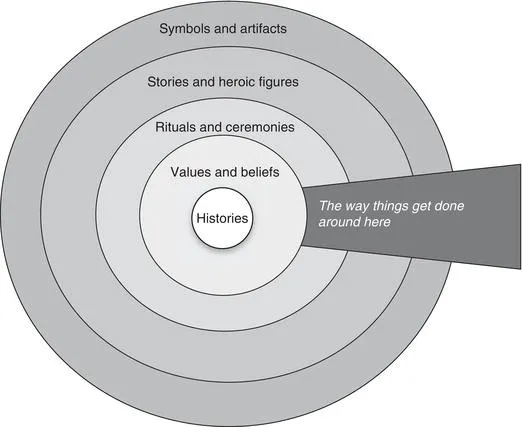
In this cultural model, the core of a company culture is formed by the history in which all kinds of convictions and core values arose in the survival of a community. A core value is something that people see as a generally positive characteristic of their behaviour. Many values are already made at an early age and are therefore usually implicit. The third ring concerns rituals and ceremonies. This involves collective activities that have an individual meaning, such as drinking coffee together at the start of the day or giving praise for good performance. These rituals result in entrenched patterns that people are scarcely aware of. These rituals and entrenched patterns are often fostered by heroes and the stories that circulate in the organization. The heroes are the role models imitated by others. Directors can be role models, as can the founders of family businesses, but successful colleagues can be role models too. The outermost ring of the model consists of symbols and artefacts. They include specific use of words, company style and external characteristics such as clothing. The values, rituals, heroes and symbols gain meaning in the daily work practice.
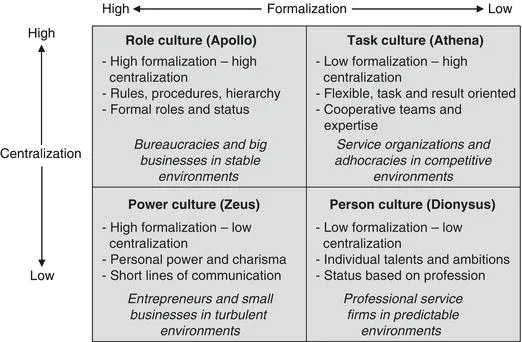
In the 1980s, Harrison,8 Handy,9 and Deal and Kennedy7 provided profiles of organizational cultures. The studies have an anthropological nature. The studies concern discovering and describing the organizational culture as an element of an organization. You can understand organizations better if you also examine the culture in them. It is not only about diagnosing the production technique, the working methods, the structure and the strategy but also about forms of conduct and work practices. The profiles of organizational cultures help in the diagnosis of the cultural characteristics of a specific organization and enable us to explain apparently irrational behaviour. The profiles are also used to reflect on the existing and desired culture and work out which transition is possible (Figure 1.2).
Handy states that every organization has certain values and follows some policies and guidelines, which differentiate it from others. The principles and beliefs of any organization form its culture. The organization culture decides the way employees interact amongst themselves as well as external parties. In the power culture only a few people are authorized to take decisions. These individuals further delegate responsibilities to the other employees. In this kind of culture the employees do have limited liberty to express their views or share their ideas and have to follow what their superior says. In a task culture, teams are formed to achieve the targets or solve critical problems. In such organizations individuals with common interests and specializations come together and contribute equally and accomplish tasks in the most innovative way. In a person culture, individuals are more concerned about their own roles and ambitions rather than the organization. Employees are interested in each other and develop professional friendships to achieve personal goals. Role culture is a culture where every employee is delegated roles and responsibilities according to his specialization, educational qualification and interest to extract the best out of him. In such a culture employees decide what best they can do and willingly accept challenges.
A breakthrough in thinking about organizational culture came in 1982 with the book In Search of Excellence by Peters and Waterman.10 In a period of economic downturn in which some companies came off badly while others survived, their book was a real eye-opener. Peters and Waterman saw culture as a separate part of the organization. It is the managers’ task to shape the culture and bend it in the right direction. They ascribe the success of businesses to eight success factors:
- Listening to the wishes of the customer and tailored marketing
- Orientation towards action and focus on executing plans
- Entrepreneurship in the entire organization by delegating responsibilities
- Strengthening people’s productivity through financial and symbolic rewards
- Every man to his trade and building further on one’s own competencies
- Simple structure with maximum autonomy for employees
- Room for initiative inside values and norms that are kept firmly in hand
- Fundamental values that are disseminated by management.
Figure 1.2 Four culture profiles for organizational culture. (Source: Based on Harrison8 and Handy9.)
A specific line of approach to culture involves the differences between company cultures in different countries. Geert Hofstede became known for his research into national differences in organizational culture. Hofstede11 distinguished between five dimensions in which the culture of organizations can differ internationally. He showed that national and regional cultures influence the behaviour of people in organizations. This behaviour and the daily practices form the ways that people deal with each other within organizations. His observations are useful for international collaboration and mergers between companies from different countries (Table 1.1).
Table 1.1 Dimensions of national cultures.
Source: Based on Hofstede11,12.
| Power distance | The extent to which the less powerful members of organizations and institutions accept and expect that power is distributed unequally. Cultures that endorse low-power distance expect and accept power relations that are more consultative or democratic. People relate to one another more as equals regardless of formal positions. In high-power distance countries, less powerful accept power relations that are more autocratic and paternalistic. Subordinates acknowledge the power of others simply based on where they are situated in certain formal, hierarchical positions |
| Uncertainty | The extent to which members of a society attempt to cope with anxiety by minimizing uncertainty. People in cultures with high uncertainty avoidance tend to minimize t... |
Table of contents
- Cover
- Title page
- Copyright page
- Dedication
- About the Author
- Preface
- Introduction
- Part 1: Cultural Change in Organizations
- Part 2: Strategies for Cultural Change
- Part 3: Organizational Culture and Leadership
- Part 4: Interventions for Cultural Change
- Part 5: Successful Cultural Change in Organizations
- Bibliography
- Index
Trusted by 375,005 students
Access to over 1.5 million titles for a fair monthly price.
Study more efficiently using our study tools.
Frequently asked questions
Yes, you can cancel anytime from the Subscription tab in your account settings on the Perlego website. Your subscription will stay active until the end of your current billing period. Learn how to cancel your subscription
No, books cannot be downloaded as external files, such as PDFs, for use outside of Perlego. However, you can download books within the Perlego app for offline reading on mobile or tablet. Learn how to download books offline
Perlego offers two plans: Essential and Complete
- Essential is ideal for learners and professionals who enjoy exploring a wide range of subjects. Access the Essential Library with 800,000+ trusted titles and best-sellers across business, personal growth, and the humanities. Includes unlimited reading time and Standard Read Aloud voice.
- Complete: Perfect for advanced learners and researchers needing full, unrestricted access. Unlock 1.5M+ books across hundreds of subjects, including academic and specialized titles. The Complete Plan also includes advanced features like Premium Read Aloud and Research Assistant.
We are an online textbook subscription service, where you can get access to an entire online library for less than the price of a single book per month. With over 1.5 million books across 990+ topics, we’ve got you covered! Learn about our mission
Look out for the read-aloud symbol on your next book to see if you can listen to it. The read-aloud tool reads text aloud for you, highlighting the text as it is being read. You can pause it, speed it up and slow it down. Learn more about Read Aloud
Yes! You can use the Perlego app on both iOS and Android devices to read anytime, anywhere — even offline. Perfect for commutes or when you’re on the go.
Please note we cannot support devices running on iOS 13 and Android 7 or earlier. Learn more about using the app
Please note we cannot support devices running on iOS 13 and Android 7 or earlier. Learn more about using the app
Yes, you can access Cultural Change and Leadership in Organizations by Jaap J. Boonstra in PDF and/or ePUB format, as well as other popular books in Psychology & Industrial & Organizational Psychology. We have over 1.5 million books available in our catalogue for you to explore.