Beginning from first principles and adopting a modular structure, this book develops the fundamental physical methods needed to describe and understand a wide range of seemingly very diverse astrophysical phenomena and processes. For example, the discussion of radiation processes including their spectra is based on Larmor's equation and extended by the photon picture and the internal dynamics of radiating quantum systems, leading to the shapes of spectral lines and the ideas of radiation transport. Hydrodynamics begins with the concept of phase-space distribution functions and Boltzmann's equation and develops ideal, viscous and magneto-hydrodynamics all from the vanishing divergence of an energy-momentum tensor, opening a natural extension towards relativistic hydrodynamics. Linear stability analysis is introduced and used as a common and versatile tool throughout the book. Aimed at students at graduate level, lecturers teaching courses in theoretical astrophysics or advanced topics in modern astronomy, this book with its abundant examples and exercises also serves as a reference and an entry point for more advanced researchers wanting to update their knowledge of the physical processes that govern the behavior and evolution of astronomical objects.
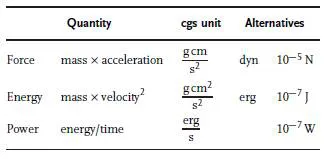
We use Gaussian centimetre-gram-second (cgs) units throughout. Lengths are measured in centimetres, masses in grams and time in seconds. The derived units of force, energy and power are listed in Table 1.1. Temperatures are unvariedly measured in Kelvin (K).
The main reason for using these rather than SI units is they allow electromagnetic relations to be expressed in a much easier way, as we shall now discuss.
1.1.2 Charges and Electromagnetic Fields
The unit of charge is chosen such that the Coulomb force between two charges q separated by the distance r is
(1.1)
Table 1.1 The units of force, energy and power are listed here in the cgs system together with their relations to SI units.
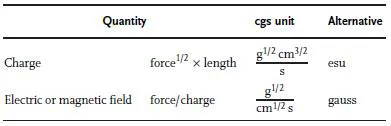
Table 1.2 This table lists the units of charge, electric and magnetic field in the Gaussian cgs system, their physical dimensions, and alternative units.
With this choice, the dielectric constant of the vacuum,
, becomes dimensionless and unity. Electric and magnetic fields are defined to have the same unit. This is most sensible in view of the fact that they are both related, and can be converted into each other, by Lorentz transforms. Their unit is chosen such that the force caused by an electric field E on a charge q is
(1.2)
This implies that charge, electric and magnetic fields must have the units given in Table 1.2. The squared electric or magnetic field strengths then have the dimension of an energy density.
By definition, the units of charge in the SI and the Gaussian cgs systems are related by
(1.3)
Electrostatic potential differences, or electrostatic potential energy changes per unit charge, are measured in volts in SI units. Consequently, we must have
(1.4)
The energy gained by a unit charge moving through an electrostatic potential difference of 1Volt, defined as the electron volt, must then be
(1.5)
1.1.3 Natural Constants
The most frequently used natural constants in cgs units are tabulated in Table 1.3.
1.2 Lorentz Invariance
This section summarises the concepts of special relativity and their consequences for the structure of space-time and for the dynamics of a particle. Its most important resultsare the relativistic time dilation (1.32) and the Lorentz contraction (1.36), the addition theorem for velocities (1.38) and the transformation of angles (1.41), the combination of energy and momentum into the momentum four vector (1.59) and the relativistic relations (1.62) and (1.63) between energy, momentum and velocity.
Table 1.3 The most frequently used natural constants are tabulated here with their common symbols and their values in cgs units. The values are taken from the Particle Data Group (http://pdg.lbl.gov/, last accessed 25 September 2012).
Quantity
Symbol
Value in cgs units
Light speed
c
2.9979 × 10¹⁰
Elementary charge
e
4.8032 × 10⁻¹⁰
Electron mass
me
9.1094 × 10⁻²⁸
Proton mass
mp
1.6726 × 10⁻²⁴
Boltzmann’s constant
kB
1.3806 × 10⁻¹⁶
Newton’s constant
G
6.6738 × 10⁻⁸
Planck’s constant
ħ
1.0546 × 10⁻²⁷
Perhaps it is helpful to begin with the statement that classical physics aims to quantify the behaviour of physical entities in space with time. Point mechanics, for example, studies the trajectories of particles with negligible extension. A trajectory can be quantified by a vector-valued function
which assigns a spatial vector
to any instant t from a finite or infinite time interval. Field theory describes forces as the effect of fields, which are functions of space and time obeying their own dynamics. Immediately, we are led to the question of how we want to identify points in space and instants in time in a quantifiable manner.
This is achieved by a refer...
Table of contents
Cover
Contents
Related Titles
Title Page
The Author
Copyright
Preface
Acknowledgements
1 Theoretical Foundations
2 Radiation Processes
3 Hydrodynamics
4 Fundamentals of Plasma Physics and Magneto-Hydrodynamics
5 Stellar Dynamics
6 Brief Summary and Concluding Remarks
Index
Trusted by 375,005 students
Access to over 1.5 million titles for a fair monthly price.
Study more efficiently using our study tools.
Frequently asked questions
Yes, you can cancel anytime from the Subscription tab in your account settings on the Perlego website. Your subscription will stay active until the end of your current billing period. Learn how to cancel your subscription
No, books cannot be downloaded as external files, such as PDFs, for use outside of Perlego. However, you can download books within the Perlego app for offline reading on mobile or tablet. Learn how to download books offline
Perlego offers two plans: Essential and Complete
Essential is ideal for learners and professionals who enjoy exploring a wide range of subjects. Access the Essential Library with 800,000+ trusted titles and best-sellers across business, personal growth, and the humanities. Includes unlimited reading time and Standard Read Aloud voice.
Complete: Perfect for advanced learners and researchers needing full, unrestricted access. Unlock 1.5M+ books across hundreds of subjects, including academic and specialized titles. The Complete Plan also includes advanced features like Premium Read Aloud and Research Assistant.
Both plans are available with monthly, semester, or annual billing cycles.
We are an online textbook subscription service, where you can get access to an entire online library for less than the price of a single book per month. With over 1.5 million books across 990+ topics, we’ve got you covered! Learn about our mission
Look out for the read-aloud symbol on your next book to see if you can listen to it. The read-aloud tool reads text aloud for you, highlighting the text as it is being read. You can pause it, speed it up and slow it down. Learn more about Read Aloud
Yes! You can use the Perlego app on both iOS and Android devices to read anytime, anywhere — even offline. Perfect for commutes or when you’re on the go. Please note we cannot support devices running on iOS 13 and Android 7 or earlier. Learn more about using the app
Yes, you can access Theoretical Astrophysics by Matthias Bartelmann in PDF and/or ePUB format, as well as other popular books in Physical Sciences & Astronomy & Astrophysics. We have over 1.5 million books available in our catalogue for you to explore.