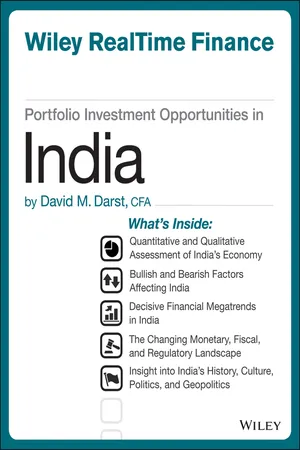
This e-book only investment report will detail India's asset classes, its investment strategies, risks and advantages, and politics and cultural history with an eye toward serving investment advisors and asset managers looking for up-to-date investment knowledge on specific alternative asset classes.
- English
- ePUB (mobile friendly)
- Available on iOS & Android
eBook - ePub
Portfolio Investment Opportunities in India
Section 1
India at a Glance
After the government of Jawaharlal Nehru (1889–1964) formed the first Planning Commission in 1950 in an attempt to efficiently allocate resources to various sectors of the economy, Indian real GDP grew at an annual rate of 3.5 percent through 1980; a relatively modest level of growth for an emerging economy, it would unfairly become known as the “Hindu rate of growth.”
Coming to power in 1984 after Indira Gandhi’s assassination, Rajiv Gandhi (1944–1991) accelerated reforms initiated by his mother, including measures to reduce the industrial-licensing system known as the “License Raj,” a reduction in tariffs on imports, and a reduction in corporate taxes and income taxes. While Gandhi’s efforts to spur reform were seen as a positive step, the reforms did not fundamentally alter the status quo of the Indian economy, known as a “Caged Tiger,” built upon the ideals of Fabian socialism.
In the late 1980s, an increase in external debt from 10 to 15 percent of Gross National Income (GNI) to 20 to 25 percent of GNI, combined with persistent and rising government fiscal and current account deficits, led to a balance of payments crisis, which left India dangerously short of foreign exchange reserves and at risk of default on its short-term debt obligations. After the June 1991 election of the Congress Party’s Narasimha Rao (1921–2004), the third government in 18 months, the crisis was stemmed following a double devaluation of the rupee and the emergency airlift of 47 tonnes of gold to be held as collateral at the Bank of England in order for India to raise $600 million.
Rao’s finance minister, Manmohan Singh (born in 1930), quickly pushed India toward a more market-based economy by introducing a wide array of economic reforms, including: virtually eliminating the “License Raj”; reducing tariffs on imports; allowing a greater level of foreign direct investment; loosening foreign-exchange controls; lowering income taxes; decreasing public expenditures; and reducing India’s fiscal deficit.
As the reform process continued, Indian real GDP grew at a rate of 6.4 percent through the remainder of the 1990s and at an accelerated rate of 7.2 percent during the 2000–2010 period.
Post-2010 Developments
As of late-2013, India’s GDP growth rate had decelerated, as India experienced an unsupportive growth mix of high fiscal deficits and declining private investment since the credit crisis of 2008 and a slowed pace of economic reform amid political gridlock. As of late-2013, Morgan Stanley & Co. Research estimated that India’s real GDP growth in 2013 and 2014 would be approximately +5.1 percent and +6.1 percent, respectively.
In August 2012, with the Indian economy in the midst of a period of slowing growth, Prime Minister Manmohan Singh reiterated his commitment to overcoming the lack of political consensus on reforms that would “increase the pace of economic growth, take steps to encourage new investment, and improve the management of Government finances.”
In September 2012, PM Singh defended the government’s decisions during the month to reduce government subsidies by hiking diesel prices and to reinitiate efforts to further open India’s fragmented retail sector to greater foreign direct investment, potentially opening the Indian market to certain global multibrand retailers.
The Indian Subcontinent
The Indian subcontinent represents a peninsular landmass of the Asian continent occupying the Indian Plate and extending into the Indian Ocean, bordered on the north by the Eurasian Plate. The region is known as a subcontinent because its geography and geology are distinct from the rest of the Asian continent.
The Indian subcontinent consists of four countries: Pakistan, Bangladesh, India, and Sri Lanka. The subcontinent is surrounded by three bodies of water: the Bay of Bengal, the Indian Ocean, and the Arabian Sea. Historically, the Indian subcontinent was known as Bharat in ancient (pre-1000 C.E.) times and Hindustan (Persian for “Land of the Hindus”) in medieval times, following the presence of the Mughals. The region came to be known as British India, or simply India, during the British Raj period.
Until the end of the nineteenth century, the Indian subcontinent along with Southeast Asia was collectively known as the East Indies by European colonists and traders. The Indian subcontinent was referred to as Hither India (India Citerior) while Southeast Asia was known as Further India (India Ulterior).
India’s Political System
As of late-2013, India was composed of 28 states and 7 union territories, the latter of which are ruled directly by the national government rather than by a state legislature.
Topography of India
India contains a veritable kaleidoscope of terrains. Its overall area encompasses just over one million square miles, yet the country offers a rich topographical diversity of varied climatic and ecological zones. The country possesses the highest snowbound mountain range in the world, the Himalayas to the north; the wettest spot on the planet, the Garo Hills of Meghalaya on the east coast; humid tropical forests in the southwest; the fertile Brahmaputra valley in the center; the low-lying mangrove swamps of the Sunderbans; and the Thar Desert with its ambient sand dunes toward the west.
India’s terrain underscores its mystic and ethereal qualities, as prehistoric crystalline rocks and lava created plateaus and rivers that flow through the uneven western lands, forming picturesque lagoons and backwaters, and traversing cliffs and coastal vistas, all of which set a tantalizing backdrop for the aspirations and development of human society.
Sanskrit and the Languages of India
Sanskrit is the oldest language in the world. The word Sanskrit literally means “perfected language” or “language brought to formal perfection.” The Sanskrit alphabet is called devanagari and literally means “cities of the gods.”
As of late-2013, the Indian constitution recognized 22 official languages, and the Indian census recorded over 200 different mother tongues.
States whose boundaries are based on languages include: Kerala for Mayalam speakers, Tamil Nadu for Tamil speakers, Karnataka for Kannada speakers, Andhra Pradesh for Telegu speakers, Maharashtra for Marathi speakers, Orissa for Oriya speakers, West Bengal for Bengali speakers, Gujarat for Gujarati speakers, Punjab for Punjabi speakers, and Assam for Assamese speakers.
India’s Kingdoms and Empires
Although isolated from the rest of Asia by oceans on three sides and mountain ranges to the north, India has experienced a near-constant influx of differing cultural influences, entering primarily via the far northwest. As a result, India reflects wide regional diversity in cultures, languages, foods, and customs.
Prehistory (30,000–1200 B.C.)
Paleolithic (primitive stone tools) sites in India are scattered across the Indian subcontinent and date from 30,000 to 10,000 B.C. The earliest Neolithic sites have been dated to 7000 B.C. and represent a transition toward agriculture, the domestication of animals, wheel-thrown pottery, and a more sedentary population. The Nal culture and the Kulli culture of this era were precursors to the Indus Valley civilization, also known as the Harappan culture. The Harappan culture represents the subcontinent’s first attempt at urbanization.
Early History (1200–600 B.C.)
The Vedic culture and its accompanying Vedic texts mark the beginning of Indian history (defined as the beginning of written accounts) and represent the first historical influx of foreign influence, in this case migrants known as Aryans thought to originate from Central Asia. During this Vedic period, the caste structure and the beginnings of the subcontinent’s second and permanent urbanization emerged.
The Rise of States, Kingdoms, and Empires (600 B.C.–1200 A.D.)
As the urbanization of the Ganges River Valley progressed, kingdoms, known as the Mahajanapadas began to form. Magadha, a Mahajanapada based in present-day Bihar, West Bengal, and Bangladesh, launched the subcontinent’s first experiment in imperial administration, the Maurya Empire. While several empires followed, including the Gupta Empire and the Buddhist Pala Empire, the Indian subcontinent was largely characterized by regional kingdoms that waxed and waned, with none attaining the level of the Maurya’s uniform authority throughout the subcontinent until the British Raj.
The Islamic Sultans and Mughals (1200–1800)
Originating from Afghanistan, a Turkish, Afghan, and Arab army founded the Islamic sultanates that introduced Muslim influence throughout the culture of the Indian subcontinent. Another foreign invader, the Mughals, originating from the Central Asian steppes but at the time ruling a kingdom in Afghanistan, reinforced this Muslim influence, and the fusion of cultures occurring during this period was physically manifested through original styles of art and architecture.
Arrival of the European Traders (1500–1947)
Portuguese, English, French, and Dutch traders arrived on the Indian subcontinent to capitalize on the trade in spices already traversing the Arabian Sea and Indian Ocean. This trade grew to include other raw materials and eventually, the European powers expanded from their trading “factories” to acquire land and revenue rights. The British Crown maneuvered to become the dominant European presence and subsequently came to govern the entire Indian subcontinent.
Post-Independence India (1947–Present)
After a decades-long effort notably marked by Mahatma Gandhi’s nonviolent and civil disobedience demonstrations, the independent nation of India was born as the world’s largest democracy.
India’s Cultural Development
Bronze Age: Mature Harappan Culture (2600–1500 B.C.)
Centered around the two cities of Mohenjo-Daro and Harappa in the present-day provinces in Pakistan of Sindh and Punjab, respectively, the Harappan culture extended its influence to cover an extensive region, with sites as far North as Shortugai in the Pamirs (present-day northern Afghanistan) and trade activity with Mesopotamia.
The Harappan culture represents the first attempt at u...
Table of contents
- Cover
- Series
- Title Page
- Copyright
- About the Author
- Introduction
- Section 1: India at a Glance
- Section 2: Issues for Consideration
- Section 3: Investing Background
- Section 4: Understanding India’s Investment Potential
- Section 5: Overview of the Investment Landscape
- Section 6: Additional Sources and Disclosures
- Section 7: Glossary of Indexes
Trusted by 375,005 students
Access to over 1.5 million titles for a fair monthly price.
Study more efficiently using our study tools.
Frequently asked questions
Yes, you can cancel anytime from the Subscription tab in your account settings on the Perlego website. Your subscription will stay active until the end of your current billing period. Learn how to cancel your subscription
No, books cannot be downloaded as external files, such as PDFs, for use outside of Perlego. However, you can download books within the Perlego app for offline reading on mobile or tablet. Learn how to download books offline
Perlego offers two plans: Essential and Complete
- Essential is ideal for learners and professionals who enjoy exploring a wide range of subjects. Access the Essential Library with 800,000+ trusted titles and best-sellers across business, personal growth, and the humanities. Includes unlimited reading time and Standard Read Aloud voice.
- Complete: Perfect for advanced learners and researchers needing full, unrestricted access. Unlock 1.5M+ books across hundreds of subjects, including academic and specialized titles. The Complete Plan also includes advanced features like Premium Read Aloud and Research Assistant.
We are an online textbook subscription service, where you can get access to an entire online library for less than the price of a single book per month. With over 1.5 million books across 990+ topics, we’ve got you covered! Learn about our mission
Look out for the read-aloud symbol on your next book to see if you can listen to it. The read-aloud tool reads text aloud for you, highlighting the text as it is being read. You can pause it, speed it up and slow it down. Learn more about Read Aloud
Yes! You can use the Perlego app on both iOS and Android devices to read anytime, anywhere — even offline. Perfect for commutes or when you’re on the go.
Please note we cannot support devices running on iOS 13 and Android 7 or earlier. Learn more about using the app
Please note we cannot support devices running on iOS 13 and Android 7 or earlier. Learn more about using the app
Yes, you can access Portfolio Investment Opportunities in India by David M. Darst,David M. Darst in PDF and/or ePUB format, as well as other popular books in Business & Investments & Securities. We have over 1.5 million books available in our catalogue for you to explore.