- Reflects Danto's revisions in his theory of art, reworking his views in ways that have not been systematically addressed elsewhere
- Features essays that critically assess the changes in Danto's thoughts and locate Danto's revised theory in the larger context of his work and of aesthetics generally
- Speaks in original ways to the relation of Danto's philosophy of art to his theory of mind
- Connects and integrates Danto's ideas on the nature of knowledge, action, aesthetics, history, and mind, as well as his provocative thoughts on the philosophy of art for the reader
- English
- ePUB (mobile friendly)
- Available on iOS & Android
eBook - ePub
Danto and His Critics
About this book
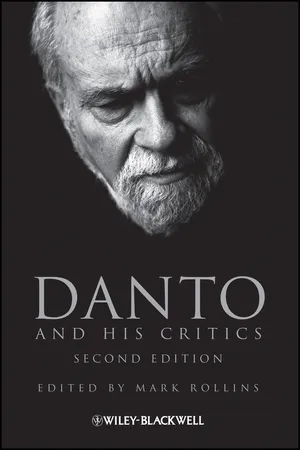
Updated and revised, the Second Edition of Danto and His Critics presents a series of essays by leading Danto scholars who offer their critical assessment of the influential works and ideas of Arthur C. Danto, the Johnsonian Professor Emeritus in the Department of Philosophy at Columbia University and long-time art critic for The Nation.
Information
Part I
System and Method
Chapter 1
Danto as Systematic Philosopher, or Comme on lit Danto en français
It is of less importance to enact the ritual task of philosophical journeymanship – putting holes in leaking conceptual vessels – than to ponder whether this vessel will serve our purpose even if sound.
Danto, Analytical Philosophy of Knowledge
There are three ways that the history of philosophy may be thought of: in Descartes' way; as Hegelian historicists do; and as Derrida does. The first view is that the essential philosophical problems are there, waiting to be discovered. The history of philosophy is the story of the discovery of these problems which, because they are problems about the structures of our thought about the world, do not change with time. We associate problems with the names “Plato” or “Kant,” but these problems can be connected with work done at other times. Descartes' Meditations sets forward positions on much-discussed issues without indicating how he was influenced by the earlier literature.
Second, the history of philosophy is the history of reflection on these issues. It is impossible to distinguish between how these problems are understood and how they are described by philosophers. Schopenhauer thinks differently from Descartes because Hume and Kant intervene between him and his precursors. There is no way to identify the problems as such apart from mentioning the proper names of the philosophers who deal with them. For the Hegelian historicist, not all things are possible at all times.
A third, Derridian, position claims not just that ways of thinking about these issues have changed, but that we cannot even describe the earlier positions in our vocabulary.1 The belief that Descartes, Hume, Wittgenstein, and Davidson are concerned with “the same problems” may be an illusion. When we use our language to describe Descartes' work, inevitably we will get things wrong because we must translate his account of what we call mental representation into our language. Descartes' view of representation differs so radically from ours that it is unclear how they may be compared. The problem is not translating his Latin or French into our English; but translating an alien conceptual scheme. The medium of talk, language, is itself a system of representation. There is no way around this problem, no neutral way of talking about philosophical problems. Discussion of the theory of representation uses one or another medium of linguistic representation. And that language involves philosophical presuppositions.
Baudelaire's poetry does not entirely translate into English, which lacks equivalent rhymes and rhythms; but we can explain in English roughly what has been lost. In philosophy the situation is different. We can say a lot about older ways of talking about representation and about our ways of describing them; what is lacking is the possibility of comparing them. Since each way of talking employs a different, incommensurable view of representation there is no sense in which some common topic is being discussed.
Perhaps Derrida's position is not coherent. If no way of comparing these views is accessible, how can we know that the same issues are being discussed? In fact, since we think that Descartes discusses issues of concern to modern philosophers, how can there not be some overlap between his position and ours? But perhaps we can only talk about Descartes in our terms, aware that we are doing violence to his way of talking. Even if there is no possibility of indicating exactly the nature of that violence, beyond knowing that we cannot “get things right,” still we may know that it is impossible for us to accurately discuss his work.
I use this admittedly schematic account to introduce Danto's work. His very basic anti-Derridian assumption is that we can talk about the earlier philosophical models in our language. And his anti-historicist view is that the philosophical problems themselves can be discussed without needing to worry about exactly who said what. He discusses the great traditional philosophers, but does not think that identifying the positions they hold requires a historical analysis of their place in the tradition. Danto holds a Cartesian view of the history of philosophy.
Danto's anti-Derridian view is implicit everywhere in his books on Nietzsche and Sartre, whose working assumption is that Nietzsche's and Sartre's concerns may be translated into the language of analytic philosophy. So Danto's Jean-Paul Sartre translates his concepts into ours; what Sartre calls “shame” is a version of our “problem of other minds.” Analytic philosophy is often criticized for being ahistorical, and for lacking a genuine interest in other philosophic traditions. While Danto's system is in one way self-consciously ahistorical, he certainly takes an interest in “alien” philosophical systems. “I have quarried Sartre's work . . . over the years, taken fragments of his thought which I would never . . . have been able to think of by myself . . . he is part of my history and world.”2 Only when he goes a bit farther afield geographically and temporally, in his book on Oriental philosophy, does he define the limits of his determined cosmopolitanism.3 The trouble with analytic philosophy, poststructuralists say, is that it treats its parochial concerns as if they were universally valid. The force of that very general complaint is easier to understand if we focus on one detail of Danto's analysis – his use of visual models – which poststructuralists like Derrida reject. Because such metaphors play a special role in Danto's aesthetics, I focus on that part of his philosophical system.
The relation of a systematic writer's aesthetics to his philosophical system is complex. For some philosophers – Plato in Danto's account and Kant according to some commentators – philosophy plays a central role in revealing structures of the mind we would not otherwise know.4 That there are artworks changes the entire way that the world and its representations are thought of. For Schopenhauer, artworks provide privileged access to the nature of things, permitting us to experience the unity of the world as will, which normally we can only know as representation. For Nietzsche, tragedy provides privileged access to the history of European culture.
For Danto, aesthetic theory is not a special source of knowledge in these ways. The indistinguishable indiscernibles, the basis for his account of knowledge and action, appear also when we look at art. But this doesn't show that artworks are kinds of entities which reveal anything to a philosopher about the world. Artworks are not identical with the physical objects from which they are indistinguishable. In this way they are like representations; indeed, and this raises potential complications, many of them are representations. But, so far as I can see, the ontological status of art does not influence Danto's larger system. Of course, that system was developed before he published the body of his work on aesthetics. But when the materials in Analytical History of Knowledge and Analytical Philosophy of Action are reworked in his recent Connections to the World they are not redeveloped in any radical way. There is no reason why they should be. The structure of argument in Danto's aesthetic mirrors that presented in his larger philosophy, without modifying its conclusions.
No special light is shed on the basic metaphysical problem, how we know the world in our representations and change it in our actions, by art. This perhaps is one reason why Danto's involvement in the artworld did not lead him early on to write about aesthetics. His interest in art, and his art criticism, has relatively few philosophical consequences.5 In this way, Danto's aesthetic, like his historiography, developed earlier in Analytical Philosophy of History, stands outside the central concerns of his system. That our ways of knowing the world and acting have changed has no especial importance for his discussion of knowledge and action, in which the positions of Plato, Berkeley, Kant, and other classic figures are juxtaposed to the arguments of Austin, Wittgenstein, and other, more recent philosophers. That the various positions were discovered at particular historical moments plays no important role in Danto's commentary. That the various sciences of mind have advanced does not transform the structure of the philosophical problems.
Given Danto's view of the general relation between science and philosophy in which philosophical argumentation is, as he says, at right angles to scientific research, it is hard to see how research could have any effect on philosophy. Even a philosopher so uninterested in history as Wittgenstein depended, in his early work, upon the then recent discoveries of logicians. And, of course, today some philosophers of mind argue that cognitive psychology has transformed the whole discipline. Danto refers to recent scientific research, but never suggests that it can have any transformative effect on thought about conceptual problems.
This is why Danto's work on aesthetics seems to subtly transform the orientation of his whole way of thought, only implicitly, perhaps, in The Transfiguration of the Commonplace but certainly explicitly in The Philosophical Disenfranchisement of Art. In so far as Danto's whole aesthetic originates from the need to define art so as to include Duchamp's ready-mades and Warhol's artifacts, he is dealing with questions which could only concern a modern aesthetician. Unlike epistemology, which for him does not depend in any deep way upon the science of psychology, aesthetics does depend upon creations of modern artists.
Plato, Kant, or Hegel could not have foreseen the problems discussed in Danto's aesthetic, which is why their accounts of art have only limited relevance to his. Danto's view of action or knowledge may be Cartesian but once he introduces this historical dimension into his aesthetic, it is natural to ask whether he shares some assumptions with the historicist.6 In this way, his aesthetic, like his epistemology and theory of action, are akin to his historiography. That standards of historical explanation have changed does not show that his historiography need be a historical account. Hegel, Marx, and various modern historians introduce new tools of historical explanation, but they do not therefore demand a different analysis from the work of Thucydides; any more than work in modern psychology, which makes Descartes' view of perception merely of antiquarian interest, changes how Danto understands mental activity.7 The properly philosophical problems of explaining a historical narrative, as opposed to dealing with such conceptual innovations as materialist dialectics, are problems posed by the very structure of a historical narrative. And those accounts appear early on in our culture.
This is why “the end of art” seems, as Danto says, to challenge the entire framework of his system. For here it is not just the case that historically novel forms of art change the definition of art, but that he makes a claim which takes us much closer to historicism. Since the very standards of what counts as art are historically variable, aesthetic theory must have a historical dimension. My aim here is not to critically discuss that definition of art, which has been done by many aestheticians, but to see how it fits into the way of thinking about philosophy's history which is developed within Danto's philosophical system.
In Danto's epistemology, theory of action, and historiography there is, as I said, no such historical dimension; nor is one even possible. But if historicism enters Danto's philosophy here in his aesthetic, it is an odd form of historicism. The thesis of “the end of art” is that the history of art has ended because no further artistic developments are possible. Aestheticians can define “art,” secure in the knowledge that no possible future counterexamples can upset that theory in the way that abstract painting upset the theory that art is mimesis. Looking back, that essay seems a necessary supplement to The Transfiguration, which is reason to wonder whether it really marks a break in Danto's work. The Transfiguration takes issue with the once-influential Wittgenstein theorizing which held that art has no essence, its different forms having family resemblances like those which in his later philosophy link language games. For a Wittgensteinian, the proliferation of new artforms could continue indefinitely, for new artforms always are similar in some ways to older art. Watteau does not paint history scenes as did Poussin and Raphael, but he too makes representations; Motherwell's abstractions are not representations, but he also makes art by applying paint to canvas. And so on. In such a Wittgensteinian account, even the most untraditional art can have family resemblances to what came earlier.8
No doubt this example employs the idea of family resemblances in a mechanical fashion. What is left aside are the ways in which novel art can really challenge its viewers. But, ultimately, there need be no problem in understanding how the most radically unconventional work also is art. For Danto this is not the case. If artists could go beyond Duchamp and Warhol, then perhaps these innovative works would not be covered by his definition of art. Claiming that the history of art has ended guarantees that there can be no future counterexamples to Danto's definition of art. There can be no counterexamples because it is in principle impossible for art to innovate in any way deep enough to yield a counterexample.9 Art after Warhol only consists in variations on well-established themes. This is not necessarily to say that artmaking will cease, though it is true that the exciting history of recent American art has depende...
Table of contents
- Cover
- Philosophers and Their Critics
- Title Page
- Copyright
- Dedication
- Notes on Contributors
- Acknowledgements
- Selected Bibliography of the Works of Arthur Danto
- Introduction
- Part I: System and Method
- Part II: Intention and Interpretation
- Part III: Philosophy of Art
- Part IV: Historical Knowledge
- Part V: What Philosophy Is
- Part VI: Responses
- Afterword: Not by a Soap Box but First by a Kiss
- Index
Trusted by 375,005 students
Access to over 1.5 million titles for a fair monthly price.
Study more efficiently using our study tools.
Frequently asked questions
Yes, you can cancel anytime from the Subscription tab in your account settings on the Perlego website. Your subscription will stay active until the end of your current billing period. Learn how to cancel your subscription
No, books cannot be downloaded as external files, such as PDFs, for use outside of Perlego. However, you can download books within the Perlego app for offline reading on mobile or tablet. Learn how to download books offline
We are an online textbook subscription service, where you can get access to an entire online library for less than the price of a single book per month. With over 1.5 million books across 990+ topics, we’ve got you covered! Learn about our mission
Look out for the read-aloud symbol on your next book to see if you can listen to it. The read-aloud tool reads text aloud for you, highlighting the text as it is being read. You can pause it, speed it up and slow it down. Learn more about Read Aloud
Yes! You can use the Perlego app on both iOS and Android devices to read anytime, anywhere — even offline. Perfect for commutes or when you’re on the go.
Please note we cannot support devices running on iOS 13 and Android 7 or earlier. Learn more about using the app
Please note we cannot support devices running on iOS 13 and Android 7 or earlier. Learn more about using the app
Yes, you can access Danto and His Critics by Mark Rollins in PDF and/or ePUB format, as well as other popular books in Philosophy & Aesthetics in Philosophy. We have over 1.5 million books available in our catalogue for you to explore.