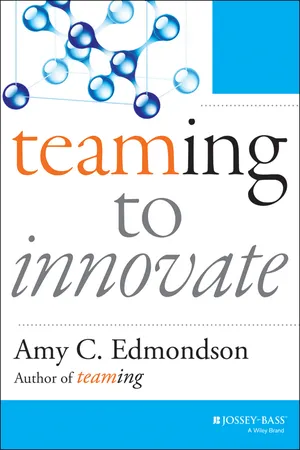
Innovation requires teaming. (Put another way, teaming is to innovation what assembly lines are to car production.) This book brings together key insights on teaming, as they pertain to innovation. How do you build a culture of innovation? What does that culture look like? How does it evolve and grow? How are teams most effectively created and then nurtured in this context? What is a leader's role in this culture? This little book is a roadmap for teaming to innovate. We describe five necessary steps along that road: Aim High, Team Up, Fail Well, Learn Fast, and Repeat. This path is not smooth. To illustrate each critical step, we look at real-life scenarios that show how teaming to innovate provides the spark that can fertilize creativity, clarify goals, and redefine the meaning of leadership.
- English
- ePUB (mobile friendly)
- Available on iOS & Android
eBook - ePub
Teaming to Innovate
About this book
Information
Team Up
Like it or not, innovation is a team sport. Few worthy innovations are accomplished alone or even by groups of people who have the same basic knowledge and expertise. Here we look at what it takes to team and explain why teaming is more challenging than it might first appear. We explore the crucial role of psychological safety—along with other enabling factors—in helping people team effectively. And because teaming across disciplinary lines is so vital to innovation, we’ll pay particular attention to the types of boundaries people confront when teaming to innovate, and how to bridge them effectively. We’ll start with a story that showcases just about every kind of seemingly insurmountable boundary imaginable.
Strange Bedfellows
It is hard to imagine two more different thought-worlds than Hollywood and the CIA. But what makes the story of the fate of six American hostages in Iran truly gripping is the teaming between these strange bedfellows, and how it brought the hostages home. As you read this story, consider the types of boundaries between these players, the nature of the teaming that occurred, and the innovative solution itself. How did teaming up across boundaries produce innovation?
Early in the morning of November 4, 1979, at the United States Embassy in Tehran, Iran’s capital city, a rapidly growing crowd of anti-American student protestors was demanding that ousted monarch (“Shah”) Mohammad Reza Pahlavi be returned from U.S. exile. They wanted him to be tried by the revolutionary government led by Ayatollah Khomeini. The crowd rushed the embassy gates, chanting, “Allahu Akbar!” (God is great!) and “Marg bar Amrika!” (Death to America!). Soon students were scaling the walls of the embassy. Within minutes, the protestors swarmed the vast compound that contained the ambassador’s residence and staff offices.21
Consular diplomat Martin Lijek, in Iran on his first consular post, hoped the adjacent visa-processing building where he worked would not be in the protestors’ path. He hoped that no one would suspect that a small collection of American embassy staff, Iranian employees, and visa applicants was on the second floor.22 Martin’s group included his wife, Cora (consular assistant), Joseph Stafford (senior foreign service officer), Stafford’s wife, Kathleen (consular assistant), and Robert Anders (senior consular officer).
Suddenly, the building went dark as power was cut. Gunshots rang out in the compound. Escaping capture was paramount: Iranian employees had known neighbors who were apprehended and executed by revolutionary guards. As the crowd neared their building, Martin and his peers destroyed the plates used to make visa stamps, improvised an evacuation plan, and ushered both staff and applicants to the back door. This was the sole exit on the embassy compound with direct street access.
The Iranian visa applicants exited first, in small groups, ahead of the American staff. One Iranian group was captured moments later and taken back to the embassy. The Lijeks, Staffords, and Anders headed to the British Embassy, several blocks away. The American escapees had almost reached the embassy when they encountered another demonstration.
Eventually, the group found refuge in the residence of Ken Taylor, the Canadian ambassador. The six became known at the State Department and CIA as the “houseguests.” Aware that the lives of the Canadian ambassador and his so-called houseguests were at risk if the presence of the Americans became known, experts in Washington, D.C., were considering a number of rescue plans, mostly involving overland routes bypassing roads and checkpoints.
Tony Mendez, Graphics Authentication Division head at the CIA, was called in to come up with a plan for bringing the hostages home. False identities were Mendez’s specialty. He had spent 14 years in the CIA’s Office of Technical Service—a real-world version of James Bond’s “Q” branch—and had helped more than a hundred agents and others escape life-threatening situations abroad.
The problem was that neither the Canadian nor American diplomatic corps leaders could conceive of a credible reason for any North Americans to be in Tehran after the hostage crisis had begun. Teachers, agricultural researchers, and others had all left. In the midst of the brainstorming, Mendez had a unique idea: to assemble a film scouting crew.
The plan was fleshed out as follows. Mendez would play the role of fictitious film producer “Kevin Harkins” from Canada, and request a “location scout” trip to Iran for a Hollywood studio film. The concept seemed plausible because so-called Hollywood creative types might conceivably be oblivious to the situation in revolutionary Iran. Focusing on finding the right backdrop for a new movie, perhaps a science fiction story in need of an exotic desert landscape, a Hollywood producer might just be crazy enough to scout out the view in Iran. Moreover, the Iranian government wanted the hard currency and might welcome this kind of business venture. A film production could mean millions of U.S. dollars.
Pursuing this idea, Mendez needed partners. The cover story seemed plausible. But a great deal of work still needed to be done to fill in the details for an operation that could withstand scrutiny while manhunting Americans was in high gear. To prepare the foundation for this cover, Mendez flew to Los Angeles in mid-January to meet John Chambers, a veteran makeup artist who had won a 1969 Academy Award for Planet of the Apes and was also a longtime Mendez collaborator. Chambers invited makeup artist and special effects expert Bob Sidell to join the meeting.
Mendez, Chambers, and Sidell brainstormed to figure out and then execute all of the details to create a fake Hollywood production company. They rented space, designed business cards, and concocted detailed identities for each of the six members of the location-scouting team, including their former film credits. The production company secured a suite at Sunset Gower Studios.
Chambers found a well-suited script in the vast archives of submitted screenplays never filmed. Mendez gave the script a new title, Argo, the name of the vessel used by Greek mythology hero Jason (and his Argonauts) on his daring voyage across the world to retrieve the Golden Fleece. Mendez and Chambers designed a full-page ad for the film to run in key trade magazines Variety and the Hollywood Reporter. As additional “pocket litter” to boost his Hollywood credentials, Mendez collected matchbooks from the famous Brown Derby restaurant in Beverly Hills, where the production crew gathered the evening before his departure for Iran.
Finally, Mendez obtained false Canadian passports for the six and flew to Tehran. Meeting the hostages, he explained the cover story and presented Jack Kirby’s conceptual art, the screenplay, the ad in Variety, and the “Studio Six” business cards. With some reluctance, the houseguests agreed the ruse could work and set about memorizing their new identities to match their fake Canadian passports. Soon they were headed to the Tehran airport to make their dangerous escape from Iran—in plain sight.
After several tense moments at the gate, Mendez and his “film crew” boarded the plane. The plane took off, and Mendez and the six escapees breathed a collective sigh of relief. Together they had successfully accomplished the most creative and improbable “exfiltration” of Mendez’s career.
Teaming Across Boundaries
Mendez, the houseguests, the Canadians who sheltered them, and the creative artists in Hollywood who made it all believable had little in common. They came from different backgrounds, different organizations, different areas of expertise, and different cultures. Yet they collaborated to execute a remarkable and remarkably innovative operation. This kind of diversity involves boundaries between people from different identity groups.
What’s in a Boundary?
Think of the adjectives you might use to describe yourself. Some of these adjectives describe identity groups, such as gender, occupation, or nationality. Some identity groups, and their corresponding boundaries, are more visible than others. Gender, for example, is visible. Occupation is less visible, except where clothing gives it away.
What is invisible, however, are the taken-for-granted assumptions, or mind-sets, that people in different groups hold. For teaming to be successful, people must be aware that they come together with different perspectives, almost always taking for granted the “rightness” of their own beliefs and values. It’s not enough to simply say, “Let’s band together,” and it will all work out. No matter how much goodwill is involved and how important the goal is, boundaries limit collaboration in ways that are both invisible and powerful.23
Education (level and type), along with the socializing processes that occur when we interact with others in our field, contributes to unconscious beliefs that the knowledge shared by one’s own group is especially important. It’s as if a wall separates engineers from marketers, nurses from doctors, and designers in Beijing from designers in Boston. The knowledge and skills we learn in a given field of expertise make up the visible curriculum. The invisible curriculum teaches us to forget what it was like not to know what we know.
The most important thing to understand about boundaries, then, is that most people take the knowledge that lies on their side of a boundary for granted. This can make it hard to communicate with those on the other side. But at its core, teaming is about reaching across or spanning such boundaries. To do this, we must first be keenly aware of what they are and what they do.
Taken-for-granted assumptions are, by definition, hard to recognize. The first step in doing so is becoming aware that they exist, so you can be on the lookout for them. Consider the example of two aeronautical businesses that joined forces to work on an innovative new aircraft.24 At the first planning meeting, everyone agreed on ambitious goals and a demanding schedule. Despite this agreement, the conversation kept getting mired in misunderstanding and miscommunication. Finally, it was discovered that the two groups meant something different when they used the simple phrase, “the plane has been delivered.” One organization understood it to mean the plane has been physically delivered to a control station. The other understood the exact same phrase to mean the plane has been delivered to the physical site and the machinery has passed all technical inspection. This semantic difference was crucial to the project because it affected how data were to be collected and categorized. This subtle difference between two groups is just a single example of the kind of misunderstanding that can be multiplied many times over when teaming spans boundaries.
Types of Boundaries
Three types of boundaries are particularly important in the context of teaming to innovate: physical distance (location, time zone, and so on), status (perceived social value, hierarchical level, profession, and so on), and knowledge (experience, education, and so on).25
Physical distance. In many companies, work teams in globally dispersed locations—so-called virtual teams—are used to integrate expertise. They’re virtual because they work together using communication technologies like email, phone, or Skype. The potential for innovation from such teaming is great; however, the challenges are equally so. Without face-to-face contact, taken-for-granted assumptions can be particularly tricky to recognize and address.
Status. The most common status differences at work are profession-based status and level in the organizational hierarchy. Professional status particularly influences speaking-up behavior. In healthcare, for example, physicians have more status and power than nurses, who in turn have more status than technicians. Yet members across these professions almost always have to team up to take care of patients. So patients are at risk if people don’t learn how to team across status boundaries. This is what Susan Thompson at Trinity Health Systems realized when she launched one of the earliest accountable care organizations in the United States (as noted in “Aim High”). Thompson asked primary care physicians, specialists, nurses, and other clinicians to team up across status lines to coordinate care in order to improve patient outcomes and at the same time reduce the cost of care. The only thing that surprised her? How quickly the innovation produced results: “In just 11 months, overall inpatient hospital utilization has declined 25 percent, 30-day readmissions have declined 43 percent, frequent emergency department patients are now receiving more consistent care and patient satisfaction scores have improved.”26
Knowledge. Teaming to innovate is most often about bridging across areas of expertise. In product and process development teams, in particular, bringing together people from different organizational function...
Table of contents
- Cover
- Contents
- Title
- Copyright
- Executive Summary
- Introduction
- Aim High
- Team Up
- Fail Well
- Learn Fast
- Conclusion
- About the Author
Trusted by 375,005 students
Access to over 1.5 million titles for a fair monthly price.
Study more efficiently using our study tools.
Frequently asked questions
Yes, you can cancel anytime from the Subscription tab in your account settings on the Perlego website. Your subscription will stay active until the end of your current billing period. Learn how to cancel your subscription
No, books cannot be downloaded as external files, such as PDFs, for use outside of Perlego. However, you can download books within the Perlego app for offline reading on mobile or tablet. Learn how to download books offline
Perlego offers two plans: Essential and Complete
- Essential is ideal for learners and professionals who enjoy exploring a wide range of subjects. Access the Essential Library with 800,000+ trusted titles and best-sellers across business, personal growth, and the humanities. Includes unlimited reading time and Standard Read Aloud voice.
- Complete: Perfect for advanced learners and researchers needing full, unrestricted access. Unlock 1.5M+ books across hundreds of subjects, including academic and specialized titles. The Complete Plan also includes advanced features like Premium Read Aloud and Research Assistant.
We are an online textbook subscription service, where you can get access to an entire online library for less than the price of a single book per month. With over 1.5 million books across 990+ topics, we’ve got you covered! Learn about our mission
Look out for the read-aloud symbol on your next book to see if you can listen to it. The read-aloud tool reads text aloud for you, highlighting the text as it is being read. You can pause it, speed it up and slow it down. Learn more about Read Aloud
Yes! You can use the Perlego app on both iOS and Android devices to read anytime, anywhere — even offline. Perfect for commutes or when you’re on the go.
Please note we cannot support devices running on iOS 13 and Android 7 or earlier. Learn more about using the app
Please note we cannot support devices running on iOS 13 and Android 7 or earlier. Learn more about using the app
Yes, you can access Teaming to Innovate by Amy C. Edmondson in PDF and/or ePUB format, as well as other popular books in Business & Leadership. We have over 1.5 million books available in our catalogue for you to explore.