- Presents and discusses a new perspective in vision science, and formalizes a field of study that will become increasingly significant to researchers in visual science and beyond
- The contributors are outstanding scholars in their fields with impeccable academic credentials, including Jan J. Koenderink, Irving Biederman, Donald Hoffmann, Steven Zucker and Nikos Logothetis
- Divided into five parts: Linking Psychophysics and Qualities; Qualities in Space, Time and Motion; Appearances; Measurement and Qualities; Science and Aesthetics of Appearances
- Each chapter will have the same structure consisting of: topic overview; historical roots; debate; new perspective; methods; results and recent developments
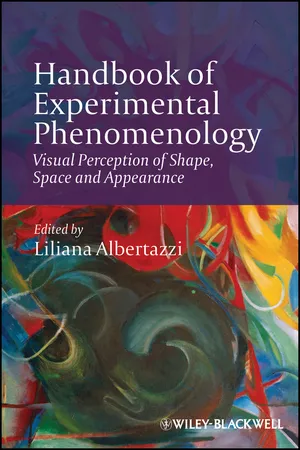
eBook - ePub
Handbook of Experimental Phenomenology
Visual Perception of Shape, Space and Appearance
- English
- ePUB (mobile friendly)
- Available on iOS & Android
eBook - ePub
Handbook of Experimental Phenomenology
Visual Perception of Shape, Space and Appearance
About this book
While the scientific study of vision is well-advanced, a universal theory of qualitative visual appearances (texture, shape, colour and so on) is still lacking. This interdisciplinary handbook presents the work of leading researchers around the world who have taken up the challenge of defining and formalizing the field of 'experimental phenomenology'.
Information
Part I
Linking Psychophysics and Qualities
1
Inferential and Ecological Theories of Visual Perception
Visual Phenomena
A basic principle of phenomenology: phenomena vary with the observer’s perspective
Visual phenomena also vary with one’s theoretical perspective. Viewer-dependence plays different roles in inferential and ecological approaches to perceptual theory. Inferences about the environmental causes of sensory data are complicated by viewer-dependent variations; but viewer-dependence has a central and explanatory role in the ecological approach.
Objective and subjective
Intuitively, the world we experience usually seems an objective reality—shaped by what is rather than by the instruments of our senses and technology. We know, of course, that what we see depends on our vantage point, on our eyes being open, whether the TV is turned on, and so forth. But when eyes and doors are opened and when a video receiver is switched on, then we generally regard a revealed scene as having been there all along, independent of our eyes and technology. A belief in the objectivity of observation has seemed essential to the professional practice of many scientists and engineers, as well as to the tacit knowledge of most of us. To be sure, the world we experience is not a fiction of our imagination.
Nevertheless, for painters, poets, musicians, and photographers, perceptual experience is neither deterministic nor the product of an objective world. Artists design objects for purposes of “orchestrating experience”1—to give meaning and emotional significance to both the objects and processes of observation. Making art is obviously creative, but observing art is also creative. Observing and making art both involve active choices of attention to form, context, and meaning. And observing art is strongly influenced by one’s vantage point and knowledge. In the everyday world as well as in museums, what we observe is selected from what might be seen. Attention is guided by context, learning, memory, meaning, and emotional significance.
Our choices of attention and action are also constrained by what our perceived surroundings afford—by walls and hallways, forests and trails, and traffic on the roads we travel. Our lives depend on the compatibility of our choices with changing environmental conditions. Our senses may sample limited patterns in our surroundings, but these perceived patterns must not conflict too often with the available constraints and opportunities.
Thus, visual phenomena are multifaceted. Different perspectives afford different descriptions and different explanations. Scientific experimenters and the observers who serve as subjects have importantly different perspectives. One’s subjective, personal experience looking, as it were, from the inside out is obviously very different from that of a scientist studying vision by looking from the outside at another person’s behavior. Scientific observations about other persons’ visual experiences are obviously limited. If visual experience is not objectively observable by another person, does it belong to science?
In fact, logically rigorous psychophysical methods have been developed to characterize other persons’ perceptual discriminations (e.g., Garner, Hake, & Eriksen, 1956; Green & Swets, 1966). Effective psychophysical methods usually concern subjects’ discriminations among physical objects rather than the subjective experience per se. Does subjective experience belong at all within the domain of science?
The method of introspection, developed in the late 19th century, was designed to observe the characteristics of other persons’ subjective experience. Subjects in an introspective experiment provided verbal descriptions of their phenomenological experiences, thereby offering to the experimental scientist indirect evidence about that experience. In the words of E. B. Titchener:
The first object of the psychologist . . . is to ascertain the nature and number of the mental elements. He takes up mental experience, bit by bit, dividing and subdividing, until the division can go no further. When that point is reached, he has found a conscious element. (1896/1899, p. 16)
Titchener regarded the introspective method as a psychological analog to chemical or anatomical analysis, supposedly revealing the structure of perceptual experience. “Structuralism” and the introspective method both failed to achieve their goals, however.
Structuralism and introspection depended on several important assumptions, including the following two:
1. Experience was assumed to be composed of sensations—products of the senses rather than properties of environmental objects.
2. Sensory experience was thought to be composed of discrete elements defined independently of their context. Thus, perceived objects, events, scenes, and patterns were regarded as compositions of elementary sensations—analogous to molecular structures of chemical elements, or to anatomical structures of cells, organs, and so forth.
From the personal perspective of an observer, visual experiences usually seem to be composed mainly of environmental objects and events. The method of introspection failed partly because subjects found it difficult to describe sensations rather than stimulus objects; they too often made “stimulus errors” by describing stimulus objects rather than the sensations per se. Vision research has progressed more rapidly by focusing on the objects of perception rather than sensory experience as such. Perhaps the objective and subjective aspects of perception cannot even be clearly distinguished.
Psychological structuralism largely disappeared after Titchener’s death. Nevertheless, relatives of the two ideas above have survived, clothed in modern concepts of sensory, perceptual, and cognitive processes. Persisting ideas about the physiological components of perception derive from implicit intuitions about the material and causal bases of visual phenomena. Empirical support for these two ideas is actually very limited. The supporting rationale is mainly just implicit in the conceptual background of many scientific perspectives.
Material objects, immaterial relations, and “the really hard problem”
From the perspectives of most scientists, visual phenomena have properties quite different from those experienced by observers. Vision occurs through the actions of material mechanisms that transfer energy by optical, physiological, chemical, and neural processes. If visual phenomena have meanings and qualities, then these properties must, in the standard scientific view, be immaterial additions produced by inference, memory, cognition, and emotion.
The problem of understanding how material processes of the eye and brain produce meaningful experience, with properties of meaning, quality, and value, is an abiding and fundamental problem in science and philosophy. Flanagan (2007) identifies this as “the really hard problem.”
Properties of meaning, sensory quality, and affective value are seemingly unobservable—to the scientist on the outside at least—and vision scientists typically ignore them for that reason. But what, exactly, is observable? Observables are often thought to be objects and events with spatial and temporal dimensions. Thus, vision scientists manipulate and measure “stimuli” (environmental objects and events or optical patterns on the eyes) and record “responses” (discriminations of stimuli or physiological responses in nerve cells and brain areas).2
Individual stimuli and responses do not have directly observable properties of meaning, quality, or value. Relations among stimuli and among responses, however, certainly can permit inferences about such immaterial properties. Physiological responses in certain brain areas are also found to correlate with certain stimuli that elicit emotional behaviors or judgments. A contemporary example: Mormann et al. (2011) found that neurons in the human amygdala responded selectively and with shorter latency to a stimulus category consisting of (pictures of) animals (both aversive and cute) but not to other categories of persons, landmarks, or inanimate objects; and similarly selective responses were not found in other areas of the brain. Converging evidence from clinical, behavioral, and neurophysiological studies supports the role of the amygdala in emotional responses. We can infer that the human subjects probably perceived affective properties of the animal pictures. Did the experimenters observe such affective properties? Or are affective phenomena necessarily only subjective, and not directly observable?
A broader question is whether immaterial properties are observable. Are observable objects and properties only those things that are measurable on well-defined physical variables such as length, duration, wavelength, mass, and energy? Implicitly if not explicitly, scientists have often represented perceived patterns as composed of sensory elements, specified by individual receptors at given spatial and temporal locations. Patterns as such are sometimes treated as not directly observable. Optical patterns, for example, can be represented as arrays of intensity values at discrete spatial and temporal positions, as in photos and movies recorded by cameras. Much of vision science has proceeded from just such representations directly analogous to the image arrays in cameras.
What, then, is the status of motion as a visual phenomenon? Efforts to answer this question have significantly influenced vision science. Motion is, after all, a relationship among material “stimuli” at particular spatial and temporal positions. Can the change itself be considered a fundamental visual property? Psychologists and physiologists have not always embraced this idea. Historically, many scientists have intuitively preferred to think of perceived motion as an inference from a sequence of stimuli at discrete spatial and temporal positions. Spatial and temporal positions have sometimes, in both past and present, been regarded as physically more fundamental than relationships in space-time. Accordingly, the phenomena of perceived motion have had a pivotal place in the history of vision science.
Many converging lines of psychophysical and physiological evidence show convincingly that motion constitutes a fundamental visual phenomenon, not derived from more elementary sensations at well-defined spatial and temporal positions. A review of the extensive literature is beyond the scope of this chapter, but many helpful collections and reviews are available, including Jansson, Bergström, and Epstein (1994), Epstein and Rogers (1995), Sekuler (1996), Mather, Verstraten, and Anstis (1998), Wade (1998), Westheimer (1999), Lappin and van de Grind (2002), Simoncelli (2004), and Warren (2004). The fundamental role of motion in vision is no longer in doubt, but the transformation from optical patterns in the eye to coherent perceptions of moving objects involves unknown steps.
Motion involves a change in spatial position. How, then, are spatial positions defined? Is the visual frame of reference for motion given by anatomical coordinates of the eye or by features of the surrounding optical pattern? Different frames of reference have different implications for the visual mechanisms that convert optics to perception. Different frames of reference for spatial structure and motion may emerge at different “stages” of visual processing—for example, from 2D to a “2½D sketch” and then a 3D framework (e.g., Marr, 1982).
Analogous but seldom articulated issues have influenced the history of research on virtually all aspects of perception, including space, form, and environmental objects and events. Marr offered a clear hypothesis about the frame of reference for vision:
. . . a process may be thought of as a mapping from one representation to another, and in the case of human vision, the initial representation is in no doubt—it consists of arrays of image intensity values as detected by the photoreceptors in the retina. (Marr, 1982, p. 31)
This statement describes a common belief among vision scientists, but it is an assumption. The topology of the surrounding optical pattern affords other frames of reference.
Do visual phenomena begin as 2D images spatially organized by the eye rather than by environmental objects and events? If so, then the perceived coherent organization, meaning, qualities, and values of our surroundings are necessarily products of our eyes, brains, memories, and imaginations. If visual phenomena begin this way, then phenomenology seems only an entertaining diversion from the sciences of neurophysiology and cognitive science. If visual phenomena are products of the physical, chemical, physiological, and neural mechanisms of the eye and brain, then understanding how organization, meaning, quality, and v...
Table of contents
- Cover
- Endorsements
- Title page
- Copyright page
- About the Editor
- About the Contributors
- Preface
- Experimental Phenomenology: An Introduction
- Part I: Linking Psychophysics and Qualities
- Part II: Qualities in Space, Time, and Motion
- Part III: Appearances
- Part IV: Measurement and Qualities
- Name Index
- Subject Index
Trusted by 375,005 students
Access to over 1.5 million titles for a fair monthly price.
Study more efficiently using our study tools.
Frequently asked questions
Yes, you can cancel anytime from the Subscription tab in your account settings on the Perlego website. Your subscription will stay active until the end of your current billing period. Learn how to cancel your subscription
No, books cannot be downloaded as external files, such as PDFs, for use outside of Perlego. However, you can download books within the Perlego app for offline reading on mobile or tablet. Learn how to download books offline
Perlego offers two plans: Essential and Complete
- Essential is ideal for learners and professionals who enjoy exploring a wide range of subjects. Access the Essential Library with 800,000+ trusted titles and best-sellers across business, personal growth, and the humanities. Includes unlimited reading time and Standard Read Aloud voice.
- Complete: Perfect for advanced learners and researchers needing full, unrestricted access. Unlock 1.5M+ books across hundreds of subjects, including academic and specialized titles. The Complete Plan also includes advanced features like Premium Read Aloud and Research Assistant.
We are an online textbook subscription service, where you can get access to an entire online library for less than the price of a single book per month. With over 1.5 million books across 990+ topics, we’ve got you covered! Learn about our mission
Look out for the read-aloud symbol on your next book to see if you can listen to it. The read-aloud tool reads text aloud for you, highlighting the text as it is being read. You can pause it, speed it up and slow it down. Learn more about Read Aloud
Yes! You can use the Perlego app on both iOS and Android devices to read anytime, anywhere — even offline. Perfect for commutes or when you’re on the go.
Please note we cannot support devices running on iOS 13 and Android 7 or earlier. Learn more about using the app
Please note we cannot support devices running on iOS 13 and Android 7 or earlier. Learn more about using the app
Yes, you can access Handbook of Experimental Phenomenology by Liliana Albertazzi in PDF and/or ePUB format, as well as other popular books in Psychology & History & Theory in Psychology. We have over 1.5 million books available in our catalogue for you to explore.