eBook - ePub
Microwaves in Nanoparticle Synthesis
Fundamentals and Applications
- English
- ePUB (mobile friendly)
- Available on iOS & Android
eBook - ePub
About this book
For the first time, this comprehensive handbook presents the emerging field of microwave technology for the synthesis of nanoparticles. Divided into three parts--fundamentals, methods, and applications--it covers topics including microwave theory, scale-up, microwave plasma synthesis, characterization, and more. This offers both an important volume for academic researchers, and a resource for those in industry exploring the applications of nanoparticles in semiconductors, electronics, catalysis, sensors, and more.
Information
1
Introduction to Nanoparticles
1.1 General Introduction to Nanoparticles
Nanotechnology is the science that deals with matter at the scale of 1 billionth of a meter (i.e., 10−9 m = 1 nm), and is also the study of manipulating matter at the atomic and molecular scale. A nanoparticle is the most fundamental component in the fabrication of a nanostructure, and is far smaller than the world of everyday objects that are described by Newton's laws of motion, but bigger than an atom or a simple molecule that are governed by quantum mechanics. The United States instituted the National Nanotechnology Initiative (NNI) back in 2000, which was soon followed (2001) by a plethora of projects in nanotechnology in nearly most of the U.S. Departments and Agencies [1]. About 20 Research Centers were subsequently funded by the Nationa1 Science Foundation (NSF), an agency responsible solely to the President of the United States and whose mandate is to fund the best of fundamental science and technology projects. NSF was the lead U.S. agency to carry forward the NNI. The word “nanotechnology” soon caught the attention of various media (TV networks, the internet, etc.) and the imagination and fascination of the community at large.
In general, the size of a nanoparticle spans the range between 1 and 100 nm. Metallic nanoparticles have different physical and chemical properties from bulk metals (e.g., lower melting points, higher specific surface areas, specific optical properties, mechanical strengths, and specific magnetizations), properties that might prove attractive in various industrial applications. However, how a nanoparticle is viewed and is defined depends very much on the specific application. In this regard, Table 1.1 summarizes the definition of nanoparticles and nanomaterials by various organizations.
Table 1.1 Definitions of nanoparticles and nanomaterials by various organizations: International Organization for Standardization (ISO), American Society of Testing and Materials (ASTM), National Institute of Occupational Safety and Health (NIOSH), Scientific Committee on Consumer Products (SCCP), British Standards Institution (BSI), and Bundesanstalt für Arbeitsschutz und Arbeitsmedizin (BAuA).
| Nanoparticle | Nanomaterial | |
|---|---|---|
| ISO | A particle spanning 1–100 nm (diameter) | – |
| ASTM | An ultrafine particle whose length in 2 or 3 places is 1–100 nm | – |
| NIOSH | A particle with diameter between 1 and 100 nm, or a fiber spanning the range 1–100 nm. | – |
| SCCP | At least one side is in the nanoscale range. | Material for which at least one side or internal structure is in the nanoscale |
| BSI | All the fields or diameters are in the nanoscale range. | Material for which at least one side or internal structure is in the nanoscale |
| BAuA | All the fields or diameters are in the nanoscale range. | Material consisting of a nanostructure or a nanosubstance |
Of particular importance, the optical property is one of the fundamental attractions and a characteristic of a nanoparticle. For example, a 20-nm gold nanoparticle has a characteristic wine red color. A silver nanoparticle is yellowish gray. Platinum and palladium nanoparticles are black. Not surprisingly, the optical characteristics of nanoparticles have been used from time immemorial in sculptures and paintings even before the 4th century AD. The most famous example is the Lycurgus cup (fourth century AD) illustrated in Figure 1.1.
Figure 1.1 Photographs of the famous Lycurgus cup which displays a different color depending on whether it is illuminated externally (a) or internally (b). For details, consult the website of the British Museum [2].
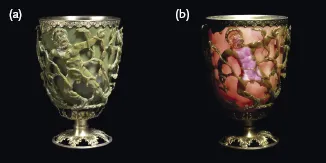
This extraordinary cup is the only complete historic example of a very special type of glass, known as dichroic glass, that changes color when held up to the light. The opaque green cup turns to a glowing translucent red when light is shone through it internally (i.e., light is incident on the cup at 90° to the viewing direction). Analysis of the glass revealed that it contains a very small quantity of tiny (∼70 nm) metal crystals of Ag and Au in an approximate molar ratio of 14 : 1, which give it these unusual optical properties. It is the presence of these nanocrystals that gives the Lycurgus Cup its special color display. The reader can marvel at the cup now in the British Museum [2].
Until the Middle Ages, the reputation of soluble gold was based mostly on its fabulous curative powers of various diseases, for example, heart and venereal diseases, dysentery, epilepsy, and tumors; it was also used in the diagnosis of syphilis. The history of the nanoparticle from ancient times to the Middle Ages has been summarized by Daniel and Astruc [3]. The first book on colloidal gold was published in 1618 by the philosopher and medical doctor Francisci Antonii. This book includes considerable information on the formation of colloidal gold sols and their medical uses, including successful practical cases. The book noted that soluble gold appeared around the fifth or fourth century B.C. in Egypt and China. On the other hand, industrial manufacturing of stained glass with colloidal particles was established by Kunckel in the seventeenth century (1676). He also published a book whose Chapter 7 was concerned with “drinkable gold that contains metallic gold in a neutral, slightly pink solution that exerts curative properties for several diseases” [4]. He concluded that gold must be present in aqueous gold solutions to a degree of contamination such that it is not visible to the human eye. A colorant in glasses, that is, the “Purple of Cassius”, was a colloid resulting from the presence of gold particles and tin dioxide and was highly popular in the seventeenth century. A complete treatise on colloidal gold was published in 1718 by Helcher [5]. In the treatise, this philosopher and doctor stated that the use of boiled starch in its drinkable gold preparation noticeably enhanced its stability. These ideas were common in the eighteenth century, as indicated in a French chemical dictionary dated 1769 [6], under the heading “or potable” it was said that drinkable gold contained gold in its elementary form, albeit under extreme sub-division suspended in a liquid. In 1794, Fuhlame reported in a book that she had dyed silk with colloidal gold [7]. In 1818, Jeremias Benjamin Richters suggested an explanation for the differences in color shown by various preparations of drinkable pink or purple gold solutions in that these solutions contained gold in the finest degree of subdivision, whereas yellow solutions were found when the fine particles had aggregated. In 1857, in a well-known publication, Michael Faraday [8] reported the formation of deep red solutions of colloidal gold by reduction of an aqueous solution of chloroaurate (AuCl4−) by phosphorus in CS2 (a two-phase system). He also investigated the optical properties of thin films prepared from dried colloidal solutions and observed reversible color changes of the films upon mechanical compression (from bluish-purple to green). Since that pioneering work, thousands of scientific papers have been published on the synthesis, modification, properties, and assembly of metal nanoparticles, using a wide variety of solvents and other substrates.
Nanotechnology is easily evident in various old churches. A well-known application of early nanotechnology is the ruby red color that was used for stained glass windows during the Middle Ages. Beautiful examples of these applications can be found in glass windows of many Gothic European cathedrals, among which the León Cathedral (Spain) represents one of these unique masterpieces, located on the medieval French pilgrimage path to Santiago de Compostela (Spain); its impressive 2000 m2 colored windows offer a unique view that certainly warrants a visit. Of course, the medieval artisans were unaware that they were using nanotechnology. They just knew that a particular process produced a beautiful effect. For example, the stained glass of a wonderful rose can be seen at the world heritage Cathédrale Notre-Dame de Chartres in France. The stained glass made in medieval times is displayed in Figure 1.2. Later chemistry clarified the reasons behind the generation of the color. These vivid colors were controlled by the size and the form (or shape) of the nanoparticles of gold and silver. The relation between particles and their associated colors has been discussed recently by Jin and coworkers [9]. In an article of 22 February 2005, the New York Times [10] summarized the relationship between the color of stained glass and the size/shape of the nanoparticles (see Figure 1.3). After several decades, the ingredients present in the stained glas...
Table of contents
- Cover
- Related Titles
- Title page
- Copyright page
- Preface
- List of Contributors
- 1: Introduction to Nanoparticles
- 2: General Features of Microwave Chemistry
- 3: Considerations of Microwave Heating
- 4: Combined Energy Sources in the Synthesis of Nanomaterials
- 5: Nanoparticle Synthesis through Microwave Heating
- 6: Microwave-Assisted Solution Synthesis of Nanomaterials
- 7: Precisely Controlled Synthesis of Metal Nanoparticles under Microwave Irradiation
- 8: Microwave-Assisted Nonaqueous Routes to Metal Oxide Nanoparticles and Nanostructures
- 9: Input of Microwaves for Nanocrystal Synthesis and Surface Functionalization Focus on Iron Oxide Nanoparticles
- 10: Microwave-Assisted Continuous Synthesis of Inorganic Nanomaterials
- 11: Microwave Plasma Synthesis of Nanoparticles: From Theoretical Background and Experimental Realization to Nanoparticles with Special Properties
- 12: Oxidation, Purification and Functionalization of Carbon Nanotubes under Microwave Irradiation
- Index
Trusted by 375,005 students
Access to over 1.5 million titles for a fair monthly price.
Study more efficiently using our study tools.
Frequently asked questions
Yes, you can cancel anytime from the Subscription tab in your account settings on the Perlego website. Your subscription will stay active until the end of your current billing period. Learn how to cancel your subscription
No, books cannot be downloaded as external files, such as PDFs, for use outside of Perlego. However, you can download books within the Perlego app for offline reading on mobile or tablet. Learn how to download books offline
Perlego offers two plans: Essential and Complete
- Essential is ideal for learners and professionals who enjoy exploring a wide range of subjects. Access the Essential Library with 800,000+ trusted titles and best-sellers across business, personal growth, and the humanities. Includes unlimited reading time and Standard Read Aloud voice.
- Complete: Perfect for advanced learners and researchers needing full, unrestricted access. Unlock 1.5M+ books across hundreds of subjects, including academic and specialized titles. The Complete Plan also includes advanced features like Premium Read Aloud and Research Assistant.
We are an online textbook subscription service, where you can get access to an entire online library for less than the price of a single book per month. With over 1.5 million books across 990+ topics, we’ve got you covered! Learn about our mission
Look out for the read-aloud symbol on your next book to see if you can listen to it. The read-aloud tool reads text aloud for you, highlighting the text as it is being read. You can pause it, speed it up and slow it down. Learn more about Read Aloud
Yes! You can use the Perlego app on both iOS and Android devices to read anytime, anywhere — even offline. Perfect for commutes or when you’re on the go.
Please note we cannot support devices running on iOS 13 and Android 7 or earlier. Learn more about using the app
Please note we cannot support devices running on iOS 13 and Android 7 or earlier. Learn more about using the app
Yes, you can access Microwaves in Nanoparticle Synthesis by Satoshi Horikoshi,Nick Serpone in PDF and/or ePUB format, as well as other popular books in Technology & Engineering & Nanotechnology & MEMS. We have over 1.5 million books available in our catalogue for you to explore.