Private Equity 4.0
eBook - ePub

Private Equity 4.0

Reinventing Value Creation

  1. English
  2. ePUB (mobile friendly)
  3. Available on iOS & Android
eBook - ePub

Private Equity 4.0

Reinventing Value Creation

About this book

"Private equity is more economically significant than ever, as institutions hunt for high returns in a risky world. Private Equity 4.0 examines the role, workings and contribution of this important industry in a straightforward yet revealing manner."

Dr. Josh Lerner
Jacob H. Schiff Professor of Investment Banking Chair, Entrepreneurial Management Unit
Harvard Business School


A multi-perspective look at private equity's inner workings

Private Equity 4.0 provides an insider perspective on the private equity industry, and analyzes the fundamental evolution of the private equity asset class over the past 30 years, from alternative to mainstream. The book provides insightful interviews of key industry figures, and case studies of some of the success stories in the industry. It also answers key questions related to strategy, fund manager selection, incentive mechanisms, performance comparison, red flags in prospectuses, and more.

Private Equity 4.0 offers guidance for the many stakeholders that could benefit from a more complete understanding of this special area of finance.

  • Understand the industry's dominant business models
  • Discover how value is created and performance measured
  • Perform a deep dive into the ecosystem of professionals that make the industry hum, including the different incentive systems that support the industry's players
  • Elaborate a clear set of guidelines to invest in the industry and deliver better performance

Written by a team of authors that combine academic and industry expertise to produce a well-rounded perspective, this book details the inner workings of private equity and gives readers the background they need to feel confident about committing to this asset class. Coverage includes a historical perspective on the business models of the three major waves of private equity leading to today's 4.0 model, a detailed analysis of the industry today, as well as reflections on the future of private equity and prospective futures. It also provides readers with the analytical and financial tools to analyze a fund's performance, with clear explanations of the mechanisms, organizations, and individuals that make the system work.

The authors demystify private equity by providing a balanced, but critical, review of its contributions and shortcomings and moving beyond the simplistic journalistic descriptions. Its ecosystem is complex and not recognizing that complexity leads to inappropriate judgments. Because of its assumed opacity and some historical deviant (and generally transient) practices, it has often been accused of evil intents, making it an ideal scapegoat in times of economic crisis, prodding leading politicians and regulators to intervene and demand changes in practices. Unfortunately, such actors were often responding to public calls for action rather than a thorough understanding of the factors at play in this complex interdependent system, doing often more harm than good in the process and depriving economies of one of their most dynamic and creative forces. Self-regulation has clearly shown its limits, but righteous political interventions even more so.

Private equity investment can be a valuable addition to many portfolios, but investors need a clear understanding of the forces at work before committing to this asset class. With detailed explanations and expert insights, Private Equity 4.0 is a comprehensive guide to the industry ways and means that enables the reader to capture its richness and sustainability.

Frequently asked questions

Yes, you can cancel anytime from the Subscription tab in your account settings on the Perlego website. Your subscription will stay active until the end of your current billing period. Learn how to cancel your subscription.
At the moment all of our mobile-responsive ePub books are available to download via the app. Most of our PDFs are also available to download and we're working on making the final remaining ones downloadable now. Learn more here.
Perlego offers two plans: Essential and Complete
  • Essential is ideal for learners and professionals who enjoy exploring a wide range of subjects. Access the Essential Library with 800,000+ trusted titles and best-sellers across business, personal growth, and the humanities. Includes unlimited reading time and Standard Read Aloud voice.
  • Complete: Perfect for advanced learners and researchers needing full, unrestricted access. Unlock 1.4M+ books across hundreds of subjects, including academic and specialized titles. The Complete Plan also includes advanced features like Premium Read Aloud and Research Assistant.
Both plans are available with monthly, semester, or annual billing cycles.
We are an online textbook subscription service, where you can get access to an entire online library for less than the price of a single book per month. With over 1 million books across 1000+ topics, we’ve got you covered! Learn more here.
Look out for the read-aloud symbol on your next book to see if you can listen to it. The read-aloud tool reads text aloud for you, highlighting the text as it is being read. You can pause it, speed it up and slow it down. Learn more here.
Yes! You can use the Perlego app on both iOS or Android devices to read anytime, anywhere — even offline. Perfect for commutes or when you’re on the go.
Please note we cannot support devices running on iOS 13 and Android 7 or earlier. Learn more about using the app.
Yes, you can access Private Equity 4.0 by Benoît Leleux,Hans van Swaay,Esmeralda Megally in PDF and/or ePUB format, as well as other popular books in Business & Finance. We have over one million books available in our catalogue for you to explore.

Information

Publisher
Wiley
Year
2015
Print ISBN
9781118939734
eBook ISBN
9781118939840
Edition
1
Subtopic
Finance

1
Private equity: from “alternative” to “mainstream” asset class?

images

Executive summary

Every day one reads about the latest private equity threat to a corporate icon. Some lament these threats, while others rejoice that at last an independent force has come in to shake up some lazy corporate assets. Private equity has been around for decades. However, in the years before the 2008 financial crisis, private equity funds gained the power to take on virtually any corporate target they chose. Some became household names—Kohlberg Kravis Roberts & Co. (KKR), Carlyle, and Blackstone from the US, Apax, Permira and CVC in Europe—just the most glamorous among the thousands of private equity funds in operation around the world. The trillion-dollar industry was bound to make some waves when it jumped into the corporate pool…
Whilst the basic principles of private equity have been around for a long time, the explosive growth of the industry is a relatively recent phenomenon. And with size comes a comprehensive “coming of age”, including a broader geographic coverage. While the US remains by far the largest market, some Asian markets are gaining in popularity, with their share in global fundraising expected to reach 20% soon.
As deal size increased, the very large transactions caught the attention of the media, politicians and regulators. Inconsiderate compensations started to generate popular resentment and attempts at regulation in many countries. The tax treatment of the general partners’ carries received a lot of attention, with their capital gains status questioned in face of the limited capital exposure by fund GPs. The use of tax-advantaged jurisdictions for the funds and special purpose vehicles for the deals fuelled the suspicion that private equity managers considered themselves somewhat exempt from greater social responsibilities, at a time when everyone was being asked to tighten their belt. A general move towards more transparency in all aspects of the financial world also put pressure on private equity to provide more disclosure.
All these signs in effect indicate an asset class that is slowly graduating to the mainstream and can no longer pretend to be “different”.
Like many of man’s greatest inventions, such as dynamite, private equity can make a great contribution to an investor’s portfolio when the basic investment rules are properly applied, and can turn into a rather explosive nightmare if put to uncontrolled use. In other words, private equity can be at the same time the best and the worst the world of assets can offer…
“Private equity” earned part of its alternative credentials because of its cherished confidentiality and privacy. As one of the most exclusive clubs, where price of admission into the best partnerships runs easily in excess of $25 million, with few if any regulatory authorities to report to until very recently, the industry was keen to maintain an aura of secrecy that helped its cause and reputation. Data on performance, strategies and mechanisms of value creation were hard to find and equally hard to assess since most stemmed from self-reporting to industry trade groups. Academic studies abound but suffer from the same shortcomings, mainly the inability to access comprehensive, unbiased data about funds and investments, especially on their performance.
The press in general also had its gripes about the industry. It shunned institutionalized private equity, preferring to spotlight VC-backed entrepreneurs and their more visible value creation and life-changing innovations. But the sheer magnitude of the industry and its deep penetration in the economic activity of countries makes it impossible for private equity to be ignored.

Moving into mainstream

Private equity has always been classified as an “alternative” asset class, i.e. a loosely defined class of asset which includes all assets beyond the three primary classes—stocks, bonds and cash. In the world of finance, alternative assets may include special physical assets, such as natural resources or real estate; special methods of investing, such as hedge funds or private equity; and even in some cases geographic regions, such as emerging markets. Private equity usually covers investments in companies not quoted on a stock market, i.e. private companies, or sometimes divisions of larger groups, or even investments in listed companies with private capital using a creative combination of equity and debt. Freed from financial and corporate constraints, properly refinanced and equipped with a strongly incentivized and focused management team, these businesses would possibly shine and deliver strong performances. The private equity owners would then sell the company to a corporate rival or take it public, hopefully with great riches for all at the end.
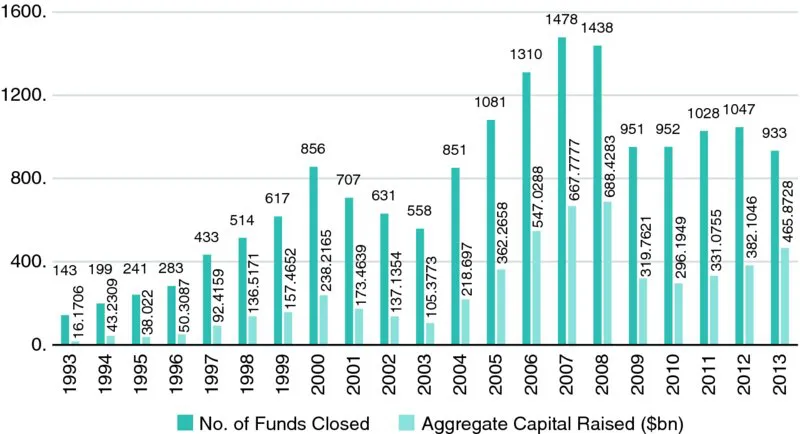
Until a few decades ago, private equity was a small, dark corner of the financial markets that few people had heard of and even fewer cared about. But the recent growth of the industry—before the debt crisis hit in 2008—has been extraordinary, whether measured by the capital raised or the number of funds on the market, as seen below in Exhibit 1.1.
images
Exhibit 1.1 Annual private equity fundraising
Source: Preqin
This extraordinary growth, according to many observers, makes the label “alternative” not appropriate anymore. In its introduction to the 2007–08 Survey on Alternative Investments, Russell Investments illustrated the new status:
“As interest in alternative investments has grown, and as such investments have become more mainstream, the phrase ‘alternative investments’ itself is beginning to sound like a contradiction in terms. What were once considered fringe investments are now deemed essential components of many institutional investors’ portfolios.”1
Large institutional investors—such as insurance companies, university endowments, pension funds and sovereign funds—have for the most part adopted private equity as a significant component of their portfolio, playing a leading role in the almost $3.2 trillion current assets under management of the entire private equity industry as of June 2012.2 For many, the move has been extremely beneficial: California Public Employees’ Retirement System (CalPERS), one of the largest public pension funds, recently reported that, since its inception in 1990 to December 31, 2011, its private equity programme has generated $20.2 billion in profits.3 Private equity is also a significant driver of returns for endowments, the most documented of which is probably the Yale Endowment Fund. In its 2013 report, the Yale Endowment Fund claimed its private equity investment programme has earned a 29.9% annualized return since inception in 1973.4 The University’s target allocation to private equity, at 31% of assets (June 2013 target), far exceeds the 9.5% actual allocation of the average educational institution, and is expected by the school to generate real returns of 10.5% with a risk of 26.8%.5
Private equity has ...

Table of contents

  1. Cover
  2. Titlepage
  3. Copyright
  4. List of case studies
  5. About the authors
  6. Professional Acknowledgments
  7. Personal acknowledgments
  8. Foreword
  9. Introduction
  10. 1 Private equity: from “alternative” to “mainstream” asset class?
  11. 2 Private equity as a business system
  12. 3 Value creation in private equity
  13. 4 Private equity performance
  14. 5 The main characters in private equity
  15. 6 The supporting cast
  16. 7 Investing in a fund
  17. 8 The future of private equity
  18. Index
  19. End User License Agreement