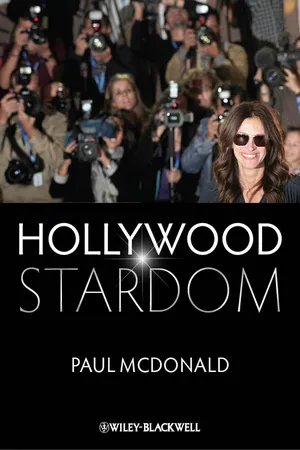
- Integrates the traditions of star studies and industry studies to establish an original and innovative mode of analysis whereby the 'star image' is replaced with the 'star brand'
- Offers the first extensive analysis of stardom in the 'post-studio' era
- Combines genre, narrative, acting, and discourse analysis with aspects of marketing theory and the economic analysis of the film market
- Draws on an extensive body of research data not previously deployed in film scholarship
- A wide range of star examples are explored including George Clooney, Mel Gibson, Tom Cruise, Daniel Day-Lewis, Tom Hanks, Will Smith, and Julia Roberts
eBook - ePub
Hollywood Stardom
About this book
By integrating star studies and film industry studies, Hollywood Stardom reveals the inextricable bonds between culture and commerce in contemporary notions of film stardom.
Information
Star Business
1
The Symbolic Commerce of Hollywood Stardom
Hollywood stardom is founded on the marketability of human identities. As one comment in a 1959 issue of the trade paper Variety noted, “Always the same obvious truism – show business is a business of names, personalities, values generated by the traits and skills and charms of potent (at the box office) individuals” (Green, 1959: 1). In the economics of Hollywood film, stars are valued as a guard against risk. Regardless of whether the budget is a few million or in the hundreds of millions, feature film production is an expensive enterprise. At the same time, the film industry is constantly confronted by the fact that it is pouring money into making things that people don’t actually need, and so unlike other goods such as basic foodstuffs, consumer demand for films is uncertain and capricious. With this mixture of high-cost investment and uncertain demand, the industry treasures concrete, material signs of content which consistently draw audiences. Popular cycles or genres can offer some certainties through the repetition of thematic and stylistic tropes, whereas the value of stars is tied up with how they represent versions of human identity. In the figure of the star, the symbolic/cultural and economic/commercial are inextricably linked. Film stars have cultural significance because they represent people and as those representations circulate in media markets, so they become figures for exchange. Since stars only portray certain categories or types of identity and not others, then stardom has symbolic and cultural power. Equally, as assets deployed in the market with the aim of securing commercial advantage, stars are a source of economic power. Examining the symbolic commerce of Hollywood stardom therefore requires understanding and critically evaluating the practices and processes which support the production, dissemination and presentation of popular identities in the film market. Initially this chapter sets out some basic dynamics at work in the symbolic commerce of stardom before considering how stardom is configured in Hollywood.
Commercial and Symbolic Dynamics of Film Stardom
Hollywood film is a form of mass communication. As John Thompson notes, mass communication is characterized by “the institutionalized production and generalized diffusion of symbolic goods via the fixation and transmission of information and symbolic content” (original emphasis, 1995: 26). Thompson poses five features defining mass communication, each of which can be applied to Hollywood film generally but can also be applied specifically to identify the foundational dynamics at work in the symbolic commerce of stardom.
1. Industrially Produced Fame
In common with other industries for mass communication, Hollywood operates by “technical and institutional means of production and diffusion” (Thompson, 1995: 27). Feature films are “complex cultural goods” (Caves, 2000: 10) or “joint products” (Becker, 1982: 35) for they require multiple inputs for their production. Films stars feature in these collaborative efforts as individuals working within the specialized division of labor that facilitates the making, circulation and presentation of film products. At the same time, Hollywood stardom itself is a work of collective creation, involving the co-ordination of numerous contributions and resources.
Film stars are not born, they are made. This may seem an excessively obvious point, yet it is worth emphasizing as popular documentaries and biographies so frequently tell quite a contrary story by reproducing the belief that the fame which a star enjoys arises only from the magnetic, compelling qualities which s/he conveys on screen. Although not philosophically systemized, this popular view is nevertheless a theory of stardom for it makes certain conceptual presumptions which can be summarized as the three I’s. The individual is presumed to be the source and origin of stardom. Secondly, the qualities which mark out star status are innate, something natural which the individual is born with. Usually those qualities can’t easily be defined: the star just has a certain “something,” the “it” factor which distinguishes him or her from others. Finally, because the person was born this way, there is the sense that stardom is inevitable, a view summarized in popular literature on stardom with observations along the lines of “from the moment of the first appearance in film, s/he was destined for stardom.” This manner of thinking can be described as the charismatic theory of stardom, for it attributes fame to the natural enigmatic attractions of the individual. It is a theory which is popular because it would appear to have some proof to support it and so holds a certain persuasive appeal. Stars are indeed individual people. On screen, they do seem to radiate qualities which make their presence far more compelling than that of other performers around them. As all they bring to the screen is their bodies and voices, why not believe star presence is an entirely natural creation, and when faced with that magnetic presence, with the gift of hindsight it can seem the coming of fame was only a matter of time.
While romantically attractive, however, the charismatic theory gives an entirely misleading account of the material conditions in which film stardom is produced. Although this view celebrates the exceptionalness of certain individuals, film production, distribution and exhibition always involves multiple personnel and resources. Now the charismatic theory is not blind to the workings of industry but simply sees such arrangements as mere secondary considerations, a transparent infrastructure enabling the greatness of the star to shine through. When seriously considered, however, these inputs become so central to the making of stars that it is impossible to imagine stardom happening without them. In Hollywood, stars depend on agents to procure work for them. Managers steer their careers, while lawyers draw up the deals which will secure remuneration for the star’s services. Casting directors make decisions about which performers are suitable for which scripts. Without producers, there would be no films for stars to appear in. Close analysis of the aesthetics and form of film reveal that whatever compelling quality a performer brings to the screen is largely the result of how cinematographers, grips (i.e. lighting technicians), sound mixers and editors manipulate the elements of film to give the star an auratic presence on screen. Marketing teams aim to cultivate public interest in films featuring stars, and in due course critics and reviewers will judge the merits of those films. Media exposure of film stars is not confined to films alone, and journalists and photographers in the gossip industry continually report and capture the off-screen lives of stars. Consequently, publicists work at managing the star’s media exposure. Star films only become available to the public because theater programmers book them, stores buy the necessary video units to rent or sell, or buyers acquire television rights. After all these efforts, the popularity and commercial success of stars is contingent on ticket sales or units rented and bought, and so the movie consuming public are always participants in the making of stardom.
Film stardom is therefore never an individual, innate or inevitable effect. It requires the organized collective actions of multiple participants. Whatever aura of presence the star brings to the screen is largely due to the artful manipulation of film form. Once these factors are taken into consideration, it becomes impossible to accept stardom is natural or predestined. Instead, fundamental to the symbolic commerce of stardom is the recognition that stardom is a product of industrialized cultural production, the outcome of multiple, highly organized, inputs and actions. In common with other arenas of artistic production, Hollywood stardom is an outcome of “collective activity” (Becker, 1982: 1). Hollywood stardom is industrially produced fame, generated at numerous points across film development, principal photography, post-production, marketing, physical distribution, exhibition, reviewing and consumption. Rather than the source, the individual is the outcome in the production of stardom.
2. Mediated Fame
Like other forms of mass communication, the film medium produces “a structured break between the production of symbolic forms and their reception” (Thompson, 1995: 29). Film places the actor in the context of mediated performance: the actor is on show but not physically present to an audience. This process of mediation is not limited to films alone but is an inter-textual effect achieved across multiple media channels, including the press, television, internet and book publishing. It is this insight which is at the core Richard Dyer’s (1998) concept of “star image”: by forcing a division between the star-as-person and the star-as-texts, the idea of star image directly challenges the charismatic theory, for whatever meaning or significance a star has cannot be attributed to the internal innate qualities of individuals but rather to the external material signifying substance of films and other media texts. If stars appear significant, it is because star texts connect with wider systems of belief about human identity. Star images may represent individuals but they are not the product of the individual. A second dynamic at work in the symbolic commerce of stardom is then how stars appear and circulate in public culture as mediated identities.
While the break between person and texts is essential to grasping the commercial work of film stardom, by avoiding discussion of the industrial conditions in which star texts are produced, the star image concept still preserves a kind of charismatic mythology, for it leaves unanswered certain pressing questions: where do stars come from?; in what conditions and through what processes are star images created? By ignoring the markets in which those images circulate, star studies have avoided interrogating in any depth the question why does Hollywood produce stars? It is precisely the aim of studying the symbolic commerce of stardom to therefore situate the production and value of star images within these conditions and markets.
3. Dispersed Fame
By separating the contexts of production and consumption, mass communication “extends the availability of symbolic forms in space and time” (Thompson, 1995: 30). This is crucial to stars entering the market. Stars are mediated figures: images of the star body and the recording of the star voice can be separated and circulated independently of the star’s physical presence. By this separation, stars are temporally and spatially dispersed identities scattered across local, regional, national and global markets.
4. Reproduced Fame
Tied to the last point, with “the public circulation of symbolic forms,” media products take on “mass” characteristics as they become “available in principle to a plurality of recipients” (p. 30). While the costs of making the original film negative are high, the unit cost is relatively low for replicating the film on celluloid prints or digital copies for showing in cinemas, duplicating discs to feed the home entertainment market, or creating downloadable files. Therefore stars are mass-reproduced identities.
5. Commodified Fame
Finally, mass communication results in the “commodification of symbolic forms” (p. 27). It is worth considering this dynamic at some length for it is fundamental to the symbolic commerce of stardom. Thompson argues symbolic forms become commodities when they are subject to two types of “valorization.” “Symbolic valorization” defines how cultural works gain “symbolic value” by “the ways in which, and the extent to which, they are esteemed by individuals – that is, praised or denounced, cherished or despised by them” (p. 27). Symbolic forms become commodities when their symbolic value is accompanied by “economic valorization,” the “value for which they can be exchanged in a market … becom[ing] objects which can be bought and sold … for a price” (pp. 27–8). By the combination of these two types of value, symbolic works become “symbolic goods” (p. 28).
Once this basic fact is established it is necessary to ask, however, what type of symbolic good is a film? John Sedgwick and Michael Pokorny note the film commodity has two aspects: a material aspect, “strips of photographic representations on celluloid … which are the object of transactions between producers, distributors and exhibitors” (2005: 10), and an immaterial aspect, “the form in which the film is consumed in the mind of each member of the cinema audience” (p. 11). On the latter note, it is useful to think of any film as an “experience good” (Caves, 2000: 3) or “experience product” (Bakker 2001: 466). A film is both a tangible good – the material film object – and an entertainment service – the delivery and exchange of emotional, humorous, or enlightening experiences.
Stars are not directly symbolic commodities because in the business of the box office or the home video market, consumers cannot actually buy stars. Walk into any multiplex and try buying, say, Sandra Bullock. It’s impossible. Across posters in the lobby, electronic noticeboards, the box-office counter, or automated ticket dispensers, all information and systems are focused on buying the film. Likewise in bricks-and-mortar video retail and rental stores, or with platforms for online retail, distribution and downloading, the point of transaction is always orientated toward purchasing the film. So while it possible to buy a ticket to see The Proposal (2009) or otherwise to rent or download The Blind Side (2009), it is just not possible to buy the star of these films, Bullock. Now the star may very well be the only reason the consumer chooses to pay to see a film, however even in such cases, the star cannot be directly purchased. It is in this sense then that Sedgwick and Pokorny describe stars as a “derivative commodity-type” (2005: 7), for buying the star is secondary to, and so derived from, buying the film. Furthermore, in keeping with the whole experiential exchange of film consumption, the act of transaction only provides an experience of the star.
Stars can’t be bought by consumers yet the presence of a star may lead the consumer to “buy into” the idea of a film. Stardom is used as a strategy to induce consumers to pay for a ticket or buy or rent a video unit. Any performer who has gained a track record of positive audience response has acquired symbolic valorization, which the industry may then choose to deploy as a means of securing economic value from the film. In the film market, audiences are never guaranteed and so therefore the industry must work to stimulate and regularize demand. To do this, it is necessary to find a delicate balance between novelty and assurance. As Sedgwick and Pokorny note, uniqueness is a key characteristic of the film commodity (p. 13): although similarities may exist, and genres feed on such resemblances, no two films, even remakes, are exactly identical. Indeed differences between films are crucial to stimulating consumer desires to watch a film. Promoting uniqueness permeates the whole of film advertising: “each film is marketed competitively against all others currently in distribution. In this way, although film advertising differentiates its product, the industry differs from general practices in individuating each item it makes” (Staiger, 1990: 6)
While necessary to the commerce of film, uniqueness equally presents a problem for both the consumers and producers of film. Until a film is actually seen, consumers are left uncertain about just exactly what it is they are paying for. As Sedgwick observes, “If novelty is an irreducible characteristic of film as a commodity, it follows that, ex ante, consumers do not know fully what they want” (2005: 197). Repeat viewings of films do happen yet the majority of transactions around films depend on consumers paying for the first time to see something which remains (at least in part) unknown. Stimulating the “want-to-see” aspect of film consumption depends precisely on preserving the unknowability of the film, yet this presents the film consumer with a question: why pay – particularly when the same expenditure could be made on more certain rewards – for an experience where it is impo...
Table of contents
- Cover
- Title page
- Copyright page
- Figures
- Tables
- Acknowledgments
- Introduction
- PART ONE: Star Business
- PART TWO: Star System
- PART THREE: Star Performance
- 10 Conclusion
- Appendix: Academy Award Nominees and Winners in the Actress and Actor in a Leading Role Categories, 1990–2009
- References
- Index
Trusted by 375,005 students
Access to over 1.5 million titles for a fair monthly price.
Study more efficiently using our study tools.
Frequently asked questions
Yes, you can cancel anytime from the Subscription tab in your account settings on the Perlego website. Your subscription will stay active until the end of your current billing period. Learn how to cancel your subscription
No, books cannot be downloaded as external files, such as PDFs, for use outside of Perlego. However, you can download books within the Perlego app for offline reading on mobile or tablet. Learn how to download books offline
Perlego offers two plans: Essential and Complete
- Essential is ideal for learners and professionals who enjoy exploring a wide range of subjects. Access the Essential Library with 800,000+ trusted titles and best-sellers across business, personal growth, and the humanities. Includes unlimited reading time and Standard Read Aloud voice.
- Complete: Perfect for advanced learners and researchers needing full, unrestricted access. Unlock 1.5M+ books across hundreds of subjects, including academic and specialized titles. The Complete Plan also includes advanced features like Premium Read Aloud and Research Assistant.
We are an online textbook subscription service, where you can get access to an entire online library for less than the price of a single book per month. With over 1.5 million books across 990+ topics, we’ve got you covered! Learn about our mission
Look out for the read-aloud symbol on your next book to see if you can listen to it. The read-aloud tool reads text aloud for you, highlighting the text as it is being read. You can pause it, speed it up and slow it down. Learn more about Read Aloud
Yes! You can use the Perlego app on both iOS and Android devices to read anytime, anywhere — even offline. Perfect for commutes or when you’re on the go.
Please note we cannot support devices running on iOS 13 and Android 7 or earlier. Learn more about using the app
Please note we cannot support devices running on iOS 13 and Android 7 or earlier. Learn more about using the app
Yes, you can access Hollywood Stardom by Paul McDonald in PDF and/or ePUB format, as well as other popular books in Medios de comunicación y artes escénicas & Historia y crítica cinematográficas. We have over 1.5 million books available in our catalogue for you to explore.