Part I
Getting Started with Blog Design
For Dummies can help you get started with lots of subjects. Visit
www.dummies.com to learn more and do more with
For Dummies. In this part. . .
Gain an understanding of why blog design matters and learn how visitors typically travel through online content.
Learn what you need to start a blog design.
Explore the foundation of great design by learning four core design principles and how to apply them.
Examine your own blog’s goals, content, and audience to make impactful blog design decisions.
Get tips on building blog design guidelines so your blog remains consistent in both design and content.
1
Recognizing Components of a Well-Designed Blog
In This Chapter
Exploring why good blog design matters in the first place
Looking at how readers generally look through websites and blogs
Aligning your blog’s message with your design
Identifying blog design tips for nondesigners
Discovering the basic tools needed for designing a blog
Blogging introduces a way for people to have a platform for sharing their words with anyone in the world. Along with that opportunity comes the chance to build a blog design that complements your words and leaves a lasting impression.
When you think of blog design, the first things that come to mind might be colors, fonts, or an overall blog layout. However, blog design goes deeper than that. In fact, this quote from Apple founder Steve Jobs pretty much sums it up: “Design is not just what it looks like and feels like. Design is how it works.”
The main purpose of this book is to teach design to bloggers who aren’t designers. Few things about design are required because designing a blog is more like part art and part science. We all have different tastes and styles, but in the end, design should function to give a visitor a positive experience.
In this chapter, I introduce you to how good blog design benefits your blog. You also get a glimpse at how web users generally look at websites — and blogs in particular. Then I tackle foundations of good blog design so you can recognize good design and understand why it’s good. Additionally, this chapter introduces a few tools to help you start designing (or re-designing) your blog.
Knowing Why Blog Design Matters
I’m sure this has happened to you: You’re hungry, so you search online for local restaurants and click a result that sounds interesting. The restaurant’s website has shockingly ugly colors, auto-playing music, and flashing graphics. The menu is at the bottom of the last page you’d look for it and offers no descriptions, no prices, and no pictures. And even if you wanted to go to this restaurant at this point, the address is nowhere to be found. This restaurant may be the best one in town, but you just formed an impression of the food solely from its website.
Great blog design matters in the same way that restaurant’s website does. When your design looks polished and professional, and is straight-forward to use, readers automatically trust that you also have good content. Good design also implies that you’re committed not only to keeping your content fresh but committed to your readers as well.
So, does design matter more than content? Nope. If you had walked into that restaurant from the street, ate there, and loved it, you probably wouldn’t care what its website looks like because you know the “content” is solid. But without an appealing blog design, a reader may never take a minute to actually read your content. After all, if your design is bad, why would your content be any better?
Good blog design reinforces the idea that your content is awesome. The ins and outs of your design keep your new visitors exploring your content, help you meet your blog goals, and draw attention to your blog’s most important asset: your content.
Communicating with design
In the face-to-face world, facial expressions and body language often speak more than the words coming from someone’s mouth. Your blog’s design communicates in the same way, speaking even before your content does. The colors you use, the fonts you select, the images you showcase, and even the layout you choose all communicate something to the reader.
Design should reinforce the personality of your blog or help convey what your blog is about. A powerful image in your header can communicate emotion or a single design element can give readers a clearer picture of your blog’s message. Even text can make a bold statement, serving as a graphical element to attract a reader’s eye.
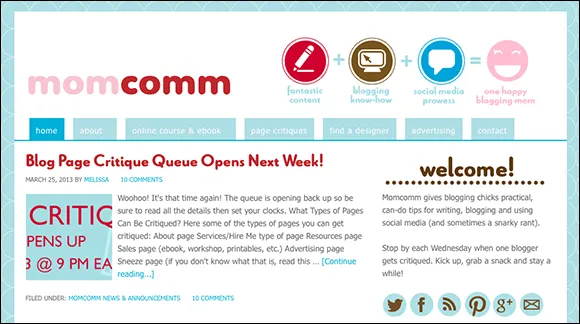
On my blog Momcomm (www.momcomm.com), I write about blogging and social media. I want my blog to be perceived as fun and approachable as well as communicate that this blog makes even complex topics easy to understand. As you can see in Figure 1-1, my blog design features a smiley face in the header and a prominent Welcome! in the sidebar to make readers feel welcome. In addition, I use plenty of formatting in my blog posts to make them easy to follow.
Figure 1-1: My blog uses design to communicate my message of being approachable and welcoming.
In addition, the placement of certain blog elements within your design can communi...