- Presents a compendium of original essays offering invaluable insights into the life and works of one of the most important and influential filmmakers in the history of cinema
- Features contributions from an international cast of major film theorists and critics
- Provides readers with both an in-depth reading of Godard's major films and a sense of his evolution from the New Wave to his later political periods
- Brings fresh insights into the great director's biography, including reflections on his personal philosophy, politics, and connections to other critics and filmmakers
- Explores many of the 80 features Godard made in nearly 60 years, and includes coverage of his recent work in video
- English
- ePUB (mobile friendly)
- Available on iOS & Android
eBook - ePub
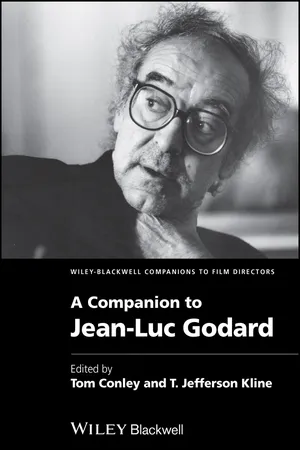
A Companion to Jean-Luc Godard
About this book
This compendium of original essays offers invaluable insights into the life and works of one of the most important and influential directors in the history of cinema, exploring his major films, philosophy, politics, and connections to other critics and directors.
Information
1
From Pen to Camera
Another Critic1
At the end of 1962, just after he had directed his first four feature films, Jean-Luc Godard met four editors of Cahiers du cinéma for a lengthy interview. The event bore witness to the importance of the work he had accomplished, as well as to the seven short films and the episodes he had directed in as many collective films. The question of the interview concerns the shift from criticism to directing:
| cahiers: | Jean-Luc Godard, you have come to cinema through criticism. What exactly is it that you owe to it? |
| jean-luc godard: | At Cahiers we were considering ourselves, all of us, to be future directors. To frequent ciné-clubs and the Cinémathèque was already tantamount both to thinking cinema and to thinking about cinema. To write already meant to make cinema, simply because the difference between writing and shooting is one of quantity and not of quality. The only critic who had been completely of this mold was André Bazin. The others – Sadoul, Balazs or Pasinette – were historians or sociologists, not critics. |
| As a critic I already assumed myself to be a filmmaker. Today, I continue to consider myself a critic and, in a way, I am all the more now than I had been before. Instead of writing a piece of criticism I make a movie, even if it means introducing a critical dimension into it. I think of myself as an essayist, I write essays in the form of novels or novels in the form of essays: but I merely film them instead of writing them. Were cinema to disappear I'd accept the fact: I'd shift over to television, and were television to disappear, I'd go back to paper and pencil. I believe that a very great continuity exists among all forms of expression. Everything is united. The question is one of knowing how to take this unity from the angle that best fits you.2 |
We cannot fail to be struck by Godard's lucid premonitions in speaking then of his work in terms that are clearly justified in view of what he had already done – especially in signaling the coherence of a future trajectory that has generally been placed under the sign of successive ruptures.
In his response, Godard articulates several pertinent differences: in the midst of the editorial production of Cahiers he separates Bazin, a “pure critic,” from the group of Young Turks who surrounded him, and with whom he took part – all of them practitioners of criticism as a way of making cinema at a moment when access to the professional practice of film making had been blocked by the corporate machinery and conservatism inherent to the milieu. In passing, he also distinguishes Bazin from other critics to whom he denies this title – if Bazin is surely not the sole critic, Godard's words are a way of affirming, at a time when it does not go without saying, that not all writing on cinema pertains to criticism. But above all Godard removes himself from his young contemporaries, the phalanx of the New Wave: the fact of continuing to be a critic, and still “even more than before,” concerns only himself, in the sense that there will be an explicitly critical dimension in the films he directs. Even if evidence shows that in the films of Truffaut, Rohmer, Chabrol or Rivette the effects of what they elaborated at once individually and collectively during their years at Cahiers is already at this stage, Godard will become even more so the sole director to make clear in his own films a commentary on cinema, on staging, on the stakes of the relation between images, the real, the articulation of the sound track and the image track, etc. His forms are the only ones that in one shape or another will increasingly make explicit their interrogation of the ways by which they are made.3 We can now mark 1967 and Godard's contribution to the collective film, Far from Vietnam, “Caméra-oeil” (Camera-Eye) as the moment when the staging of this reflection becomes central.
In passing, in his answer to the interviewers of Cahiers, Godard positions himself in a sort of symmetry with Bazin, the “pure critic.” He implies that he too is just that, but with a far richer palette of means.4 And this is what he began to do, and what he continued – and continues – to do (among other things) as a filmmaker. He brings criticism to another level of potential and effectiveness: he invents criticism of cinema by way of cinema. In other words, he invents an equivalent of literary criticism whereby the latter criticizes works whose raw materials are words mixed with words. Godard becomes practically the only filmmaker to criticize images and sounds with images and sounds.
In 1962, when Godard said that “I consider myself an essayist,” the formula “essay-film” had not yet been invented. Only much later does it define a practice of cinema that has nonetheless become current among a few directors, most notably Chris Marker and Alain Resnais, two of Godard's contemporaries. Yet in themselves these two other great figures of the modern resurgence of French cinema in the 1950s and 1960s do not come from criticism per se. They “come,” as it were, from both montage and politics. Together (Les Statues meurent aussi (Statues Also Die) and, no less, Nuit et brouillard (Night and Fog) to which Marker amply contributed), or in a complicit manner in their respective films, remarkably in Lettre de Sibérie (Letter from Siberia), in the fishy Iakoute sequence or, less directly, the recourse to visual archives and the leitmotif “tu n'as rien vu à Hiroshima” (you saw nothing in Hiroshima) in Resnais's first feature, they take up in their films the very means of cinematographic language and their political effects. In this respect the resemblance between Godard's episode and that of Resnais, in Claude Bitter, or in Loin de Vietnam (Far from Vietnam), is quite significant.
In What Cinema Is, Dudley Andrew wonders what, had he been able to see them, Bazin might have thought of Godard's films.5 This is a keen question that one of Godard's principal theoretical – and not critical – essays anticipates: in “Montage mon beau souci” (Goddard, 1956), published in Cahiers du cinema, Godard is overtly opposed to the defense and illustration of the sequence-shot that Bazin had promoted. Far from praise of the “the dress without the stitching of the real,” at that time the young Godard reclaims the virtues of the quick shot – “a heartbeat” – in which it is not difficult to discern his interest in a writing of the mise-en-scène that is nearer to the constructions of verbal language than to resources belonging to cinematographic recording. Here he is thus clearly nearer to the “Left Bank Group” (Resnais, Marker, Agnès Varda) than the Bazinian ideas to which the other Cahiers editors refer. It is most notably in Marker that what is found in what the latter later calls “le commentaire dirigeant” (commentary directing), in which the primacy of the text is not to reduce the image to the status of an illustration (what no filmmaker worthy of the name ever does), but as a structuring principle that organizes images, including, as Godard will therein become a specialist, in making an image of the text through recourse to inscriptions – that is, to the composition of words seen directly on the screen.6 When he directed Puissance de la parole (Power of Speech) in 1988, it is perfectly logical that the film can begin with images of an editing table.
“Today, I continue to consider myself a critic and, in a way, I am all the more now than I had been before.” When, today, we read the critical articles Godard published in Cahiers and Arts during the 1950s, we can even defend the idea that he has become not only “moreover a critic” but also an other critic. Despite the lucidity and the pertinence of many statements in his printed writings, his critical juvenilia is especially marked by a will of self-affirmation, of his own tastes, of his subjectivity, of his capacity to convoke and to bring together (already in montage) as many allusions as possible, with a massive recourse to classical (literary, pictural, musical …) culture that sometimes acquires the aspect of a pedantic array. Nothing of the sort is to be found in these films, even including those where cultural references are mobilized. When Ferdinand reads Élie Faure on Velasquez in Pierrot le fou (Pierrot the Mad), whatever smacks of pedantry is immediately swept away by the very strong feeling that he is in fact speaking of something else, that he is secretly murmuring the words of an inquiry into film and, moreover, into life itself. The pertinent issue is not at all that of knowing that Velasquez was a painter of the evening, even if Élie Faure said this, but that something else is in play – in an arena at once of this very ...
Table of contents
- Cover
- Table of Contents
- Wiley-Blackwell Companions to Film Directors
- Title page
- Copyright page
- Notes on Contributors
- Introduction
- 1: From Pen to Camera
- 2: À bout de souffle
- 3: “Médicis 15-37”
- 4: Un Femme est infâme
- 5: Michel Legrand Scores Une femme est une femme
- 6: Three-Way Mirroring in Vivre sa vie
- 7: Commerce and the War of the Sexes
- 8: Les Carabiniers
- 9: A Postmodern Consideration of Jean-Luc Godard's Le Mépris
- 10: Totally, Tenderly, Tragically … and in Color
- 11: Le Mépris
- 12: Bande(s) à part
- 13: Pierrot le fou and a Legacy of Forme
- 14: Godard's Wars
- 15: (Dé)collage
- 16: The Children of Marx and Esso
- 17: One or Two Points About Two or Three Things I Know About Her
- 18: Godard's Remote Control
- 19: La Chinoise … et après?
- 20: Jean-Luc, Community, and Communication
- 21: On and Under Communication
- 22: Factories and the Factory
- 23: Passion's Ghost
- 24: Schizoanalyzing Souls
- 25: Godard the Hegelian
- 26: Godard's Ecotechnics
- 27: Retrospective Godard
- 28: “An Accurate Description of What Has Never Occurred”
- 29: Noli me tangere
- 30: Godard the Historiographer
- 31: The Old Place, Space of Legends
- 32: Notre musique
- 33: Jean-Luc Godard
- Index
- End User License Agreement
Trusted by 375,005 students
Access to over 1.5 million titles for a fair monthly price.
Study more efficiently using our study tools.
Frequently asked questions
Yes, you can cancel anytime from the Subscription tab in your account settings on the Perlego website. Your subscription will stay active until the end of your current billing period. Learn how to cancel your subscription
No, books cannot be downloaded as external files, such as PDFs, for use outside of Perlego. However, you can download books within the Perlego app for offline reading on mobile or tablet. Learn how to download books offline
Perlego offers two plans: Essential and Complete
- Essential is ideal for learners and professionals who enjoy exploring a wide range of subjects. Access the Essential Library with 800,000+ trusted titles and best-sellers across business, personal growth, and the humanities. Includes unlimited reading time and Standard Read Aloud voice.
- Complete: Perfect for advanced learners and researchers needing full, unrestricted access. Unlock 1.5M+ books across hundreds of subjects, including academic and specialized titles. The Complete Plan also includes advanced features like Premium Read Aloud and Research Assistant.
We are an online textbook subscription service, where you can get access to an entire online library for less than the price of a single book per month. With over 1.5 million books across 990+ topics, we’ve got you covered! Learn about our mission
Look out for the read-aloud symbol on your next book to see if you can listen to it. The read-aloud tool reads text aloud for you, highlighting the text as it is being read. You can pause it, speed it up and slow it down. Learn more about Read Aloud
Yes! You can use the Perlego app on both iOS and Android devices to read anytime, anywhere — even offline. Perfect for commutes or when you’re on the go.
Please note we cannot support devices running on iOS 13 and Android 7 or earlier. Learn more about using the app
Please note we cannot support devices running on iOS 13 and Android 7 or earlier. Learn more about using the app
Yes, you can access A Companion to Jean-Luc Godard by T. Jefferson Kline,Tom Conley in PDF and/or ePUB format, as well as other popular books in Media & Performing Arts & Film History & Criticism. We have over 1.5 million books available in our catalogue for you to explore.