Network Security
eBook - ePub

Network Security

  1. English
  2. ePUB (mobile friendly)
  3. Available on iOS & Android
eBook - ePub

Network Security

About this book

This book introduces the security mechanisms deployed in Ethernet, Wireless-Fidelity (Wi-Fi), Internet Protocol (IP) and MultiProtocol Label Switching (MPLS) networks. These mechanisms are grouped throughout the book according to the following four functions: data protection, access control, network isolation, and data monitoring.

Data protection is supplied by data confidentiality and integrity control services. Access control is provided by a third-party authentication service. Network isolation is supplied by the Virtual Private Network (VPN) service. Data monitoring consists of applying rules to data in order to authorize its transfer or detect attacks.

The chapters of the book cover cryptography, 802.1x mechanism, WPA mechanisms, IPSec mechanism, SSL/TLS/DTLS protocols, network management, MPLS technology, Ethernet VPN, firewalls and intrusion detection.

Tools to learn more effectively

Saving Books

Saving Books

Keyword Search

Keyword Search

Annotating Text

Annotating Text

Listen to it instead

Listen to it instead

1

Introduction to Cryptography

1.1. The encryption function

The encryption function is the mechanism used to provide a confidentiality service. It enables the modification of a string of bytes (the data being transmitted) in order to make it incomprehensible to anyone who is not authorized to know its content.
Encryption is done using two types of algorithm:
– symmetrical or secret-key algorithms. The same (secret) key is used for encryption and decryption;
– asymmetrical or public key algorithms. Different keys are used for encryption and decryption. The public key (or, conversely, the private key) is used for encryption. The private key (or, conversely, the public key) is used for decryption.
Symmetrical algorithms are grouped into two categories:
– stream cipher algorithms act on bits. A stream cipher generally consists of an exclusive OR or XOR (eXclusive OR) operation between data issued by a pseudo-random number-generator and the data being transmitted;
– block cipher algorithms act on blocks of between 32 and 512 bits in size.
Asymmetrical algorithms are based on modular exponentiation or an elliptical curve.
Asymmetrical algorithms based on modular exponentiation are not adapted to data encryption because they have the disadvantage of being slow. This is due to the size of the keys used. They are used mainly in the following two scenarios:
– secret-key transport. The secret key is encrypted by the public key and decrypted by the private key. Only the holder of the private key can recover the secret key, which guarantees confidentiality;
– signature. The data digest, calculated using a hash function, is encrypted by the private key and decrypted by the public key. The data source is the only holder of the private key, which guarantees the integrity control of the data received, the authentication of the data source, and the non-repudiation by the client.
Table 1.1 shows a comparison of key sizes depending on whether symmetrical and asymmetrical algorithms are used to obtain an equivalent level of security.
Table 1.1. Comparison of key size depending on algorithm
Symmetrical algorithm Asymmetrical algorithm Modular exponentiation Asymmetrical algorithm Elliptical curve
80 1,024 160
112 2,048 224
128 3,072 256
192 7,680 384
256 15,360 512

1.1.1. 3DES algorithm

The triple data encryption standard (3DES) algorithm is a symmetrical algorithm by blocks. It strings three successive operations of the DES algorithm on a single 64-bit data block.
Three keys (key1, key2 and key3) are used for encryption, one key per operation. Each 64-bit key contains 56 randomly generated bits and 8 odd parity check bits. Two options are defined for the composition of keys:
– option 1: the three keys (key1, key2 and key3) are different;
– option 2: two keys (key1 and key2) are different; two keys (key1 and key3) are identical.
The 3DES algorithm encryption operation consists of sequencing a DES encryption (E) with the key1, a DES decryption (D) with the key2, and a DES encryption (E) with the key3.
f0101.tif
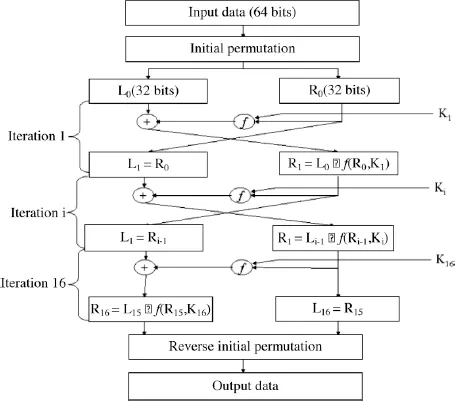
The DES encryption algorithm is shown in Figure 1.1.
Each 64-bit data block is submitted to an initial permutation function. The resulting 64-bit block is then cut into two 32-bit blocks (left block L0 and right block R0).
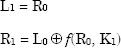
The DES algorithm is constructed using 16 successive iterations. The first iteration generates, from the two blocks L0 and R0, two blocks L1 and R1 in the following manner:
f0101.tif
Figure 1.1. DES algorithm
f0101.tif
At each iteration, the same operation is executed:
– left block Li corresponds to right block Ri-1;
– right block Ri is an exclusive OR of left block Li-1 and of the result of an f function applied to right block Ri-1and to Ki deducted from the initial 64-bit key (key1, key2 or key3).
The output of the last iteration is composed of left block L16 and right block R16. Block R16L16 is subjected to a reverse initial permutation.
The f function is described in Figure 1.2.
The E function is u...


Table of contents

  1. Cover
  2. Contents
  3. Title Page
  4. Copyright
  5. Preface
  6. Abbreviations
  7. 1 Introduction to Cryptography
  8. 2 802.1x Mechanism
  9. 3 WPA Mechanisms
  10. 4 IPSec Mechanism
  11. 5 SSL, TLS and DTLS Protocols
  12. 6 Network Management
  13. 7 MPLS Technology
  14. 8 Ethernet VPN
  15. 9 Firewalls
  16. 10 Intrusion Detection
  17. Bibliography
  18. Index

Frequently asked questions

Yes, you can cancel anytime from the Subscription tab in your account settings on the Perlego website. Your subscription will stay active until the end of your current billing period. Learn how to cancel your subscription
No, books cannot be downloaded as external files, such as PDFs, for use outside of Perlego. However, you can download books within the Perlego app for offline reading on mobile or tablet. Learn how to download books offline
Perlego offers two plans: Essential and Complete
  • Essential is ideal for learners and professionals who enjoy exploring a wide range of subjects. Access the Essential Library with 800,000+ trusted titles and best-sellers across business, personal growth, and the humanities. Includes unlimited reading time and Standard Read Aloud voice.
  • Complete: Perfect for advanced learners and researchers needing full, unrestricted access. Unlock 1.4M+ books across hundreds of subjects, including academic and specialized titles. The Complete Plan also includes advanced features like Premium Read Aloud and Research Assistant.
Both plans are available with monthly, semester, or annual billing cycles.
We are an online textbook subscription service, where you can get access to an entire online library for less than the price of a single book per month. With over 1 million books across 990+ topics, we’ve got you covered! Learn about our mission
Look out for the read-aloud symbol on your next book to see if you can listen to it. The read-aloud tool reads text aloud for you, highlighting the text as it is being read. You can pause it, speed it up and slow it down. Learn more about Read Aloud
Yes! You can use the Perlego app on both iOS and Android devices to read anytime, anywhere — even offline. Perfect for commutes or when you’re on the go.
Please note we cannot support devices running on iOS 13 and Android 7 or earlier. Learn more about using the app
Yes, you can access Network Security by André Pérez in PDF and/or ePUB format, as well as other popular books in Technology & Engineering & Electrical Engineering & Telecommunications. We have over one million books available in our catalogue for you to explore.