Discover Bitcoin, the cryptocurrency that has the finance world buzzing
Bitcoin is arguably one of the biggest developments in finance since the advent of fiat currency. With Understanding Bitcoin, expert author Pedro Franco provides finance professionals with a complete technical guide and resource to the cryptography, engineering and economic development of Bitcoin and other cryptocurrencies. This comprehensive, yet accessible work fully explores the supporting economic realities and technological advances of Bitcoin, and presents positive and negative arguments from various economic schools regarding its continued viability.
This authoritative text provides a step-by-step description of how Bitcoin works, starting with public key cryptography and moving on to explain transaction processing, the blockchain and mining technologies. This vital resource reviews Bitcoin from the broader perspective of digital currencies and explores historical attempts at cryptographic currencies. Bitcoin is, after all, not just a digital currency; it's a modern approach to the secure transfer of value using cryptography. This book is a detailed guide to what it is, how it works, and how it just may jumpstart a change in the way digital value changes hands.
Understand how Bitcoin works, and the technology behind it
Delve into the economics of Bitcoin, and its impact on the financial industry
Discover alt-coins and other available cryptocurrencies
Explore the ideas behind Bitcoin 2.0 technologies
Learn transaction protocols, micropayment channels, atomic cross-chain trading, and more
Bitcoin challenges the basic assumption under which the current financial system rests: that currencies are issued by central governments, and their supply is managed by central banks. To fully understand this revolutionary technology, Understanding Bitcoin is a uniquely complete, reader-friendly guide.
There has been ample media coverage of Bitcoin, and many public figures have been compelled to state their opinion. As Bitcoin is a complex topic, covering cryptography, software engineering and economics, it is difficult to grasp its essence and implications with only a superficial look at it. Thus some commentators might not have a clear picture of how it works and the implications. It is the goal of this book to equip the reader with the knowledge to evaluate the merits of this technology.
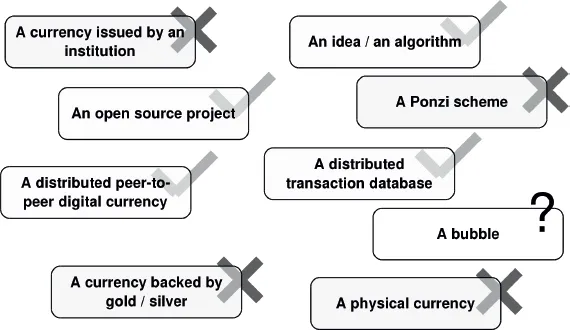
Figure 1.1 summarizes some misconceptions around Bitcoin.
FIGURE 1.1 What Bitcoin is (and isn’t)
Bitcoin is a decentralized digital currency. This means there is no person or institution behind it, either backing it or controlling it. Neither is it backed by physical goods, such as precious metals. This might seem counter-intuitive at first glance: how could it exist if no one controls it? Who created it then? How did the creator lose control over it?
The answer to this seeming paradox is that Bitcoin is just a computer program. How exactly this computer program works is the subject of the second part of this book. The program has a creator (or creators) but his identity is unknown as he released the Bitcoin software using what is believed to be a pseudonym: Satoshi Nakamoto. Bitcoin is not controlled in a tight sense by anyone. The creator did not lose control of it because he (she?, they?) never owned the code. The code is open source and thus it belongs to the public domain, as will be further explained in section 1.2.
One of the most innovative features of Bitcoin is that it is decentralized. There is no central server where Bitcoin is running. Bitcoin operates through a peer-to-peer network of connected computers. Bitcoin is the first digital currency built in a decentralized way, a technological breakthrough. The decentralized nature of Bitcoin will be further explored in section 1.1.
Bitcoin creates its own currency called bitcoin, with a small b. The creation of a currency is integral to how the system operates, as it serves two simultaneous purposes. First, it serves to represent value. Second, issuance of new bitcoins is used to reward operators in the network for securing the distributed ledger. These two functions cannot be unbundled without significantly changing the design.
The heart of the Bitcoin network is a database holding the transactions that have occurred in the past as well as the current holders of the funds. This database is sometimes called a ledger, because it holds the entries representing the owners of the funds. Bitcoin is not the first distributed database to be created. However, the requirements of a financial database are different from those of other applications, such as file sharing or messaging systems. In particular, financial databases must be resilient against users trying to double-spend their funds, which Bitcoin solves elegantly. This is explored in the following sections and in Chapter 2.
Some critics have argued that Bitcoin is a Ponzi scheme. It is not. In a Ponzi scheme there is a central operator who pays returns to current investors from new capital inflows. First of all, in Bitcoin there is no central operator who can profit from the relocation of funds. Second, there is no mechanism to deflect funds from new investments to pay returns. The only funds recognized in the Bitcoin protocol are bitcoins, the currency. Transfers of bitcoins are initiated by the users at their will: the protocol cannot deflect funds from one user to another. Third, a new investment in Bitcoin is always matched with a disinvestment. Investors who put money into bitcoins usually operate through an exchange where they buy the bitcoins from another investor who is selling her investment. There is simply no new investment flowing into bitcoins: the amount of sovereign currency that has flown into bitcoins exactly matches the amount that has flown out of bitcoins.
However, bitcoin, the currency, can be a bubble. Whether the value of bitcoin crashes, holds, or increases depends on whether bitcoins will be used in the future for different applications. There are several interesting applications for Bitcoin, of which the most straightforward (but not the only) are to serve as a medium of exchange and a store of value. It is too early to tell whether any of these applications will become important in the future. The merits of bitcoins as medium of exchange and store of value are explored in Chapter 3.
Finally, Bitcoin is not just a currency but a whole infrastructure that can be used to transfer value digitally: see section 1.4 and Chapter 12.
1.1 DECENTRALIZED
Most currencies in use today are fiat currencies, where the currency is issued by the government and its supply managed by a central bank.
FIAT MONEY
Most currencies today (Euro, US Dollar) are fiat money. Fiat money does not have intrinsic value, as it is not backed by anything. It is called fiat money because there is a government decree (“fiat”) declaring the currency to be legal tender. The acceptance of fiat money depends on expectations and social convention. If confidence in a currency is lost, usually because of irresponsible monetary policy, fiat money can stop being accepted.
Experience has shown that leaving monetary policy in the hands of governments is usually not a good idea, as governments could have an incentive to increase the monetary supply to solve pressing short-term financial problems. This behavior can lead to high inflation and a loss of confidence in the currency.
The conventional solution is to entrust monetary policy to a semi-independent central bank. The central bank is tasked with managing the monetary policy, usually with the goals of economic growth, price stability, and, in some cases, stability of the financial system.
Bitcoin is based on a peer-to-peer network of computers running the software. These computers are called nodes. Participants in the network might be running nodes for different reasons: for profit as in the case of miners (Chapter 9), to manage full-node wallets (Chapter 8), to collect and study information about the network (Chapter 13), or simply as a social good.
Bitcoin’s decentralized nature contrasts to the structure of fiat currencies. Central banks make monetary decisions after evaluating evidence gathered from the evolution of the economy. In a decentralized system such as Bitcoin, discretionary decisions are not possible. The original creators of the system have to take most of the decisions upfront at the design phase. These decisions have to be carefully balanced, and take into account the incentives of the different users, otherwise the decentralized system is doomed to fail. In Bitcoin the monetary policy follows a simple rule: the final monetary base is fixed at around 21 million bitcoins and new bitcoins are minted at a planned schedule and paid to users who help secure the network. This serves the double purpose of providing the bitcoins with value due to their scarcity and creating incentives for users to connect to the network and help secure it by providing their computational power.
Control in a centralized system is usually concentrated in an institution or a small group of key people. Thus changes in a centralized system are relatively straightforward to decide and implement. Control in a peer-to-peer network is more subtle: changes in a peer-to-peer network have to be agreed by a majority of the peers at least. But even then, if a strong minority does not agree to a change, implementing the change can be technically challenging as the network runs the risk of a split.
One advantage of the decentralization of power is that changes that are contrary to the interests of most users would be rejected. In contrast, in centralized systems sometimes the outcomes are adverse to most of the participants, as in a currency debasement by excessive printing which usually leads to high inflation.
Another f...
Table of contents
Cover
Title page
Copyright
Dedication
About the Author
Acknowledgments
Foreword
Prologue
Preface
Part One: Introduction and Economics
Part Two: Bitcoin Technology
Part Three: The Cryptocurrencies Landscape
Bibliography
Index
End User License Agreement
Trusted by 375,005 students
Access to over 1.5 million titles for a fair monthly price.
Study more efficiently using our study tools.
Frequently asked questions
Yes, you can cancel anytime from the Subscription tab in your account settings on the Perlego website. Your subscription will stay active until the end of your current billing period. Learn how to cancel your subscription
No, books cannot be downloaded as external files, such as PDFs, for use outside of Perlego. However, you can download books within the Perlego app for offline reading on mobile or tablet. Learn how to download books offline
Perlego offers two plans: Essential and Complete
Essential is ideal for learners and professionals who enjoy exploring a wide range of subjects. Access the Essential Library with 800,000+ trusted titles and best-sellers across business, personal growth, and the humanities. Includes unlimited reading time and Standard Read Aloud voice.
Complete: Perfect for advanced learners and researchers needing full, unrestricted access. Unlock 1.5M+ books across hundreds of subjects, including academic and specialized titles. The Complete Plan also includes advanced features like Premium Read Aloud and Research Assistant.
Both plans are available with monthly, semester, or annual billing cycles.
We are an online textbook subscription service, where you can get access to an entire online library for less than the price of a single book per month. With over 1.5 million books across 990+ topics, we’ve got you covered! Learn about our mission
Look out for the read-aloud symbol on your next book to see if you can listen to it. The read-aloud tool reads text aloud for you, highlighting the text as it is being read. You can pause it, speed it up and slow it down. Learn more about Read Aloud
Yes! You can use the Perlego app on both iOS and Android devices to read anytime, anywhere — even offline. Perfect for commutes or when you’re on the go. Please note we cannot support devices running on iOS 13 and Android 7 or earlier. Learn more about using the app
Yes, you can access Understanding Bitcoin by Pedro Franco in PDF and/or ePUB format, as well as other popular books in Business & Finance. We have over 1.5 million books available in our catalogue for you to explore.