This concise and systematic account of the current state of this new branch of astrophysics presents the theoretical foundations of plasma astrophysics, magneto-hydrodynamics and coronal magnetic structures, taking into account the full range of available observation techniques -- from radio to gamma.
The book discusses stellar loops during flare energy releases, MHD waves and oscillations, plasma instabilities and heating and charged particle acceleration. Current trends and developments in MHD seismology of solar and stellar coronal plasma systems are also covered, while recent progress is presented in the observational study of quasi-periodic pulsations in solar and stellar flares with radio, optical, X and gamma rays. In addition, the authors investigate the origin of coherent radio emission from stellar loops, paying special attention to their fine structure.
For advanced students and specialists in astronomy, as well as theoretical and plasma physics.
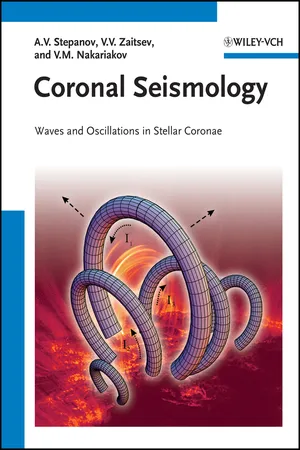
eBook - ePub
Coronal Seismology
Waves and Oscillations in Stellar Coronae
- English
- ePUB (mobile friendly)
- Available on iOS & Android
eBook - ePub
Coronal Seismology
Waves and Oscillations in Stellar Coronae
About this book
Information
Chapter 1
Introduction
Uchida [1], who suggested the idea of plasma and magnetic field diagnostics in the solar corona on the basis of waves and oscillations in 1970, and Rosenberg [2], who first explained the pulsations in type IV solar radio bursts in terms of the loop magnetohydrodynamic (MHD) oscillations, can be considered to be pioneers of coronal seismology.
Various approaches have been used to describe physical processes in stellar coronal structures: kinetic, MHD, and electric circuit models are among them. Two main models are presently very popular in coronal seismology. The first considers magnetic flux tubes and loops as wave guides and resonators for MHD waves and oscillations, whereas the second describes a loop in terms of an equivalent electric (RLC) circuit. Several detailed reviews are devoted to problems of coronal seismology (see, i.e., [3–7]). Recent achievements in the solar coronal seismology are also referred in Space Sci. Rev. vol. 149, No. 1–4 (2009). Nevertheless, some important issues related to diagnostics of physical processes and plasma parameters in solar and stellar flares are still insufficiently presented in the literature. The main goal of the book is the successive description and analysis of the main achievements and problems of coronal seismology.
There is much in common between flares on the Sun and on late-type stars, especially red dwarfs [8]. Indeed, the timescales, the Neupert effect, the fine structure of the optical, radio, and X-ray emission, and the pulsations are similar for both solar and stellar flares. Studies of many hundreds of stellar flares have indicated that the latter display a power–law radiation energy distribution, similar to that found for solar flares. Thus, we can use the solar–stellar analogy to study flaring stars.
The next goal of this book is to illustrate the efficiency of coronal seismology as a diagnostic tool for the analysis of stellar flares.
1.1 Magnetic Loops and Open Flux Tubes as Basic Structural Elements in Solar and Stellar Coronae
Magnetic loops constitute the basic structural element in the coronae of the Sun and late-type stars [9–11]. They play an important role in solar activity. Observations made with Skylab, Solar and Heliospheric Observatory (SOHO), Yohkoh, Reuven Ramaty High-Energy Solar Spectroscopic Imager (RHESSI), Transition Region and Coronal Explorer (TRACE), Complex Orbital Near-Earth Observations of Activity of the Sun – Photon (CORONAS–F), Hinode, Solar Dynamic Observatory (SDO) space missions, as well as with large optical telescopes Vacuum Tower Telescope (VTT), and radio telescopes (Very Large Array (VLA), Siberian Solar Radio Telescope (SSRT), NoRH (Nobeyama Radioheliograph)) have shown that solar flares originate in coronal loops [3, 12]. Eruptive prominences and coronal transients result in giant coronal mass ejections (CMEs) and also frequently display the loop shape [13]. The flaring activity of dMe-stars and close binaries is also spawned by the energy release in magnetic loops [9, 14, 15]. In some late-type stars, magnetic spots cover up to 70–80% of the surface, whereas solar spots occupy ∼0.04% of the photosphere. This implies that, in fact, loops form the magnetic structure of stellar coronae. In addition, loops are typical for the magnetic structure of the atmospheres of accretion disks, young stellar objects, and neutron stars [16–19]. Owing to space-borne observations and advances in the physics of the loops, some progress has been recently made in finding a solution for the problem of the origin of coronal loops. Alfvén and Carlqvist [20] have suggested that a flaring loop can be considered to be an equivalent electric circuit. This phenomenological approach was nevertheless very productive in understanding the energy pattern of flare processes. The description of the loops in terms of resonators and wave guides for MHD waves explains various kinds of modulations of stellar flare emissions and serves as a diagnostic tool for the flare plasma. The concept of a coronal loop as a magnetic mirror trap for energetic particles makes it possible to efficiently describe particle dynamics and peculiarities of emission generated by energetic particles.
Open magnetic structures – the flux tubes – are wave guides for MHD waves, which make them important channels of energy transfer from one part of the stellar atmosphere to another, from the photosphere and chromosphere to the corona, and further to the solar and stellar wind. Similar to magnetic loops, the flux tubes provide a necessary link in the mechanism of coronal heating. Flux tubes are exemplified by solar spicules, which are energy/mass bridges between the dense and dynamic photosphere and the tenuous hot solar corona [21].
Prominence dynamics and oscillations also present important subjects for coronal seismology [22, 23] since prominences play a crucial role both in triggering flares [24, 25] and in CME’s origin [26]. Therefore, the study of ballooning instability presents a very important point in the context of flaring and CME’s activity.
1.2 Data of Observations and Types of Coronal Loops
The corona of the Sun (a main-sequence G2 star) in its active phase consists predominantly of magnetic loops filled with comparatively dense and hot plasma, which is observed in soft X rays and constitutes an essential part of the total mass of the corona. The presence of magnetic loops indicates the complexity of the subphotospheric magnetic field, which is most likely linked to convective motions of the photosphere matter. Observ...
Table of contents
- Cover
- Title
- Related Titles
- Copyright
- Preface
- Chapter 1: Introduction
- Chapter 2: Coronal Magnetic Loop as an Equivalent Electric Circuit
- Chapter 3: Resonators for MHD Oscillations in Stellar Coronae
- Chapter 4: Propagating MHD Waves in Coronal Plasma Waveguides
- Chapter 5: Prominence Seismology
- Chapter 6: The Coronal Loop as a Magnetic Mirror Trap
- Chapter 7: Flaring Events in Stellar Coronal Loops
- Chapter 8: Stellar Coronal Seismology as a Diagnostic Tool for Flare Plasma
- Chapter 9: Heating Mechanisms in Stellar Coronae
- Chapter 10: Loops and QPOs in Neutron Stars and Accretion Disk Coronae
- Chapter 11: Conclusions
- Index
Trusted by 375,005 students
Access to over 1.5 million titles for a fair monthly price.
Study more efficiently using our study tools.
Frequently asked questions
Yes, you can cancel anytime from the Subscription tab in your account settings on the Perlego website. Your subscription will stay active until the end of your current billing period. Learn how to cancel your subscription
No, books cannot be downloaded as external files, such as PDFs, for use outside of Perlego. However, you can download books within the Perlego app for offline reading on mobile or tablet. Learn how to download books offline
Perlego offers two plans: Essential and Complete
- Essential is ideal for learners and professionals who enjoy exploring a wide range of subjects. Access the Essential Library with 800,000+ trusted titles and best-sellers across business, personal growth, and the humanities. Includes unlimited reading time and Standard Read Aloud voice.
- Complete: Perfect for advanced learners and researchers needing full, unrestricted access. Unlock 1.5M+ books across hundreds of subjects, including academic and specialized titles. The Complete Plan also includes advanced features like Premium Read Aloud and Research Assistant.
We are an online textbook subscription service, where you can get access to an entire online library for less than the price of a single book per month. With over 1.5 million books across 990+ topics, we’ve got you covered! Learn about our mission
Look out for the read-aloud symbol on your next book to see if you can listen to it. The read-aloud tool reads text aloud for you, highlighting the text as it is being read. You can pause it, speed it up and slow it down. Learn more about Read Aloud
Yes! You can use the Perlego app on both iOS and Android devices to read anytime, anywhere — even offline. Perfect for commutes or when you’re on the go.
Please note we cannot support devices running on iOS 13 and Android 7 or earlier. Learn more about using the app
Please note we cannot support devices running on iOS 13 and Android 7 or earlier. Learn more about using the app
Yes, you can access Coronal Seismology by Alexander Stepanov,Valery V. Zaitsev,Valery M. Nakariakov in PDF and/or ePUB format, as well as other popular books in Physical Sciences & Astronomy & Astrophysics. We have over 1.5 million books available in our catalogue for you to explore.