Principles of Group Accounting under IFRS
eBook - ePub

Principles of Group Accounting under IFRS

  1. English
  2. ePUB (mobile friendly)
  3. Available on iOS & Android
eBook - ePub

Principles of Group Accounting under IFRS

About this book

A professional perspective to implementing IFRS 10, 11, and 12

The new International Financial Reporting Standards (IFRS) 10, 11, and 12 are changing group accounting for many businesses. As business becomes increasingly global, more and more firms will need to transition using the codes and techniques described in Principles of Group Accounting under IFRS. This book is a practical guide and reference to the standards related to consolidated financial statements, joint arrangements, and disclosure of interests. Fully illustrated with a step-by-step case study, Principles of Group Accounting under IFRS is equally valuable as an introductory text and as a reference for addressing specific issues that may arise in the process of consolidating group accounts.

The new international standards will bring about significant changes in group reporting, and it is essential for accountants, auditors, and business leaders to understand their implications. Author Andreas Krimpmann is an internationally recognized authority on the transition from GAAP to IFRS, and this new text comes packaged with GAAP/IFRS comparison resources that will help make the changes clear. Other bonus resources include an Excel-based consolidation tool, checklists, and a companion website with the latest information. Learn about:

  • Definitions, requirements, processes, and transition techniques for IFRS 10, 11, and 12 covering group level accounting
  • Practical implementation strategies demonstrated through a clear case study of a midsize group
  • Key concepts related to consolidated financial statements, joint ventures, management consolidation, and disclosure of interests
  • Comparisons between GAAP and IFRS to clarify the required changes for international firms

Whatever stage of the consolidation process you are in, you will appreciate the professional perspective in Principles of Group Accounting under IFRS.
Frequently asked questions

Yes, you can cancel anytime from the Subscription tab in your account settings on the Perlego website. Your subscription will stay active until the end of your current billing period. Learn how to cancel your subscription.
At the moment all of our mobile-responsive ePub books are available to download via the app. Most of our PDFs are also available to download and we're working on making the final remaining ones downloadable now. Learn more here.
Perlego offers two plans: Essential and Complete
  • Essential is ideal for learners and professionals who enjoy exploring a wide range of subjects. Access the Essential Library with 800,000+ trusted titles and best-sellers across business, personal growth, and the humanities. Includes unlimited reading time and Standard Read Aloud voice.
  • Complete: Perfect for advanced learners and researchers needing full, unrestricted access. Unlock 1.4M+ books across hundreds of subjects, including academic and specialized titles. The Complete Plan also includes advanced features like Premium Read Aloud and Research Assistant.
Both plans are available with monthly, semester, or annual billing cycles.
We are an online textbook subscription service, where you can get access to an entire online library for less than the price of a single book per month. With over 1 million books across 1000+ topics, we’ve got you covered! Learn more here.
Look out for the read-aloud symbol on your next book to see if you can listen to it. The read-aloud tool reads text aloud for you, highlighting the text as it is being read. You can pause it, speed it up and slow it down. Learn more here.
Yes! You can use the Perlego app on both iOS or Android devices to read anytime, anywhere — even offline. Perfect for commutes or when you’re on the go.
Please note we cannot support devices running on iOS 13 and Android 7 or earlier. Learn more about using the app.
Yes, you can access Principles of Group Accounting under IFRS by Andreas Krimpmann in PDF and/or ePUB format, as well as other popular books in Business & Financial Accounting. We have over one million books available in our catalogue for you to explore.

Information

Publisher
Wiley
Year
2015
Print ISBN
9781118751411
eBook ISBN
9781118751381
Edition
1

F

SUBSEQUENT CONSOLIDATION

About this chapter:

The subsequent consolidation of a group is that recurring task that has to be executed at the end of each period. It has to be arranged in a way that external deadlines to publish consolidated financial statements have to be met. To ensure smooth and timely preparation, special attention is given in practice to the subsequent consolidation, as this is the core process in preparing consolidated financial statement.
This chapter discusses the whole subsequent consolidation process. Its focus is on all the necessary consolidation steps, particularly equity, debt and profit consolidation. It also deals with presentation issues, particularly for non-controlling interests and group transactions such as the impairment test. For all consolidation steps, detailed explanation is given on intercompany relationships, consolidation techniques and the treatment of consolidation problems and errors. This includes journal entries of each consolidation step. The chapter also covers the accounting of special intercompany business transactions like transfer pricing, dividend payments, non-current asset sales and the consolidation of multi-level groups.
The consolidation process is explained for subsidiaries. The subsequent handling of associates and joint ventures are discussed in chapters 7 - Associated companies and 8 - Joint Ventures.

1. BASICS

image
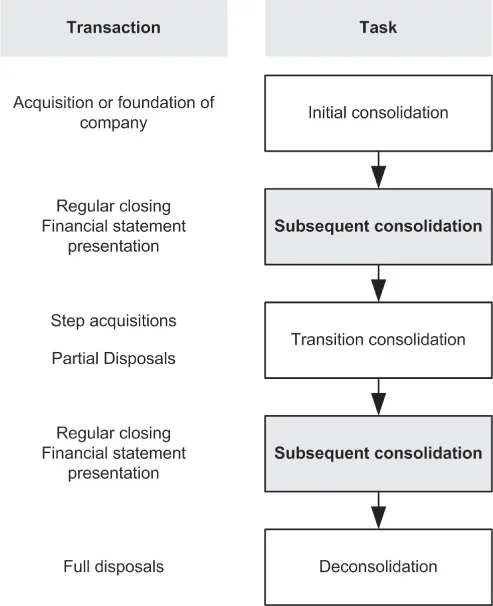
Fig F.1 Lifecycle of a corporation: Subsequent consolidation
Consolidated financial statements need to be prepared at the end of each period during the lifecycle of a group. The lifecycle – and therefore, subsequent consolidation – will continue until the last subsidiary is sold, liquidated, or otherwise no longer part of the group's companies. Consolidation of the subsidiary is the process that prepares consolidated financial statements based on the various financial statements of all companies which are subject to consolidation.
The relevant standards for the subsequent consolidation are IAS 27 –Separate Financial Statements and IFRS 10 – Consolidated Financial Statements. While IAS 27 focuses on the preparation of separate financial statements, this standard is important if companies of the group apply IFRS as their local accounting standard. By contrast, IFRS 10 covers all accounting requirements for the preparation of consolidated financial statements. This standard does not care how separate financial statements of the group's companies are prepared. IFRS 10 does not differentiate between initial and subsequent consolidations. Therefore, the same accounting rules apply to both consolidations.
The preparation of consolidated financial statements is embedded in a set of accounting requirements defined by IFRS 10.B86 to 10.B99. According to these requirements, the following items need to be considered when preparing consolidated financial statements:
  • Consolidation procedures
    In general IFRS 10.B86 requires elimination of all group-internal transactions. The eli...

Table of contents

  1. Cover
  2. Title Page
  3. Copyright
  4. Table of Contents
  5. Dedication
  6. LIST OF FIGURES
  7. LIST OF TABLES
  8. PREFACE
  9. INTRODUCTION TO THE BOOK
  10. A: THE CASE STUDY
  11. B: LEGAL REQUIREMENTS FOR CONSOLIDATED FINANCIAL STATEMENTS
  12. C: DEFINITION OF GROUPS
  13. D: PREPARATION OF CONSOLIDATED FINANCIAL STATEMENTS AND ANNUAL REPORTS
  14. E: INITIAL CONSOLIDATION
  15. F: SUBSEQUENT CONSOLIDATION
  16. G: ASSOCIATED COMPANIES
  17. H: JOINT ARRANGEMENTS
  18. I: CHANGES IN CONTROL
  19. J: DISPOSALS AND DECONSOLIDATION
  20. K: SPECIAL AREAS
  21. L: MANAGEMENT CONSOLIDATION
  22. M: CONSOLIDATED FINANCIAL STATEMENTS
  23. N APPENDIX I: FAIR VALUE MEASUREMENT
  24. APPENDIX II: IFRS – US-GAAP COMPARISON
  25. APPENDIX III: IFRS
  26. GLOSSARY
  27. REFERENCE LIST
  28. INDEX
  29. End User License Agreement