A Companion to Roman Italy investigates the impact of Rome in all its forms—political, cultural, social, and economic—upon Italy's various regions, as well as the extent to which unification occurred as Rome became the capital of Italy.
The collection presents new archaeological data relating to the sites of Roman Italy
Contributions discuss new theories of how to understand cultural change in the Italian peninsula
Combines detailed case-studies of particular sites with wider-ranging thematic chapters
Leading contributors not only make accessible the most recent work on Roman Italy, but also offer fresh insight on long standing debates
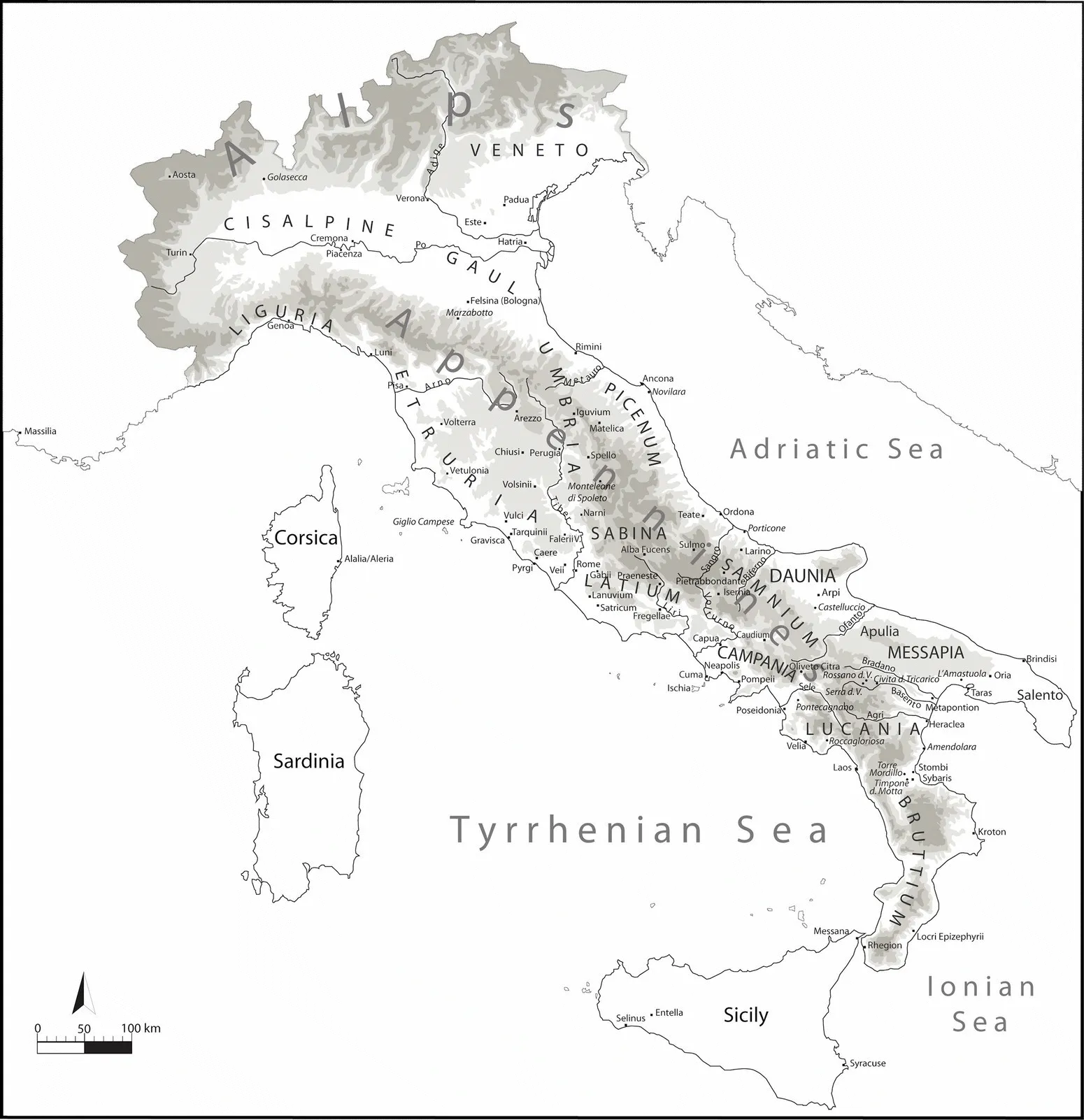
The spread of Roman hegemonic power was not itself responsible for the creation of an entity called Italy (Figure 1.1). In the end it was the result of a newly formed method of organization, an overarching structure that by the late Republic bound all those inhabiting the peninsula to each other through the central authority based in Rome; an authority that became the director of resources both human and material, shaping the Italian landscape to orient itself around the center (Morley, 1996). Yet we can argue for an Italy even before this moment. Already in the early 2nd century BC Cato could treat the peninsula as if it was his high street, noting the best places to get provisions for running a farm: if purchasing an olive press, best to go to the yard of Rufrius in Pompeii (De agricultura: 22). Interregional connections which developed rapidly in the Hellenistic period led to the formation of a single organism. Prior to such a moment, Italy the peninsula was multi-polar, and not only in a physical sense. A number of overlapping organizational forces operated simultaneously, and competed in controlling the resource base. These forces were not restricted by the coastline; Italy was not their container: rather, they drew on networks that criss-crossed the Mediterranean and reached beyond it (Horden and Purcell, 2000; van Dommelen and Knapp, 2010). In the Archaic period a merchant from Veii in Etruria probably had more in common with another such trader from Carthage, Corinth, or Massilia than with one living in the region of Messapia in the heel of Italy. There was more chance that the two Italians would meet at a festival abroad, a port at one of the trading hubs such as Corinth, a boat captured by pirates, or as part of a mixed mercenary force fighting for a Greek tyrant, than on the peninsula itself. It is also plausible that they might find it easier to communicate with each other in Punic or Greek, rather than in any Italic language, of which there would have been at least a dozen at the time (cf. Lomas, ch.11 this vol.). That does not mean that there were no links, common socio-political worries, interest in economic opportunities, or shared modes of cultural expression that ran along the length of Italy’s spine, but rather that such ties were not necessarily stronger simply because those who were bound by them shared the landscapes of the peninsula as their home.
Figure 1.1 Map of Italy with sites cited in the text (modern names in italics). Drawing: Antonio Montesanti.
Narratives of pre-Roman Italy usually begin by outlining its broad regional divisions, where each territorial section overlaps with a particular ethnic group’s sphere of influence, its associated language, and its other distinguishing cultural characteristics. These tend to include the following: most prominently the Etruscans with a base in Etruria who extended to Campania in the south and the Po Valley in the north; they edged the territory of Cisalpine Gaul, which encompassed Liguria, the Veneto, the Insubres and also a number of Celtic groups; in a central position reaching to the west coast was Latium; the length of Italy’s spine was the main home to the speakers of Osco-Umbrian or Sabellic languages associated mostly with the Umbrians, Samnites, and Lucanians, stretching into the toe of Bruttium, and Campania on the west coast; these were edged on the east coast by Picenum, and further south the Apulian region incorporated Daunia and Messapia on the Salento peninsula; ringed around the south coast, the Greek colonies which appeared from the eighth century BC onward are also usually taken as a group. Such an overview is helpful for categorizing information, but also has the danger of lending cohesion to areas where it did not exist, while overlooking ties beyond them. Even the homogeneity of the Greek colonies has been questioned. Scholars point to the mixed nature of such settlements and show that their beginnings have the characteristic of being small group ventures rather than any state-initiated enterprise (Osborne, 1998; Hurst and Owen, 2005; Bradley and Wilson, 2006). A regional approach to Italy begins to break down once the focus shifts onto individual sites and networks of connectivity that ran through them (Bradley, Isayev, and Riva, 2007). This chapter looks at the organizational possibilities that were prevalent in Italy before it gained a cohesive form, at a time when her shores were fluid. How these were transformed and superseded, and which of them continued to exist in a Roman Italia, is in part what the rest of this volume is about.
1.2 Forces of Centralization – InterpretingSettlement Patterns
The single settlement is often seen as the most concrete organizational unit, whether it is a city, town, or village. But its relationship to a particular community is less straightforward. We may take the most obvious case of the Roman citizen body, which extended well beyond the group who inhabited the physical city. Those born in Rome who held the citizenship could choose to live abroad, while those born outside the city could gain the citizenship through various means, such as the carrying out of services for the state (Sherwin-White, 1973). Eventually whole settlements, such as colonies, held Roman citizen status, and in 89 BC it was granted to all communities south of the Po. We know little about how other Italic memberships functioned, but there is enough to indicate fluidity between members of different communities who were of the same high social standing, including those from outside Italy. It is such fluidity and openness that allowed Rome to experiment with different forms of membership status and inter-community ties that some see as the key to its success in Italy and the Mediterranean (Eckstein, 2006: ch. 7).
The question is how we interpret the diverse settlement patterns across the peninsula that existed simultaneously, and what do the structures on the ground tell us about community and state- formation (Bradley, Isayev, and Riva, 2007; Terrenato and Haggis, 2011; Cornell, 1995; Riva 2010a)? Landscape archaeology has allowed for a wide-reaching sweep of the peninsula (Attema, Burgers, and van Leusen, 2010; Patterson, 2004; Carter, 2006). The material shows two key points of transformation which, although varying in scale and rates of change, affect the whole of Italy: centralization in the early centuries of the first millennium BC, and a filling in of habitation in the countryside in the early Hellenistic period. A shift to nucleated settlements occurs in the period between the Final Bronze Age and the Iron Age. It is most visible in Etruria, Umbria and northern Latium, in what was already a densely populated landscape characterized by a multiplicity of small sites of circa 1–15 hectares throughout the Bronze Age. Within only a few centuries there was a process of amalgamation, which led to the rise of fewer but substantially larger settlements, some of 100–200 hectares, occupying broad plateaus that could accommodate populations in the thousands (Attema, Burgers, and van Leusen, 2010; Smith, 2007b). The most prominent communities that continued to flourish and exert power throughout the eighth–sixth centuries BC were Tarquinii, Caere, Veii, Volsinii, Vulci, Orvieto, Chiusi, Arezzo, and arguably Rome.
Just to the south of these hubs in the Pontine region of Latium, the transformations resulted in a different pattern. Here, sites such as Satricum and Lanuvium also show centralizing tendencies, but the sites are significantly smaller, 20–50 hectares and they are distributed more evenly through the landscape, especially around the Alban Hills (Attema, Burgers and van Leusen, 2010: 112–17). A similar pattern of site distribution is evident in the south of Italy. Nucleating forces in the Salento peninsula privileged the creation of equally modest sites of 30–50 hectares, such as Oria (Attema, Burgers, and van Leusen, 2010: 132). In the north of Italy, a region such as the Veneto saw both the creation of substantial towns such as Este and Padua, and smaller sites in the mountainous hinterland (Lomas, 2007), which was also characteristic of Liguria in the east (Häussler, 2007).
Comparative settlement s...
Table of contents
Cover
Title Page
Table of Contents
List of Illustrations
List of Tables
Notes on Contributors
Acknowledgements
INTRODUCTION: Setting the Scene
CHAPTER 1: Italy Before the Romans
PART I: The Impact of Rome – Unification and Integration
PART II: Local and Regional Diversity
PART III: Town and Country
PART IV: Economy and Society
Index
End User License Agreement
Trusted by 375,005 students
Access to over 1.5 million titles for a fair monthly price.
Study more efficiently using our study tools.
Frequently asked questions
Yes, you can cancel anytime from the Subscription tab in your account settings on the Perlego website. Your subscription will stay active until the end of your current billing period. Learn how to cancel your subscription
No, books cannot be downloaded as external files, such as PDFs, for use outside of Perlego. However, you can download books within the Perlego app for offline reading on mobile or tablet. Learn how to download books offline
We are an online textbook subscription service, where you can get access to an entire online library for less than the price of a single book per month. With over 1.5 million books across 990+ topics, we’ve got you covered! Learn about our mission
Look out for the read-aloud symbol on your next book to see if you can listen to it. The read-aloud tool reads text aloud for you, highlighting the text as it is being read. You can pause it, speed it up and slow it down. Learn more about Read Aloud
Yes! You can use the Perlego app on both iOS and Android devices to read anytime, anywhere — even offline. Perfect for commutes or when you’re on the go. Please note we cannot support devices running on iOS 13 and Android 7 or earlier. Learn more about using the app
Yes, you can access A Companion to Roman Italy by Alison E. Cooley in PDF and/or ePUB format, as well as other popular books in History & Roman Ancient History. We have over 1.5 million books available in our catalogue for you to explore.