Steel-reinforced concrete is used ubiquitously as a building material due to its unique combination of the high compressive strength of concrete and the high tensile strength of steel. Therefore, reinforced concrete is an ideal composite material that is used for a wide range of applications in structural engineering such as buildings, bridges, tunnels, harbor quays, foundations, tanks and pipes. To ensure durability of these structures, however, measures must be taken to prevent, diagnose and, if necessary, repair damage to the material especially due to corrosion of the steel reinforcement.
The book examines the different aspects of corrosion of steel in concrete, starting from basic and essential mechanisms of the phenomenon, moving up to practical consequences for designers, contractors and owners both for new and existing reinforced and prestressed concrete structures. It covers general aspects of corrosion and protection of reinforcement, forms of attack in the presence of carbonation and chlorides, problems of hydrogen embrittlement as well as techniques of diagnosis, monitoring and repair. This second edition updates the contents with recent findings on the different topics considered and bibliographic references, with particular attention to recent European standards. This book is a self-contained treatment for civil and construction engineers, material scientists, advanced students and architects concerned with the design and maintenance of reinforced concrete structures. Readers will benefit from the knowledge, tools, and methods needed to understand corrosion in reinforced concrete and how to prevent it or keep it within acceptable limits.
The protection that concrete provides to the embedded steel and, more in general, its ability to withstand various types of degradation, depend on its microstructure and composition. Concrete is a composite material made of aggregates and hydrated cement paste, that is, the reaction product of the cement and the mixing water. This chapter illustrates the properties of the most utilized cements and the microstructure of hydrated cement pastes. The properties of concrete and its manufacturing are discussed in Chapter 12.
1.1 Portland Cement and Hydration Reactions
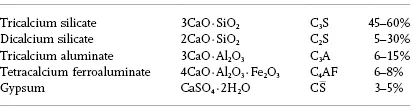
Cements are fine mineral powders that, when they are mixed with water, form a paste that sets and hardens due to hydration reactions. Portland cement is the basis for the most commonly used cements [1–5]. It is produced by grinding clinker, which is obtained by burning a suitable mixture of limestone and clay raw materials. Its main components are tricalcium and dicalcium silicates (C3S and C2S),1) the aluminate and ferroaluminate of calcium (C3A and C4AF, respectively). Gypsum (
) is also added to clinker before grinding, to control the rate of hydration of aluminates. Table 1.1 shows the typical ranges of variation of the constituents of portland cement. Other components, such as sodium and potassium oxides, are present in small but variable amounts.
Table 1.1 Main components of portland cement and typical percentages by mass.
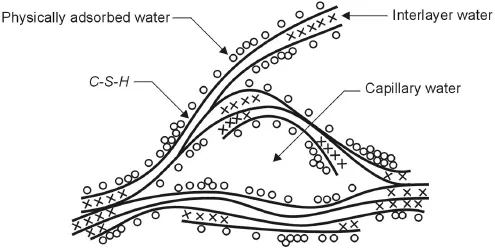
In the presence of water, the compounds of portland cement form colloidal hydrated products of very low solubility. Aluminates react first, and are mainly responsible for setting, that is, solidification of the cement paste. The hydration of C3A and C4AF, in the presence of gypsum, mainly gives rise to hydrated sulfoaluminates of calcium. Hardening of cement paste, that is, the development of strength that follows setting, is governed by the hydration of silicates. The hydration of C3S and C2S gives rise to calcium silicate hydrates forming a gel, indicated as C–S–H. It is composed of extremely small particles with a layer structure that tend to aggregate in formations a few μm in dimension, characterized by interlayer spaces of small dimensions (<2 nm) and by a large surface area (100–700 m2/g). Figure 1.1 shows a model proposed to describe this structure. Due to the high surface area, C–S–H can give considerable strength to the cement paste. Its chemical composition is not well defined since the ratio between the oxides may vary as the degree of hydration, water/cement ratio, and temperature vary (for instance the C/S ratio may vary from 1.5 to 2). However, upon complete hydration, it tends to correspond to the formula C3S2H3 usually used in stoichiometric calculations. C–S–H represents approximately 50–60% of the volume of the completely hydrated cement paste.
Figure 1.1 Feldman–Sereda model for C–S–H [2].
Hydration of calcium silicates also produces hexagonal crystals of calcium hydroxide (Ca(OH)2, portlandite). These have dimensions of the order of a few μm and occupy 20 to 25% of the volume of solids. They do not contribute to the strength of cement paste. However, Ca(OH)2, as well as NaOH and KOH, are very important with regard to protecting the reinforcement, because they cause an alkaline pH up to 13.5 in the pore liquid (Section 2.1.1).
The hydration reactions of tricalcium and dicalcium silicates can be illustrated as follows:
(1.1)
(1.2)
The reaction products are the same, but the proportions are different. The ratio between C–S–H and portlandite, passing from the hydration of C3S to that of C2S changes from 61/39 to 82/18, and the amount of water required for hydration from 23% to 21%. In principle, C2S should lead to a higher ultimate strength of the cement paste by producing a higher amount of C–S–H. Nevertheless, the rate of hydration is much lower for C2S compared with C3S, and the strength of cement paste after 28 days of wet curing is mainly due to C3S. Thus, the larger the amount of C3S in a portland cement, the higher the rate of hydration and strength development of its cement paste. Increasing the fineness of cement particles can also increase the rate of hydration. The reactions leading to hydration of portland cement are exothermic; hence increasing the rate of hydration also increases the rate of generation of heat of hydration.
1.2 Porosity and Transport Processes
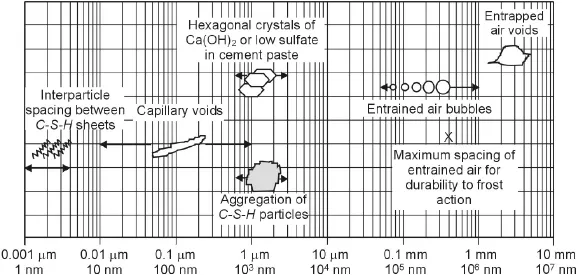
The cement paste formed by the hydration reactions contains interconnected pores of different sizes, as shown in Figure 1.2. Although the classification of concrete porosity is quite a complex matter [6], for the purposes of this book pores can be roughly divided into air voids, capillary pores and gel pores. The interlayer spacing within C–S–H (gel pores) have dimensions ranging from a few fractions of a nm to several nm. These essentially do not affect the durability of concrete and its protection of the reinforcement because they are too small to allow significant transport of aggressive species. The capillary pores are the voids not filled by the solid products of hydration within the hardened cement paste. They have dimensions of 10 to 50 nm if the cement paste is well hydrated and produced using low water/cement ratios (w/c), but can reach up to 3–5 μm if the concrete is made using high w/c ratios or it is not well hydrated. Larger pores of dimensions of up to a few mm are the result of the air entrapped during mixing and not removed by vibration of fresh concrete. Air bubbles with diameter of about 0.05–0.2 mm may also be introduced in the cement paste intentionally by means of air-entraining admixtures, so as to produce resistance to freeze–thaw cycles (Section 3.1.3). Both capillary pores and entrapped air are relevant to the durability of concrete and its protection of the rebars, since they determine the resistance to the penetration of aggressive species. The main factors affecting the capillary porosity, that is, water/cement ratio, curing, and type of binder, will be briefly analyzed in the following sections. Entrapped air can be reduced by providing adequate workability to the fresh concrete and proper compaction; this is dealt with in Chapter 12.
Figure 1.2 Dimensional range of solids and pores in hydrated cement paste [3].
1.2.1 Water/Cement Ratio and Curing
The water/cement ratio, that is, the ratio between mass of mixing water and mass of cement, and curing have a major effect on the capillary porosity, which can be described by considering changes occurring in time. During the hydration of cement paste, the gross volume of the mixture practically does not change, so that the initial volume, equal to the sum of the volumes of mixed water (Vw) and cement (Vc) is equal to the volume of the hardening product. As indicated in Figure 1.3 from Neville and Brooks [7], the total volume consists in the sum of the volume of cement that has not yet reacted (Vuc), the hydrated cement (Vp + Vgw), the capillary pores that are filled by water (Vcw) or by air (Vec). The volume of the products of hydration can be assumed to be roughly double that of the cement; hence during hydration these products fill the space previously occupied by the cement that has hydrated and part of the surrounding space initially occupied by water (Figure 1.4). Therefore, if the cement paste is kept moist (curing), the hydration proceeds and the volume of the capillary pores decreases and will reach a minimum when the hydration of cement has completed. Nevertheless, the porosity reached after complete hydration will be greater in proportion to the initial space between the cement particles and thus to the amount of mixing water. Figure 1.5 shows an example of the effect of w/c ratio and curing on the pore-size distribution, measured by mercury intrusion porosimetry. As the w/c ra...
Table of contents
Cover
Related Titles
Title page
Copyright page
Preface to the Second Edition
Preface to the First Edition
1: Cements and Cement Paste
2: Transport Processes in Concrete
3: Degradation of Concrete
4: General Aspects
5: Carbonation-Induced Corrosion
6: Chloride-Induced Corrosion
7: Electrochemical Aspects
8: Macrocells
9: Stray-Current-Induced Corrosion
10: Hydrogen-Induced Stress Corrosion Cracking
11: Design for Durability
12: Concrete Technology for Corrosion Prevention
13: Corrosion Inhibitors
14: Surface Protection Systems
15: Corrosion-Resistant Reinforcement
16: Inspection and Condition Assessment
17: Monitoring
18: Principles and Methods for Repair
19: Conventional Repair
20: Electrochemical Techniques
Index
Trusted by 375,005 students
Access to over 1.5 million titles for a fair monthly price.
Study more efficiently using our study tools.
Frequently asked questions
Yes, you can cancel anytime from the Subscription tab in your account settings on the Perlego website. Your subscription will stay active until the end of your current billing period. Learn how to cancel your subscription
No, books cannot be downloaded as external files, such as PDFs, for use outside of Perlego. However, you can download books within the Perlego app for offline reading on mobile or tablet. Learn how to download books offline
Perlego offers two plans: Essential and Complete
Essential is ideal for learners and professionals who enjoy exploring a wide range of subjects. Access the Essential Library with 800,000+ trusted titles and best-sellers across business, personal growth, and the humanities. Includes unlimited reading time and Standard Read Aloud voice.
Complete: Perfect for advanced learners and researchers needing full, unrestricted access. Unlock 1.5M+ books across hundreds of subjects, including academic and specialized titles. The Complete Plan also includes advanced features like Premium Read Aloud and Research Assistant.
Both plans are available with monthly, semester, or annual billing cycles.
We are an online textbook subscription service, where you can get access to an entire online library for less than the price of a single book per month. With over 1.5 million books across 990+ topics, we’ve got you covered! Learn about our mission
Look out for the read-aloud symbol on your next book to see if you can listen to it. The read-aloud tool reads text aloud for you, highlighting the text as it is being read. You can pause it, speed it up and slow it down. Learn more about Read Aloud
Yes! You can use the Perlego app on both iOS and Android devices to read anytime, anywhere — even offline. Perfect for commutes or when you’re on the go. Please note we cannot support devices running on iOS 13 and Android 7 or earlier. Learn more about using the app
Yes, you can access Corrosion of Steel in Concrete by Luca Bertolini,Bernhard Elsener,Pietro Pedeferri,Elena Redaelli,Rob B. Polder in PDF and/or ePUB format, as well as other popular books in Technology & Engineering & Materials Science. We have over 1.5 million books available in our catalogue for you to explore.