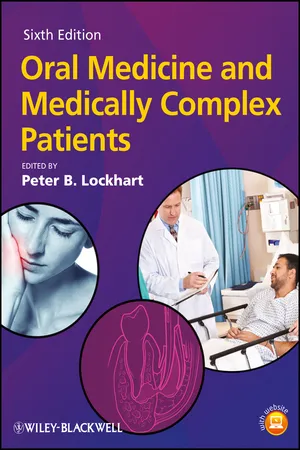
Oral Medicine and Medically Complex Patients
eBook - ePub

Oral Medicine and Medically Complex Patients

  1. English
  2. ePUB (mobile friendly)
  3. Available on iOS & Android
eBook - ePub

Oral Medicine and Medically Complex Patients

About this book

Oral Medicine and Medically Complex Patients, Sixth Edition provides succinct, yet comprehensive information on in-hospital care and outpatient management of the medically complex dental patient, as well as the management of non-surgical problems of the maxillofacial region. Fully revised to include up-to-date information on procedures and medications, the Sixth Edition contains over 15 additional charts and tables for rapid reference and expanded coverage on maxillofacial prosthodontics and increasingly prevalent conditions, such as ONJ.

Oral Medicine and Medically Complex Patients follows a practical approach, organizing essential information into quickly referenced tables, easy-to-read diagrams and step-by-step procedures. Replete with examples of hospital charts, operative notes, and consultations, the book provides thorough coverage of the broad scope of clinical problems and patient populations encountered by dentists. A truly must-have resource Oral Medicine and Medically Complex Patients serves the needs of an increasing number of dental students, residents in general practice and specialty training, and practitioners engaged in the care of both hospitalized and ambulatory patients.

Trusted by 375,005 students

Access to over 1.5 million titles for a fair monthly price.

Study more efficiently using our study tools.

Information

Year
2012
Edition
6
eBook ISBN
9781118495834
Subtopic
Dentistry
1
In-Hospital Care of the Dental Patient

Dental Admissions

Introduction

Both the medical health and the dental needs of patients must be considered when deciding on hospital admission. Hospital admission should be considered whenever the required treatment could threaten the patient’s well-being, or indeed life, or when the patient’s medical problems may seriously compromise the treatment.

Reasons for Admission

The reasons for admission to the hospital can be categorized into two groups: emergent hospitalizations, usually from the emergency department, or elective/scheduled hospitalizations for specific oral surgical or dental procedures.

Fractures of the Mandible/Maxillofacial Structures

Admission to the hospital is necessary for the management of multisystem injuries or injuries concomitant to mandible/maxillofacial fractures. It may be required for medically complex or special needs patients.

Infection

Admission is necessary if the patient has an infection that:
  • Compromises nutrition or hydration (especially fluid intake, e.g., severe herpetic stomatitis in very young children, which might require hospitalization because of dehydration)
  • Compromises the airway (e.g., Ludwig’s angina)
  • Involves secondary soft tissue planes that drain or traverse potential areas of particular hazard and so are a danger to the patient (e.g., retropharyngeal or infratemporal abscesses)

Compromised Patients

Medically, mentally, or physically compromised patients who are insufficiently cooperative to be treated in an outpatient setting may be admitted to hospital for their procedure. This category includes patients who might require general anesthesia or deep sedation and/or appropriate cardiorespiratory monitoring during treatment (e.g., anxiety disorders).

Children

Young children who require treatment under deep sedation or general anesthesia because of the combination of poor cooperation and the need for a large number of dental procedures as a result of extensive caries and/or consequent infection may be admitted to the hospital.
Medical Consultations

Objectives

The objectives of medical consultations are to:
  • Determine and reduce peri- and postoperative medical risk to the patient from the planned oral surgical/dental procedures
  • Determine, and thus lessen or indeed prevent, the effects of the proposed surgery/procedures on any medical illness and limit possible post-procedure complications by managing and treating the patient’s underlying medical conditions

The Patient’s Medical History

The Admission Note

Introduction

There is an art to eliciting the correct, pertinent, and relevant information regarding a patient’s current medical and physical status. Taking an accurate, relevant, and concise medical history requires repeated practice and experience. The goal is to obtain sufficient information from the patient to facilitate the physical examination and, in conjunction with the examination, to arrive at a working diagnosis or diagnoses of the problem.
Old hospital records, if they exist, can be immeasurably helpful in providing information about past hospitalizations, operations (including complications), and medications, particularly if the reliability of the patient or guardian as an informant is in question.
Key Points for Taking a Medical History
  • Record the patient’s positive and negative responses.
  • Remember that the patient might not understand the need for, and value of, an accurate medical history in the dental setting.
  • Be persistent and patient.
  • Confirm the veracity of the information by reframing the questions (e.g., ask patients to list their current medical problems; a bit later ask for a list of their current medications; follow this up by asking the patient to detail what each specific drug/medication is used for).
  • If you need to use an interpreter, try as much as possible to use a professional healthcare interpreter and not members of the patient’s family.
  • If you need to gain consent for minors and intellectually impaired adults or elders, make sure that the person whose consent you gain (patient’s parent/guardian/caregiver) has the legal authority to provide consent.

Elements of the History

The following discussion of the components of the medical history is directed at providing a full and complete history. Often, a shorter form of the medical history is sufficient for a healthy patient admitted for routine care (e.g., extraction of teeth).
Informant and Reliability
Note the name of the person or material used to obtain the pertinent information (e.g., patient, parent, relative, medical/nursing record). Also note whether the informant was reliable—were your questions understood, was the informant coherent and knowledgeable, and how well does he or she know the patient?
Chief Complaint (CC)
Record what patients perceive to be the problem that brought them to the hospital. The patient’s own words should be used if possible.
History of Present Illness (HPI)
Make a chronologic description of the development of the chief complaint. Record the following:
  • When the symptoms started
  • The course since onset—the duration and progression
  • Whether the symptoms are constant or episodic (if episodic, note the nature and duration of any periods of remission and exacerbation)
  • The character of the symptoms (e.g., sharp, dull, burning, aching) and severity (e.g., impact on daily living)
  • Any systemic signs and/or symptoms (e.g., weight gain or loss, chills, fever)
  • Previous diagnoses and the results of previous trials (success, partial resolu­tion, or unsuccessful) with treatment and/or medication related to the chief complaint
Past Dental History
You now need to gather as full a past dental history as possible. Ask the patient about:
  • Previous oral surgery, orthodontics (age, duration), periodontics, endodontics (tooth, date, reason), prosthetics, other appliances, oral mucosal problems (e.g., secondary herpes, aphthae), dental trauma
  • Frequency of dental visits (regular or emergency only)
  • Frequency of dental cleanings (when were the patient’s teeth last cleaned?)
  • Experience with local anesthesia/sedation (if possible, find out what type was used) and general anesthesia (e.g., allergy, syncope) (Appendix 12, Table A12-7)
  • Experience with extractions—was there postoperative bleeding or infection? How well did they heal?
  • History of pain, swelling, bleeding, abscess, toothaches
  • Temporomandibular joint—history of pain, clicking, subluxation, trismus, crepitus
  • Habits including nail-biting, thumb-sucking, clenching, bruxing, mouth-breathing
  • Fluoride exposure—was this systemic or topical?
  • Home care—brushing method and frequency, instruction, floss or other aids; caregiver assistance required?
  • Food habits/diet—ask about form and frequency of sucrose exposure (includ­ing liquid oral medicines). For children, the history and frequency of bottle and breastfeeding as well as between-meal snacking should be included. Find out about nutritional supplements (form and consistency), liquid diets, tube feedings
  • Problems with saliva (hyper-/hypo-salivation) chewing, speech
  • Negative dental experiences
Past Medical History (PMH)
Direct questioning is probably the best way to elicit the patient’s past medical history.
Ask the patient “Are you being treated for anything by your doctor at the moment?” If the answer is “Yes,” ascertain how severe the condition is (the extent to which it interferes in daily living activities) and how stable it is. A severe condition (e.g., angina) might prove not to be a significant hindrance to planned dental treatment as long as it is well managed and stable. However, a patient with unstable angina should not be treated until the angina is stabilized, or if this is not practical, treatment should be planned while...

Table of contents

  1. Cover
  2. Website
  3. Title page
  4. Copyright page
  5. Contributors
  6. Contributors to the Previous Edition
  7. Acknowledgments
  8. Introduction
  9. 1 In-Hospital Care of the Dental Patient
  10. 2 Outpatient Management of the Medically Compromised Patient
  11. 3 Oral Medicine: A Problem-Oriented Approach
  12. 4 Consultations
  13. 5 Dental, Oral, and Maxillofacial Emergencies
  14. 6 Medical Emergencies
  15. 7 Maxillofacial Prosthetics
  16. Appendix
  17. Index

Frequently asked questions

Yes, you can cancel anytime from the Subscription tab in your account settings on the Perlego website. Your subscription will stay active until the end of your current billing period. Learn how to cancel your subscription
No, books cannot be downloaded as external files, such as PDFs, for use outside of Perlego. However, you can download books within the Perlego app for offline reading on mobile or tablet. Learn how to download books offline
Perlego offers two plans: Essential and Complete
  • Essential is ideal for learners and professionals who enjoy exploring a wide range of subjects. Access the Essential Library with 800,000+ trusted titles and best-sellers across business, personal growth, and the humanities. Includes unlimited reading time and Standard Read Aloud voice.
  • Complete: Perfect for advanced learners and researchers needing full, unrestricted access. Unlock 1.5M+ books across hundreds of subjects, including academic and specialized titles. The Complete Plan also includes advanced features like Premium Read Aloud and Research Assistant.
Both plans are available with monthly, semester, or annual billing cycles.
We are an online textbook subscription service, where you can get access to an entire online library for less than the price of a single book per month. With over 1.5 million books across 990+ topics, we’ve got you covered! Learn about our mission
Look out for the read-aloud symbol on your next book to see if you can listen to it. The read-aloud tool reads text aloud for you, highlighting the text as it is being read. You can pause it, speed it up and slow it down. Learn more about Read Aloud
Yes! You can use the Perlego app on both iOS and Android devices to read anytime, anywhere — even offline. Perfect for commutes or when you’re on the go.
Please note we cannot support devices running on iOS 13 and Android 7 or earlier. Learn more about using the app
Yes, you can access Oral Medicine and Medically Complex Patients by Peter B. Lockhart in PDF and/or ePUB format, as well as other popular books in Medicine & Dentistry. We have over 1.5 million books available in our catalogue for you to explore.