![]()
Chapter 1
Fundamentals of Electrostatics
1.1 Introduction
We are all familiar with electrostatic discharge (ESD): shuffle your feet across a shag carpet in your favorite sneakers, touch a piece of metal, and zap! For a human being, we let out an “ouch!”; but for micro-electronics to nano-electronics, this can lead to product failures [1].
But, today, and in the future, static charge will remain an important industrial issue for the production of both electronic devices to systems. It is also an issue in fields of munitions, explosives, chemical, and material industries. Any industry where there is a risk of impact to quality, yield, degradation, or physical harm will be concerned with electrostatic discharge (ESD), electrical overstress (EOS), electromagnetic interference (EMI), and electromagnetic compatibility (EMC).
In this book, a short survey of ESD from manufacturing to product use will be shown. The text will discuss fundamentals of electrostatics, manufacturing electrostatic issues, component level issues, system level issues, to design.
So, where did all this all begin?
1.2 Electrostatics
The discovery of electrostatic attraction and electrostatic discharge is one of the world's earliest understandings of scientific thought and analysis. Its first discovery goes back to the early foundation of the problem of the nature of matter, astronomy, mathematics and foundation of Greek philosophy, and pre-dates the nature of matter.
1.2.1 Thales of Miletus and Electrostatic Attraction
Thales of Miletus, born in 624 B.C.E and died in 546 B.C.E, was the founder of the Ionian School (or Milesian School) and one of the Seven Wise Men of Ancient Greece in the Pre-Socratic era. Thales was an astronomer, mathematician, and philosopher. He was an inventor and an engineer. Thales of Miletus established a heritage of searching for knowledge for knowledge sake, development of the scientific method, establishment of practical methods, and the conjecture approach to questions of natural phenomenon. The Milesian School is regarded as establishing the critical method of questioning, debate, explanation, justification and criticism. The students of Thales included Euclid, Pythagoras, and Eudemus [2].
It was Thales of Miletus who was accredited with the discovery of the electrostatic attraction created after the material amber was rubbed. Thales noted after amber was rubbed, straw was attracted to the piece of amber. It was from this event, the Greek word for amber, ελεκτρoν (trans. electron) became associated with the electrical phenomenon.
Knowledge of Thales' ideas was common through writings of his disciples and notary Greek Philosophers. In De Anima 411 a7-8, Aristotle stated “Some think that the soul pervades the whole universe, when perhaps came Thales' view that everything is full of gods.” [3].
Electrostatic phenomenon pre-dated early thoughts of the nature of physical matter. Thales of Miletus's ESD experiments and study of electrostatic attraction was before the atomic schools of matter in Greece and Rome. Electrostatic phenomena and thought began before the Greek atomistic schools of Democritus (420 B.C.E.), and Epicurus (370 B. C.E.), and Roman School of Lucretius (50 B.C.E). Thales was deceased by the time the schools of atomic thought were active. On his tomb read, “Here in a narrow tomb Great Thales lie; Yet his renown for wisdom reached the skies [4].”
Robert A. Millikan, in the Introduction of his 1917 edition of “The Electron” [5] stated,
“Perhaps it is merely a coincidence that the man who first noticed rubbing of amber would induce in it a new and remarkable state now known as the state of electrification was also the man who first gave expression to the conviction that there must be some great unifying principle which links together all phenomena and is capable of making them rationally intelligible; that behind all the apparent variety and change of things there is some primordial element, out of which all things are made and the search for which must be the ultimate aim of all natural science. Yet if this be merely coincidence, at any rate to Thales of Miletus must belong a double honor. For he first correctly conceived and correctly stated, as far back as 600 B.C., the spirit which has actually guided the development of physics in all ages, and he also first described, though in a crude and imperfect way, the very phenomenon the study of which has already linked together several of the erstwhile isolated departments of physics, such as radiant heat, light, magnetism, and electricity, and has very recently brought us nearer to the primordial element than we have ever been before.”
J.H. Jeans, in the 1925 Fifth Edition of The Mathematical Theory of Electricity and Magnetism [6], wrote
“The fact that a piece of amber, on being rubbed, attracted to itself other small bodies, was known to the Greeks, the discovery of this fact being attributed to Thales of Miletus”
“A second fact, namely, that a certain mineral ore (lodestone) possessed the property of attracting iron, is mentioned by Lucretius. These two facts have formed the basis from which the modern science of Electromagnetism has grown.”
1.2.2 Electrostatics and the Triboelectric Series
With the death of Thales of Miletus, little progress proceeded on ESD phenomenon. Although history moved forward, the advancement of tribo-electric charging and electrostatic discharge phenomenon was slow relative to the time that passed. In Europe, mankind saw the Roman Empire, the Golden Age of Islam, the Middle Ages, the Black Death, the Renaissance, the Reformation, and the advancement of nation states. ESD phenomenon was discovered by Thales while China was undergoing the Zhou Dynasty. Asia underwent tremendous change with the Qin, Han, Sui, Tang, and Song, Yuan, and Ming dynastic periods, but there was no advancement of this field of knowledge.
With all this social change, insignificant growth in the understanding of electrostatic phenomenon increased until the eighteenth century. The interest in tribo-charging and electrostatic phenomenon became the luxury of scientists supported by the courts of Europe and laboratories of France and England.
So, how does tribo-charging happen?
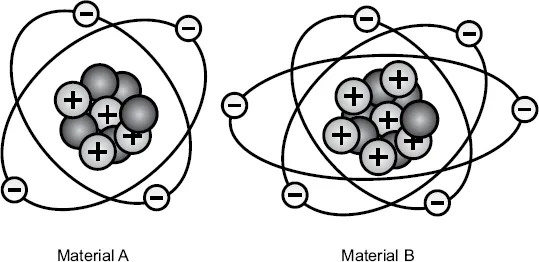
When two materials come into contact, the atoms contained within the materials come into close contact. Figure 1.1 shows an example of two atoms of different materials. The nucleus is tightly bound, with neutrons and protons, and is positively charged. Strong interactions hold the neutrons and protons together. According to the Bohr model, the electrons orbit around the nucleus, and are drawn to the nucleus by the electrostatic attraction between the negative electrons and the positive nucleus. In a neutral un-charged atom, the number of protons and electrons are equal in number.
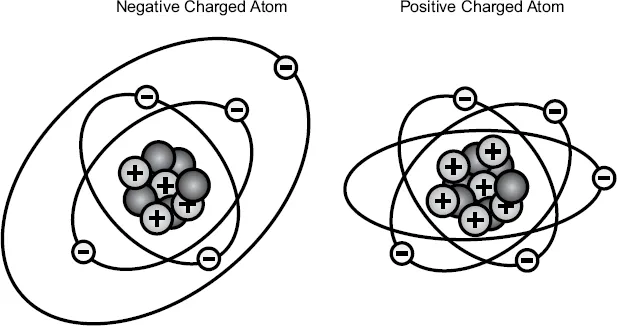
When two materials are in contact, charge transfer occurs through the friction or physical contact. An electron of the outer orbitals can transfer from one material to the second material. Figure 1.2 shows an example after the two materials are separated. In this case, the material that loses the electron becomes positively charged, and the material that gains the electron becomes negatively charged.
1.2.3 Triboelectric Series and Gilbert
Gilbert, in the seventeenth century, noted that interaction between a glass rod and silk produced the same phenomenon discussed by Thales of Miletus – materials when rubbed with silk became “amberized” [5]. Gilbert began construction of the earliest list of tribo-electrification.
1.2.4 Triboelectric Series and Gray
In the same period, Stephen Gray (1696–1736) thought of the concept of the division of materials according to its nature of removing or sustaining electrification [5]. He defined a class of materials which remove “amberization” as conductors, and the class of materials which allowed a body to retain its electrification as non-conductors, or insulators.
1.2.5 Triboelectric Series and Dufay
This work was followed by French physicist Dufay in 1733 d...