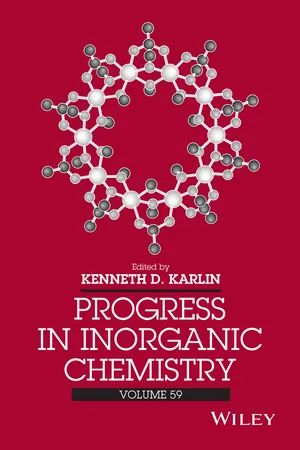
Progress in Inorganic Chemistry, Volume 59
eBook - ePub

Progress in Inorganic Chemistry, Volume 59

  1. English
  2. ePUB (mobile friendly)
  3. Available on iOS & Android
eBook - ePub

Progress in Inorganic Chemistry, Volume 59

About this book

This series provides inorganic chemists and materials scientists with a forum for critical, authoritative evaluations of advances in every area of the discipline. Volume 59 continues to report recent advances with a significant, up-to-date selection of contributions by internationally-recognized researchers.

The chapters of this volume are devoted to the following topics:
• Iron Catalysis in Synthetic Chemistry
• A New Paradigm for Photodynamic Therapy Drug Design: Multifunctional, Supramolecular DNA Photomodification Agents Featuring Ru(II)/Os(II) Light Absorbers Coupled to Pt(II) or Rh(III) Bioactive Sites
• Selective Binding of Zn2+ Complexes to Non-Canonical Thymine or Uracil in DNA or RNA.
• Progress Toward the Electrocatalytic Production of Liquid Fuels from Carbon Dioxide
• Monomeric Dinitrosyl Iron Complexes: Synthesis and Reactivity
• Interactions of Nitrosoalkanes/arenes, Nitrosamines, Nitrosothiols, and Alkyl Nitrites with Metals
• Aminopyridine Iron and Manganese Complexes as Molecular Catalysts for Challenging Oxidative Transformations

Trusted by 375,005 students

Access to over 1.5 million titles for a fair monthly price.

Study more efficiently using our study tools.

Information

Publisher
Wiley
Year
2014
Print ISBN
9781118870167
eBook ISBN
9781118870037
Edition
1
Subtopic
Biochemistry

Iron Catalysis in Synthetic Chemistry

Sujoy Rana, Atanu Modak, Soham Maity, Tuhin Patra, and Debabrata Maiti
Department of Chemistry, Indian Institute of Technology Bombay, Powai, Mumbai, India
CONTENTS
  1. I. Introduction
  2. II. Addition Reactions
    1. A. Cycloadditions
      1. 1. The [2 + 2] Cycloaddition
      2. 2. The [3 + 2] Cycloaddition
      3. 3. The [2 + 2 + 2] Cycloaddition
      4. 4. The [4 + 2] Cycloaddition
    2. B. Cyclopropanation
    3. C. Aziridination and Aziridine Ring-Opening Reactions
    4. D. Carbometalation of C—C Unsaturated Bond
    5. E. Michael Addition
    6. F. Barbier-Type Reaction
    7. G. Kharasch Reaction
  3. III. The C—C Bond Formations VIA C—H Functionalization
    1. A. The C—H Arylation
      1. 1. Direct Arylation With Organometallic Reagents
      2. 2. Direct Arylation With Aryl Halides
    2. B. The C—C Bond Formation Via Cross-Dehydrogenative Coupling
      1. 1. The CDC Between Two sp3 C—H Bonds
      2. 2. The CDC Between sp3 and sp2 C—H Bonds
      3. 3. The CDC Between sp3 and sp C—H Bonds
    3. C. The C—C Bond Formation via Cross-Decarboxylative Coupling
    4. D. The C—C Bond Formation via Alkene Insertion
    5. E. Oxidative Coupling of Two C—H Bonds
  4. IV. The C—H Bond Oxidation
    1. A. Hydroxylation
    2. B. Epoxidation
    3. C. cis-Dihydroxylation
  5. V. Cross-Coupling Reactions
    1. A. Alkenyl Derivatives as Coupling Partners
    2. B. Aryl Derivatives as Coupling Partners
    3. C. Alkyl Derivatives as Coupling Partners
      1. 1. Low-Valent Iron Complex in Cross-Coupling Reactions
    4. D. Acyl Derivatives as Coupling Partners
    5. E. Iron-Catalyzed C—O, C—S, and C—N Cross-Coupling Reaction
    6. F. Iron-Catalyzed Mizoraki–Heck Reaction
    7. G. Iron-Catalyzed Negishi Coupling Reaction
    8. H. Suzuki–Miyaura Coupling Reaction
    9. I. Sonogashira Reaction
    10. J. Mechanism of Cross-Coupling Reactions
    11. K. Hydrocarboxylation
    12. L. Enyne Cross-Coupling Reaction
  6. VI. Direct C—N Bond Formation VIA C—H Oxidation
  7. VII. Iron-Catalyzed Amination
    1. A. Allylic Aminations
    2. B. Intramolecular Allylic Amination
  8. VIII. Sulfoxidations and Synthesis of Sulfoximines, Sulfimides, and Sulfoximides
    1. A. Sulfoxidation
    2. B. Synthesis of Sulfoximines, Sulfimides, and Sulfoximides
      1. 1. Mechanism
  9. IX. Reduction Reactions
    1. A. Hydrosilylation of Alkenes
    2. B. Hydrosilylation of Aldehydes and Ketones
    3. C. Hydrogenation of C—C Unsaturated Bonds
    4. D. Hydrogenation of Ketones
    5. E. Hydrogenation of Imines
    6. F. Reduction of Nitroarene to Anilines
    7. G. Hydrogenation of Carbon Dioxide and Bicarbonate
    8. H. Amide Reduction
    9. I. Reductive Aminations
  10. X. Trifluoromethylation
  11. XI. Conclusion
  12. Acknowledgments
  13. Abbreviations
  14. ...

Table of contents

  1. Cover
  2. Advisory Board
  3. Title Page
  4. Copyright
  5. Chapter 1: Iron Catalysis in Synthetic Chemistry
  6. Chapter 2: A New Paradigm for Photodynamic Therapy Drug Design: Multifunctional, Supramolecular DNA Photomodification Agents Featuring Ru(II)/Os(II) Light Absorbers Coupled to Pt(II) or Rh(III) Bioactive Sites
  7. Chapter 3: Selective Binding of Zn2+ Complexes to Non-Canonical Thymine or Uracil in DNA or RNA
  8. Chapter 4: Progress Toward the Electrocatalytic Production of Liquid Fuels from Carbon Dioxide
  9. Chapter 5: Monomeric Dinitrosyl Iron Complexes: Synthesis and Reactivity
  10. Chapter 6: Interactions of Nitrosoalkanes/arenes, Nitrosamines, Nitrosothiols, and Alkyl Nitrites with Metals
  11. Chapter 7: Aminopyridine Iron and Manganese Complexes as Molecular Catalysts for Challenging Oxidative Transformations
  12. Subject Index
  13. Cumulative Index
  14. End User License Agreement

Frequently asked questions

Yes, you can cancel anytime from the Subscription tab in your account settings on the Perlego website. Your subscription will stay active until the end of your current billing period. Learn how to cancel your subscription
No, books cannot be downloaded as external files, such as PDFs, for use outside of Perlego. However, you can download books within the Perlego app for offline reading on mobile or tablet. Learn how to download books offline
Perlego offers two plans: Essential and Complete
  • Essential is ideal for learners and professionals who enjoy exploring a wide range of subjects. Access the Essential Library with 800,000+ trusted titles and best-sellers across business, personal growth, and the humanities. Includes unlimited reading time and Standard Read Aloud voice.
  • Complete: Perfect for advanced learners and researchers needing full, unrestricted access. Unlock 1.5M+ books across hundreds of subjects, including academic and specialized titles. The Complete Plan also includes advanced features like Premium Read Aloud and Research Assistant.
Both plans are available with monthly, semester, or annual billing cycles.
We are an online textbook subscription service, where you can get access to an entire online library for less than the price of a single book per month. With over 1.5 million books across 990+ topics, we’ve got you covered! Learn about our mission
Look out for the read-aloud symbol on your next book to see if you can listen to it. The read-aloud tool reads text aloud for you, highlighting the text as it is being read. You can pause it, speed it up and slow it down. Learn more about Read Aloud
Yes! You can use the Perlego app on both iOS and Android devices to read anytime, anywhere — even offline. Perfect for commutes or when you’re on the go.
Please note we cannot support devices running on iOS 13 and Android 7 or earlier. Learn more about using the app
Yes, you can access Progress in Inorganic Chemistry, Volume 59 by Kenneth D. Karlin in PDF and/or ePUB format, as well as other popular books in Physical Sciences & Biochemistry. We have over 1.5 million books available in our catalogue for you to explore.