- Explores issues central to the civil uprisings that swept the world in 2011, drawing profound connections between democracy and neoliberalism in an urban context
- Features in-depth analysis of key political theorists such as Gramsci; Lefebvre; Rancière; Deleuze and Guattari; and Hardt and Negri
- Advocates the reframing of democracy as a personal and collective struggle to discover the best in ourselves and others
- Includes empirical analysis of recent instances of collective action
- English
- ePUB (mobile friendly)
- Available on iOS & Android
eBook - ePub
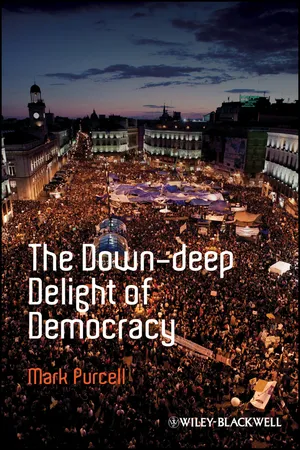
The Down-Deep Delight of Democracy
About this book
Arguing that the hegemony of the neoliberal/capitalist nexus must be challenged if we are to address the proliferating challenges facing our world, this inspiring book explains how democracy can revive the political fortunes of the left.
Information
1
What Is to Be Done?
…be on the watch.
there are ways out.
there is a light somewhere.
it may not be much light but
it beats the
darkness.
be on the watch.
the gods will offer you
chances.
know them, take them…
the more often you
learn to do it,
the more light there will
be…
you are marvelous.
the gods wait to delight
in
you.
there are ways out.
there is a light somewhere.
it may not be much light but
it beats the
darkness.
be on the watch.
the gods will offer you
chances.
know them, take them…
the more often you
learn to do it,
the more light there will
be…
you are marvelous.
the gods wait to delight
in
you.
—“The Laughing Heart,” Charles Bukowski (1993)1
In The Politics, Aristotle describes how oligarchies fall and give way to democracies: “by concentrating power into ever fewer hands, because of a shameful desire for profit, [the oligarchs] made the multitude stronger, with the result that it revolted and democracies arose” (Aristotle, 1998b, p. 1286b). As we stagger through the flotsam of the financial crisis and the preposterous proposal of “austerity” as a solution, it is not hard to see ourselves in the first part of Aristotle’s account. But in this book, I want to focus on the second part, the part where he suggests that oligarchies tend to “make the multitude stronger,” that they awaken and activate a popular power that rises up and expresses its desire for democracy.
Aristotle also reminds us that, in a sense, political questions are always very old ones. He advises that we should “take it, indeed, that pretty well everything…has been discovered many times…in the long course of history….Therefore, one should make adequate use of what has been discovered, but also try to investigate whatever has been overlooked” (Aristotle, 1998b, p. 1329b). Nietzsche displays a similar kind of humility in the face of the long history of political thought, arguing that ideas
grow up in connection in relationship with each other…. However suddenly and arbitrarily they seem to appear in the history of thought, they [are] nevertheless…far less a discovery than a recognition, of remembering, a return and a homecoming to a remote, primordial, and inclusive household of the soul, out of which those concepts grew originally: philosophizing is to this extent a kind of atavism of the highest order (Nietzsche, 1989a, p. 27).
So asking the question “What is to be done?” is always an atavistic enterprise in a way, a kind of mining of past political action and thought. It is Lenin’s old question, but it is no less the question Plato and Aristotle were asking, writing as they were in the wake of the Athenian defeat in the Peloponnesian War and living under a pervasive sense that their society was crumbling. Marx was asking the question too, and Lenin, and Gramsci. In the poem that opens the chapter, Bukowski is also searching for an answer, as are we today. And so in taking up the question of what is to be done, I try to be very much aware of this history, of what has already been discovered, and I try to make adequate use of it. I mine the work of thinkers like Aristotle, Plato, Hobbes, Lefebvre, Deleuze and Guattari, Rancière, Laclau and Mouffe, Gramsci, and others, trying to learn what they have to teach us. At the same time, I do not mean only to retrace the steps of others. I intend to use the political wisdom of the past to cut a path toward a possible future, toward a political community we have not yet realized.
My answer to Lenin’s question of “What is to be done?” is: democracy. Less concisely, what is to be done, what we all must do together, is to engage in a collective and perpetual struggle to democratize our society and to manage our affairs for ourselves. I do not propose democracy as the Platonic Form of the good community. It is not some end of history we should expect to reach. Rather, my argument is more restrained: perpetual democratization is the best way forward in the current context and for the foreseeable future. What we need in our time is to move politically from oligarchy to democracy, from passivity to activity, and from heteronomy to autonomy.
The Current Context
To understand what it would mean to democratize society in the current context, it helps to have some sense of what that context is. Over the course of the last seventy-five years or so, capitalist social relations of production were extended (if incompletely) to almost all parts of the globe; the dominance of Keynesian and social-democratic thinking was replaced by a neoliberal common sense; attempts to establish a state-socialist alternative to capitalism collapsed in utter failure; the world’s population has not only grown rapidly but become predominantly urban; geopolitics moved from the Cold War to a “war on terror” to the current post-terror landscape; and the environment (both the global climate and localized disasters) came to be seen as a central political question at all scales. Like all periods, the current era has also been greatly shaped by recurrent manifestations of popular power, in the form of both intense eruptions and everyday struggles by people to collectively liberate themselves from the various structures that contain them.
Political economy
The recent processes of globalization, through which capitalist production spread to incorporate almost every part of the globe, have been so extremely well documented that I think recounting them at length here is unnecessary (e.g. Dicken, 1998; Brenner and Theodore, 2003; Harvey, 2005). I will therefore offer only a brief review. Although capitalism has been extending itself geographically since its inception, the globalization processes of the twentieth century have greatly speeded up the process by which the entire globe is being integrated into a single capitalist economic machine. How we orient ourselves to this machine is a central political, economic, and cultural question in the current context. State socialism, of the kind that came to power in the Soviet Union, Eastern Europe, and China, among other places, represents a state-led attempt to create a non-capitalist alternative. While these regimes often call themselves communist, they are all more properly socialist societies managed by the state. Another option, what we might call a welfare-state approach, has been to accept capitalism but use the state to actively manage it with an eye toward stability and material redistribution for social justice. Keynesianism and social democracy are the leading models associated with this second option. A third option, generally known as neoliberalism, wants to unleash the capitalist market by reducing the size of the state and its ability to regulate the economy. I argue that each of these options, in its own way, is nothing other than a form of oligarchy. None offers a properly democratic response to the question of what is to be done.
The modern welfare-state model was born in the wake of the Great Depression. It typically followed a national-Keynesian approach to economic policy, which is to say it favored a very strong and active central government that carved out an expansive public sphere: strong state authority and generous provision of public goods and services. It was a model in which the state (usually a liberal-democratic one) acted as the primary representative of the public. This association became so ingrained in the culture as to make the state virtually synonymous with the public or the people. In this role as public, the state closely regulated industries and managed the macro economy. It also standardized currencies and ensured relative monetary stability. Government spending was seen as a primary economic variable, a linchpin for ensuring economic growth. Large government bureaucracies were required to carry out this economic management. They employed many people, generally with good wages and benefits. Labor organization was typically strong, and governments participated centrally in creating broad accords between capital and labor that usually secured high wages and good job security for workers. Beyond those accords, government policies tended to favor material redistribution to the less wealthy. Such policies included national social security, high minimum wages, subsidized health care, and the like. In addition, high tax rates enabled governments to provide well-funded and high-quality infrastructure such as public schools and universities, child care, hospitals and clinics, libraries, parks, public transportation, and so on. In the more fully social-democratic regimes, most of which were in Europe, it was common for the state to assume even greater economic control by owning certain enterprises and even monopolizing entire economic sectors like natural resources, telecommunications, or transportation.
Clearly there is a spectrum of possible policy actions within the welfare-state model, and particular policy combinations vary by place and time. However, for the purposes of this brief account, in broad outline what all such regimes share is a commitment to a large and interventionist state that acts on behalf of citizens, usually to create social policies whose goal is some amount of material redistribution for greater equality. The welfare-state model thus occupies the broad middle between the hard-left alternative of state socialism and neoliberalism’s free-market fundamentalism. It insists that a liberal-democratic state can and should play a large role in regulating capitalist economic activity so that we can have a stable, prosperous, and incrementally more equal society.
During roughly the same period that the welfare state was the dominant model in the capitalist world, a number of revolutions across the globe created an archipelago of state-socialist regimes that offered a stark alternative to capitalism. The Russian Revolution of 1917 created the Soviet Union, and after World War II Soviet insistence helped install state-socialist regimes in Central and Eastern Europe. Relatively more independent revolutions in Yugoslavia and Cuba produced state socialism there. The Communist victory in the Chinese Civil War in 1949 initiated state socialism in the East Asian sphere, and it spread to places like Korea, Vietnam, Cambodia, and Mongolia. As with the welfare state, state socialism varied in its particulars. In basic outline, it took its agenda from the Communist Manifesto, which called for workers’ parties to seize the state and use its power to expropriate from the bourgeoisie the privately owned means of production. Such collectivization or nationalization was designed to abolish private property and classes, and thus end capitalist relations of production. The idea was that this socialist phase led by a one-party state would be temporary; once classes were abolished, the state would no longer be necessary, since its purpose was to manage the conflict between the bourgeoisie and the proletariat. The state would wither away in due course and lead to a self-managed and egalitarian communist society. Of course, this transition from state-led socialism to stateless communism did not occur in actual practice. In fact, the opposite tended to happen: as the state bureaucracy took over control of the means of production, it became the new ruling class and ruthlessly intensified the power and scope of the state to the very limits of imagination. Stalinist Russia and Maoist China were the largest-scale disasters, but few state-socialist regimes avoided the horrors of totalitarianism and authoritarianism. Part of the failure was due to the folly of trying to manage national-scale economies through central-state command, and part of it was the ill-conceived attempt to defeat the capitalist West in a race to industrialize. But perhaps an even more fatal flaw of such states was the brutality and terrorism of their totalitarian political regimes. Extraordinary movements in Hungary, Yugoslavia, Poland, Czechoslovakia, China, and Romania, just to name a few, demonstrated that people will not submit to a totalitarian state indefinitely. They will resist, resolutely and creatively, through both small everyday acts and large public spectacles, when the state attempts to control virtually every aspect of their lives.
By 1989, the state-socialist model was largely exhausted. The Soviet Bloc began its rapid collapse and entered a “post-socialist” phase. Today, only China, Laos, Vietnam, North Korea, and Cuba remain as countries with state-socialist regimes.2 To be clear, the “utter failure” of this model I mentioned is not at all the failure of communism, which was never achieved in almost any sense. It is rather the failure of state socialism: the central management of a national economy by an authoritarian state controlled by a single party nominally allied to the proletariat.
As we saw, during the era when state socialism was at its height, it faced a capitalist world in which the welfare-state model was dominant. But by the early 1970s, the welfare state’s dominance had begun to erode. Two main forces precipitated its decline. The first was a sustained ideological assault from the right carried out by neoliberal intellectuals. The second was the emergence of economic problems such as unemployment, inflation, and capital flight that began to intensify in and around 1973. The intellectuals’ ideological attacks began to emerge in the late 1940s, when thinkers associated with groups like the Mont Pelerin Society remobilized traditional arguments from liberal economics. Scholars like Friedrich von Hayek, Milton Friedman, Ludwig von Mises, and Karl Popper opposed state intervention in the economy, and they insisted that society is more efficient, wealthier, and more open when capitalist markets are allowed to operate as freely as possible (Popper, 1945; Friedman, 1962; Hayek, 1994). Throughout the 1950s and 1960s, they prosecuted a long war of ideas against Keynesianism and the welfare state and for a neoliberal alternative. Then, in the early 1970s, economic events provided neoliberals with an important opportunity: most economies in the developed world underwent simultaneous and acute stagnation and inflation. It was a clear opportunity to press the case that management by a Keynesian welfare state could not provide economic stability and prosperity. At about the same time, it was becoming increasingly feasible for corporations to relocate their operations, to flee the high wages and benefits won by labor in some parts of the industrialized world for areas with weaker labor organization and lower wages. Some of that flight remained within the industrialized economies, but some left for less industrialized places like Korea and Taiwan and then at different times China, Thailand, Brazil, Malaysia, the Philippines, and Mexico, among others. The flight of capital from Keynesian welfare states made such states appear unable to compete effectively in a rapidly globalizing world economy.
The rise of politicians like Reagan and Thatcher in the 1980s helped translate these intellectual and economic trends into concrete policy for the global North. Markets were deregulated, ownership and control of economic enterprise was privatized, and social services were aggressively cut. Such policy initiatives spread insistently, though at different rates, to governments in other wealthy economies, so by the mid-1980s neoliberalism was having great success in its struggle to supplant the Keynesian welfare state. This success was only intensified by the fall of most state-socialist regimes in the late 1980s. As the Soviet Union and its Eastern European satellites collapsed under the weight of their failed totalitarian model, the neoliberalizing West was quick to claim ideological and economic victory, narrating the changes as inevitable, a result of the inherent superiority of free markets and liberal democracy over their “communist” alternative. Francis Fukuyama’s thesis about the “end of history” was perhaps the most memorable example (Fukuyama, 1992).
The dominance of neoliberalism extended very much also to the question of economic development in the global South. Over the course of the 1980s and 1990s, a line of thinking known as the “Washington Consensus” came to dominate international economic policy, especially with respect to countries in the global South. The World Bank and the International Monetary Fund (IMF) helped produce a pervasive common sense regarding poorer countries, whereby the only possible path to development was austerity and “structural adjustment,” which would drastically reduce state spending and ownership of assets, lower trade barriers, encourage Foreign Direct Investment, and energetically integrate their economies into global commodity flows. The World Bank and IMF induced such policy changes by making them conditions of the loans they offered to developing countries. Throughout this period, more and more Southern countries were integrated into this system whereby the public/state sector was reduced and the economy reoriented toward the production of commodities for the global capitalist market. The fall of the Berlin Wall only accelerated this process, as countries could no longer rely on their position in the Cold War system of satellite or client states to secure resources. They were increasingly forced to participate effectively in the global market.
By the 1990s, neoliberalism had become so taken-for-granted that center-left leaders like Clinton and Blair were unable and/or unwilling to propose either a return to Keynesian welfarism or some other alternative. Or perhaps it is more accurate to say that by the 1990s it had become very hard to imagine anything other than neoliberalism. It was only when the great recession of 2007 hit that the neoliberal consensus began to weaken. The housing sector and its financial markets were widely seen as the leading cause of the crash, and those markets had been subject to the same active deregulation as other markets. It became no longer self-evident that the markets will regulate themselves, that public oversight by the state is superfluous. This new doubt was symbolized by the appearance of Alan Greenspan, a leading light of neoliberal thought, before Congress in October 2008. Greenspan was ashen and penitent. He testified that the crisis had exposed serious flaws in his economic worl...
Table of contents
- Cover
- Series page
- Title page
- Copyright page
- Dedication
- Acknowledgments
- 1 What Is to Be Done?
- 2 What Democracy Means
- 3 Becoming Democratic
- 4 Becoming Active
- 5 Revolutionary Connections
- 6 Conclusion
- References
- Index
Trusted by 375,005 students
Access to over 1.5 million titles for a fair monthly price.
Study more efficiently using our study tools.
Frequently asked questions
Yes, you can cancel anytime from the Subscription tab in your account settings on the Perlego website. Your subscription will stay active until the end of your current billing period. Learn how to cancel your subscription
No, books cannot be downloaded as external files, such as PDFs, for use outside of Perlego. However, you can download books within the Perlego app for offline reading on mobile or tablet. Learn how to download books offline
Perlego offers two plans: Essential and Complete
- Essential is ideal for learners and professionals who enjoy exploring a wide range of subjects. Access the Essential Library with 800,000+ trusted titles and best-sellers across business, personal growth, and the humanities. Includes unlimited reading time and Standard Read Aloud voice.
- Complete: Perfect for advanced learners and researchers needing full, unrestricted access. Unlock 1.5M+ books across hundreds of subjects, including academic and specialized titles. The Complete Plan also includes advanced features like Premium Read Aloud and Research Assistant.
We are an online textbook subscription service, where you can get access to an entire online library for less than the price of a single book per month. With over 1.5 million books across 990+ topics, we’ve got you covered! Learn about our mission
Look out for the read-aloud symbol on your next book to see if you can listen to it. The read-aloud tool reads text aloud for you, highlighting the text as it is being read. You can pause it, speed it up and slow it down. Learn more about Read Aloud
Yes! You can use the Perlego app on both iOS and Android devices to read anytime, anywhere — even offline. Perfect for commutes or when you’re on the go.
Please note we cannot support devices running on iOS 13 and Android 7 or earlier. Learn more about using the app
Please note we cannot support devices running on iOS 13 and Android 7 or earlier. Learn more about using the app
Yes, you can access The Down-Deep Delight of Democracy by Mark Purcell in PDF and/or ePUB format, as well as other popular books in Social Sciences & Human Geography. We have over 1.5 million books available in our catalogue for you to explore.