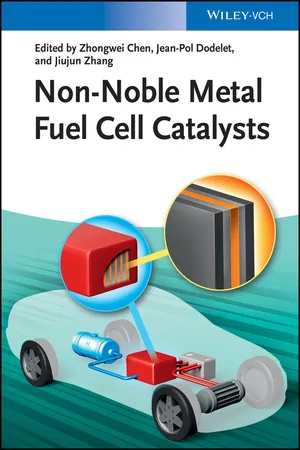
Written and edited by top fuel cell catalyst scientists and engineers from both industry and academia, this is the first book to provide a complete overview of this hot topic. It covers the synthesis, characterization, activity validation and modeling of different non-noble metal electrocatalysts, as well as their integration into fuel cells and their performance validation, while also discussing those factors that will drive fuel cell commercialization.
With its well-structured approach, this is a must-have for researchers working on the topic, and an equally valuable companion for newcomers to the field.
eBook - ePub
Non-Noble Metal Fuel Cell Catalysts
- English
- ePUB (mobile friendly)
- Available on iOS & Android
eBook - ePub
Non-Noble Metal Fuel Cell Catalysts
About this book
Information
1
Electrocatalysts for Acid Proton Exchange Membrane (PEM) Fuel Cells – an Overview
1.1 Introduction
Fuel cells are devices that directly convert chemical energy stored in a fuel into electricity. The main components of fuel cells are the electrodes (anode and cathode), which are separated by an electrolyte. Several of these electrode–electrolyte units may be connected in series to give a so-called fuel cell stack. In a fuel cell, the fuel (typically hydrogen, but also others like methanol) is oxidized at the anode, and the electrons released during oxidation are conducted to the cathode, where the oxidant (typically oxygen, either pure or as air) is reduced. The driving force for this process is the negative Gibbs free energy of the overall reaction (see Section 1.2.2). The first description of the fuel cell principle dates back to the year 1839/1842, when Sir William Grove described his gaseous voltaic battery based on Schönbeins findings. Since then, different types of fuel cells have been developed [1–3], which differ in the electrodes and the electrolyte used, their operation temperature, and the fuel used. The main types of fuel cells are the low-temperature fuel cells, namely, the “alkaline fuel cell” (AFC) and “proton exchange membrane fuel cell” (PEMFC), including the “direct methanol fuel cell” (DMFC); the medium-temperature fuel cell, namely, “phosphoric acid fuel cell” (PAFC); and the high-temperature types, namely, the “molten carbonate fuel cell” (MCFC) and “solid oxide fuel cell” (SOFC). These fuel cells are labeled according to the electrolyte used; however, the DMFC, which is a proton exchange membrane (PEM) type FC, is an exception. Details on the design and operation of these fuel cells can be found in the cited literature. Other types of fuel cells have also been described, for example, biofuel cells, which use enzymes or even microorganisms to catalyze reactions, and borohydride fuel cells.
The aim of this chapter is to give an overview of the PEMFC, its design and operation, and to discuss the basics of its cathode reaction, namely, electrocatalytic oxygen reduction (ORR, oxygen reduction reaction). As will become clear, the ORR is a major challenge in current fuel cell research both from the fundamental as well as from the applications point of view. This chapter is intended to provide the background for more specialized chapters that follow.
1.2 Acid PEM Fuel Cell Background and Fundamentals
1.2.1 Acid PEM Fuel Cell Overview – History, Status, and Advantages
As mentioned above, the first description of the fuel cell principle dates back to Grove's gaseous voltaic battery. It is amazing that this first system already used hydrogen and oxygen, which were converted at Pt electrodes in an acid electrolyte. However, it took a long time and significant efforts to progress from Grove's Pt sheet electrodes to today's advanced catalysts, from the acid liquid electrolyte to today's proton-conducting membranes [3]. At that time, further development of the “gaseous voltaic battery” was impeded by two main factors. The first was that larger amounts of hydrogen were not easily available at that time and hydrogen was produced by laboratory techniques, for example, by the dissolution of Zn. The second issue was the development of the dynamo by Siemens in 1866/1867, which made available electrical energy on a larger scale, thus there was no technical need to further develop the gaseous voltaic battery. It thus took more than a century until the development of fuel cells gained momentum again, albeit research and development activities have been reported on during that time [1]. The development of fuel cells was boosted in the 1950s, with focus on the AFC, which found early application in spaceflight, where sources of electrical energy with high energy density were needed and cost was not an issue. Despite having certain advantages such as high efficiency, the necessity to use high-purity gases and the highly corrosive liquid electrolyte posed a challenge at that time. The next impulse for further developing the fuel cell technology was the oil crisis in the early 1970s. During these periods of technical progress, the above types of fuel cells were developed to an advanced state. However, in all these fuel cells, issues occurred that hindered their commercialization and it was only during the last 20 years that commercialization of fuel cells for a mass market came within reach. More details on the history and the state-of-the-art of fuel cells can be found in the literature [2–4].
The same issues hold true for the PEMFC, which is in the focus of this book. The prerequisite for the development of the PEM fuel cells was the development of proton-conducting polymer electrolytes that could be processed into thin membranes. Early materials have been described that led to the development of the PEM fuel cell in the 1960s; however, the PEMs had a limited lifetime. A breakthrough was the development of Nafion® by DuPont in 1967. It is still a state-of-the-art material although other proton-conducting membranes have been described.
While the most important step in the development of acid PEMFCs was the membrane, one of the major driving forces was the automobile industry, which was driven by the necessity to provide mobility solutions for the upcoming area of depleted fossil resources as well as to contribute toward more environmentally benign mobility. During the 1980s and 1990s, several large automotive companies announced research and development activities in the fuel cell car sector with the NECAR (new electric car) by Daimler being the most popular one. Later, various national hydrogen initiatives were announced and significant public funding for fuel cell research was available, for example, in Germany, Japan, or the United States.
In today's PEMFCs, the anode and the cathode are separated by the PEM, which serves as electrolyte. The PEM conducts protons from the anode, where they are formed by oxidation of hydrogen, to the cathode, where they are involved in the reduction of oxygen preferably to water. In order to keep Ohmic losses as small as possible, the membrane should be thin (depending on the fuel cell, below 100 μm) and at the same time be electronically isolating, mechanically stable, and impermeable to the reactive gases. The membrane is sandwiched between two gas diffusion electrodes (“GDEs”; i.e., the cathode and the anode), which themselves consist of at least two layers: a catalyst layer, about 5–30 μm in thickness, and a gas diffusion layer of 100–300 μm. While the former typically consists of carbon-supported Pt particles, the latter is usually a porous carbon paper or woven carbon cloth that should help to evenly distribute and transport the reactants to the catalyst layer and provide conductivity paths for the electrons. Often these two layers are separated by a microporous carbon layer. The requirements for GDEs are an optimum porosity, high electric and thermal conductivity, and chemical and mechanical stability. Equally impo...
Table of contents
- Cover
- Related Titles
- Titlepage Text
- Copyright
- Preface
- List of Contributors
- Chapter 1: Electrocatalysts for Acid Proton Exchange Membrane (PEM) Fuel Cells – an Overview
- Chapter 2: Heat-Treated Transition Metal-NxCy Electrocatalysts for the O2 Reduction Reaction in Acid PEM Fuel Cells
- Chapter 3: Modified Carbon Materials for O2 Reduction Reaction Electrocatalysts in Acid PEM Fuel Cells
- Chapter 4: Transition Metal Chalcogenides for Oxygen Reduction Electrocatalysts in PEM Fuel Cells
- Chapter 5: Transition Metal Oxides, Carbides, Nitrides, Oxynitrides, and Carbonitrides for O2 Reduction Reaction Electrocatalysts for Acid PEM Fuel Cells
- Chapter 6: Theoretical Modeling of Non-noble Metal Electrocatalysts for Acid and Alkaline PEM Fuel Cells
- Chapter 7: Membranes for Alkaline Polyelectrolyte Fuel Cells
- Chapter 8: Electrocatalysts for Alkaline Polymer Exchange Membrane (PEM) Fuel Cells – Overview
- Chapter 9: Carbon Composite Cathode Catalysts for Alkaline PEM Fuel Cells
- Chapter 10: Non-precious Metal Oxides and Metal Carbides for ORR in Alkaline-Based Fuel Cells
- Chapter 11: Automotive Applications of Alkaline Membrane Fuel Cells
- Index
- End User License Agreement
Trusted by 375,005 students
Access to over 1.5 million titles for a fair monthly price.
Study more efficiently using our study tools.
Frequently asked questions
Yes, you can cancel anytime from the Subscription tab in your account settings on the Perlego website. Your subscription will stay active until the end of your current billing period. Learn how to cancel your subscription
No, books cannot be downloaded as external files, such as PDFs, for use outside of Perlego. However, you can download books within the Perlego app for offline reading on mobile or tablet. Learn how to download books offline
Perlego offers two plans: Essential and Complete
- Essential is ideal for learners and professionals who enjoy exploring a wide range of subjects. Access the Essential Library with 800,000+ trusted titles and best-sellers across business, personal growth, and the humanities. Includes unlimited reading time and Standard Read Aloud voice.
- Complete: Perfect for advanced learners and researchers needing full, unrestricted access. Unlock 1.5M+ books across hundreds of subjects, including academic and specialized titles. The Complete Plan also includes advanced features like Premium Read Aloud and Research Assistant.
We are an online textbook subscription service, where you can get access to an entire online library for less than the price of a single book per month. With over 1.5 million books across 990+ topics, we’ve got you covered! Learn about our mission
Look out for the read-aloud symbol on your next book to see if you can listen to it. The read-aloud tool reads text aloud for you, highlighting the text as it is being read. You can pause it, speed it up and slow it down. Learn more about Read Aloud
Yes! You can use the Perlego app on both iOS and Android devices to read anytime, anywhere — even offline. Perfect for commutes or when you’re on the go.
Please note we cannot support devices running on iOS 13 and Android 7 or earlier. Learn more about using the app
Please note we cannot support devices running on iOS 13 and Android 7 or earlier. Learn more about using the app
Yes, you can access Non-Noble Metal Fuel Cell Catalysts by Zhongwei Chen, Jean-Pol Dodelet, Jiujun Zhang, Zhongwei Chen,Jean-Pol Dodelet,Jiujun Zhang in PDF and/or ePUB format, as well as other popular books in Technology & Engineering & Materials Science. We have over 1.5 million books available in our catalogue for you to explore.