The Wiley Blackwell Companion to Tourism presents a collection of readings that represent an essential and authoritative reference on the state-of-the-art of the interdisciplinary field of tourism studies.
Presents a comprehensive and critical overview of tourism studies across the social sciences
Introduces emerging topics and reassesses key themes in tourism studies in the light of recent developments
Includes 50 newly commissioned essays by leading experts in the social sciences from around the world
Contains cutting-edge perspectives on topics that include tourism's role in globalization, sustainable tourism, and the state's role in tourism development
Sets an agenda for future tourism research and includes a wealth of bibliographic references
Chapter 1 Tourism Conceptualizations, Disciplinarity, Institutions, and Issues
C. Michael Hall, Allan M. Williams, and Alan A. Lew
Any contemporary global account of tourism has to acknowledge at its outset the continued growth of international and domestic tourism. Despite temporary setbacks since the turn of the twenty-first century, tourism as an industry has probably achieved a higher profile in the public consciousness of the developed world than ever before. The impacts on international tourism of the terrorist attacks of September 11, 2001, the American-led invasion of Iraq in 2003, government and traveler responses to the SARS virus in 2003, the Indian Ocean Boxing Day tsunami in 2004, the 2008–2012 international economic and financial crisis, and the “Arab Spring” starting in 2010 in Tunisia have all proven transitory with respect to tourism growth at the global scale, although their destination, community, and firm effects remain significant. Regional and local changes in consumer confidence and travel behavior and corresponding shifts in travel patterns, such as a reported growth in “staycations” and more local travel, have, in the main, been short term as economic conditions improve in generating regions (Hall, 2010a). Indeed, economic problems in destinations, such as Cyprus, Greece, Portugal, Spain, Thailand, and Tunisia, only served to make tourism more important than ever, not only with respect to business vitality and the economy but also in its sociocultural, environmental, and political contexts.
Although the statistics relating to the economic role of tourism are by now familiar, it is worth emphasizing them here as part of the framing of this volume. Ranked the fourth largest economic sector after fuels, chemicals, and food, tourism accounts for an estimated 5% of global gross domestic product (GDP) and 6–7% of employment (direct and indirect) (UNWTO, 2012). International tourism's export value, including international passenger transport, was US$1.2 trillion in 2011, accounting for 30% of the world's commercial service exports or 6% of total exports (UNWTO, 2012). Tourism is also one of five top export earners in over 150 countries, while in 60 countries it is the number one export sector (UNCTAD, 2010). It is also the main source of foreign exchange for one-third of developing countries and half of the least-developed countries (UNWTO and UNEP, 2011).
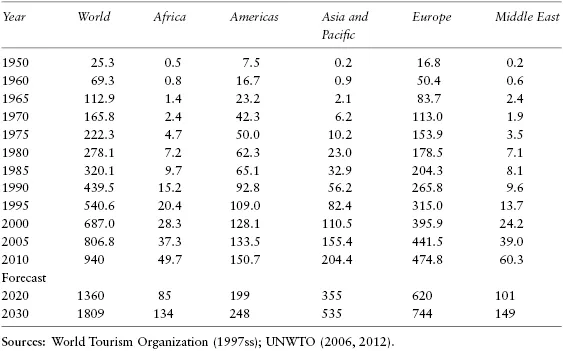
The United Nations World Tourism Organization (UNWTO) predicts the number of international tourist arrivals will increase by an average 3.3% per year between 2010 and 2030 (an average annual increase of 43 million arrivals), reaching an estimated 1.8 billion arrivals by 2030 (UNWTO, 2011, 2012) (see Table 1.1). Upper and lower forecasts for global tourism in 2030 are between approximately 2 billion arrivals (the “real transport costs continue to fall” scenario) and 1.4 billion arrivals (“slower-than-expected economic recovery and future growth” scenario) respectively (UNWTO, 2011). Most growth is forecast to come from the emerging economies and the Asia-Pacific region, and by 2030 it is estimated that 57% of international arrivals will be in what are currently classified as emerging economies (UNWTO, 2011, 2012). It is also important to note that although international tourism is often the focus of government policy because of its trade and foreign exchange implications, international tourism only accounts for around 16% of all tourist trips. Forecasts and outcomes can, of course, be very different, but these forecast not only frame but, through their influence on confidence and investments, also inform the trajectory of tourism.
Table 1.1. International tourism arrivals and forecasts 1950–2030 (millions).
Tourism research does not exist in a vacuum. It is affected not only by changes in tourism consumption and production, but also wider global events and the shifting priorities and policies of higher education institutions and research funders which have placed a stronger emphasis on assessments research output quality, public–private partnerships, and the “entrepreneurial university” (Rhoades and Slaughter, 1997; Deem, 2001; Slaughter and Leslie, 2001; Slaughter and Rhoades, 2004; Paasi, 2005; Hall, 2011c, 2013a). The constant fluidity and change in their environment has led many researchers to question many of their assumptions about tourism and reassess the relevance of their work, not only in terms of policy and other applications, but also, more fundamentally, to revisit the ways in which the subject is theorized and conceptualized (Gibson, 2008, 2009, 2010; Waitt et al., 2008; Tribe, 2009, 2010; Winter, 2009; Wilson, 2012; Benckendorff and Zehrer, 2013; Hall, 2013a). A history of the sociology of tourism knowledge, unlike a history of tourist activity, has not yet been completed. While this was not explicitly the aim of this volume, the range and depth of the chapters in this book do provide an opportunity to assess many of the key themes and issues in tourism studies, as well as the intellectual context within which they were prepared.
This introductory chapter is divided into three main sections. First, a brief account is presented of some of the issues surrounding the definition of tourism and, hence, its study. Second is a discussion of some of the key themes and issues that have emerged in tourism as a field of social scientific endeavor. Third, and finally, some comments are made regarding the relationships between areas of tourism research and their ebb and flow, and the selection of chapters in this volume. These issues are again taken up in the conclusion (see Chapter 50).
Conceptualizing Tourism
Although many students of tourism have long sympathized with the sentiments of Williams and Shaw's observation that “the definition of tourism is a particularly arid pursuit” (1988: 2) it is, as they also acknowledged, “crucially important.” This is in part because of the continuing need to determine tourism's economic impacts and employment effects, and its broader effects and policy ramifications. Based on generally accepted international agreements for collecting and comparing tourism statistics, the term tourism trip has come to refer to a trip of not more than 12 months and for a main purpose other than being employed at the destination (UN and UNWTO 2007). However, despite United Nations and UNWTO recommendations, substantial differences remain between countries with respect to the length of time that they use to define a tourist, as well as how employment is defined (Hall and Lew, 2009).
Undoubtedly, a substantial amount of government, industry body, and academic research effort has gone into the determination of “supply-side” or industry approaches to the definition of tourism, such as the development of Tourism Satellite Accounts (TSAs), which have become significant policy tools for organizations such as the World Travel and Tourism Council (Smith 2004, 2007; Hall and Lew, 2009). From a production or supply-side perspective, which TSAs seek to measure, the t...
Table of contents
Cover
Table of Contents
Wiley Blackwell Companions to Geography
Title page
Copyright page
Notes on Contributors
Part 1: Introduction
Part 2: Perspectives on Tourism
Part 3: Producing Tourism and Tourism Spaces
Part 4: Globalizing People, Places, and Markets in Tourism
Part 5: Social Theories of Tourist Practice, Experience, and Landscapes Encounters
Part 6: Tourist Attractions: Places, Spaces, and Forms
Part 7: Tourism and the Environment: Change, Impacts, and Response
Part 8: Tourism Policies, Planning, and Governance
Part 9: Conclusions
Index
End User License Agreement
Trusted by 375,005 students
Access to over 1.5 million titles for a fair monthly price.
Study more efficiently using our study tools.
Frequently asked questions
Yes, you can cancel anytime from the Subscription tab in your account settings on the Perlego website. Your subscription will stay active until the end of your current billing period. Learn how to cancel your subscription
No, books cannot be downloaded as external files, such as PDFs, for use outside of Perlego. However, you can download books within the Perlego app for offline reading on mobile or tablet. Learn how to download books offline
Perlego offers two plans: Essential and Complete
Essential is ideal for learners and professionals who enjoy exploring a wide range of subjects. Access the Essential Library with 800,000+ trusted titles and best-sellers across business, personal growth, and the humanities. Includes unlimited reading time and Standard Read Aloud voice.
Complete: Perfect for advanced learners and researchers needing full, unrestricted access. Unlock 1.5M+ books across hundreds of subjects, including academic and specialized titles. The Complete Plan also includes advanced features like Premium Read Aloud and Research Assistant.
Both plans are available with monthly, semester, or annual billing cycles.
We are an online textbook subscription service, where you can get access to an entire online library for less than the price of a single book per month. With over 1.5 million books across 990+ topics, we’ve got you covered! Learn about our mission
Look out for the read-aloud symbol on your next book to see if you can listen to it. The read-aloud tool reads text aloud for you, highlighting the text as it is being read. You can pause it, speed it up and slow it down. Learn more about Read Aloud
Yes! You can use the Perlego app on both iOS and Android devices to read anytime, anywhere — even offline. Perfect for commutes or when you’re on the go. Please note we cannot support devices running on iOS 13 and Android 7 or earlier. Learn more about using the app
Yes, you can access The Wiley Blackwell Companion to Tourism by Alan A. Lew, C. Michael Hall, Allan M. Williams, Alan A. Lew,C. Michael Hall,Allan M. Williams in PDF and/or ePUB format, as well as other popular books in Business & Hospitality, Travel & Tourism Industry. We have over 1.5 million books available in our catalogue for you to explore.