Understanding Wind Power Technology
eBook - ePub

Understanding Wind Power Technology

Theory, Deployment and Optimisation

  1. English
  2. ePUB (mobile friendly)
  3. Available on iOS & Android
eBook - ePub

Understanding Wind Power Technology

Theory, Deployment and Optimisation

About this book

Wind energy technology has progressed enormously over the last decade. In coming years it will continue to develop in terms of power ratings, performance and installed capacity of large wind turbines worldwide, with exciting developments in offshore installations.

Designed to meet the training needs of wind engineers, this introductory text puts wind energy in context, from the natural resource to the assessment of cost effectiveness and bridges the gap between theory and practice. The thorough coverage spans the scientific basics, practical implementations and the modern state of technology used in  onshore and offshore wind farms for electricity generation.

Key features: 

  • provides in-depth treatment of all systems associated with wind energy, including the aerodynamic and structural aspects of blade design, the flow of energy and loads through the wind turbine, the electrical components and power electronics including control systems 
  • explains the importance of wind resource assessment techniques, site evaluation and ecology with a focus of project planning and operation 
  • describes the integration of wind farms into the electric grid and includes a whole chapter dedicated to offshore wind farms 
  • includes questions in each chapter for readers to test their knowledge

Written by experts with deep experience in research, teaching and industry, this text conveys the importance of wind energy in the international energy-policy debate, and offers clear insight into the subject for postgraduates and final year undergraduate students studying all aspects of wind engineering. Understanding Wind Power Systems is also an authoritative resource for engineers designing and developing wind energy systems, energy policy makers, environmentalists, and economists in the renewable energy sector.

Frequently asked questions

Yes, you can cancel anytime from the Subscription tab in your account settings on the Perlego website. Your subscription will stay active until the end of your current billing period. Learn how to cancel your subscription.
At the moment all of our mobile-responsive ePub books are available to download via the app. Most of our PDFs are also available to download and we're working on making the final remaining ones downloadable now. Learn more here.
Perlego offers two plans: Essential and Complete
  • Essential is ideal for learners and professionals who enjoy exploring a wide range of subjects. Access the Essential Library with 800,000+ trusted titles and best-sellers across business, personal growth, and the humanities. Includes unlimited reading time and Standard Read Aloud voice.
  • Complete: Perfect for advanced learners and researchers needing full, unrestricted access. Unlock 1.4M+ books across hundreds of subjects, including academic and specialized titles. The Complete Plan also includes advanced features like Premium Read Aloud and Research Assistant.
Both plans are available with monthly, semester, or annual billing cycles.
We are an online textbook subscription service, where you can get access to an entire online library for less than the price of a single book per month. With over 1 million books across 1000+ topics, we’ve got you covered! Learn more here.
Look out for the read-aloud symbol on your next book to see if you can listen to it. The read-aloud tool reads text aloud for you, highlighting the text as it is being read. You can pause it, speed it up and slow it down. Learn more here.
Yes! You can use the Perlego app on both iOS or Android devices to read anytime, anywhere — even offline. Perfect for commutes or when you’re on the go.
Please note we cannot support devices running on iOS 13 and Android 7 or earlier. Learn more about using the app.
Yes, you can access Understanding Wind Power Technology by Alois Schaffarczyk in PDF and/or ePUB format, as well as other popular books in Technology & Engineering & Power Resources. We have over one million books available in our catalogue for you to explore.

Information

1
The History of Wind Energy

Jos Beurskens

1.1 Introduction

Wind has been used as a source of energy for more than 1500 years. In times when other sources of energy were unknown or scarce, wind energy represented a successful means for industrial and economic development. Wind energy became a marginal source once cheaper, easier to exploit and easily obtainable sources of energy became available. From the point of view of the contribution of wind energy to economic development, one can divide the history of wind energy into four overlapping time periods (see Figure 1.1). Except in the first period, the emphasis here is the generation of power by wind:
  • 600–1890: Classical period. Classic windmills for mechanical drives; more than 100,000 windmills in northwestern Europe. The period ended after the discovery of the steam engine and because of the ready availability of wood and coal.
  • 1890–1930: Development of electricity-generating wind turbines. The development of electricity as a source of energy available to everyone leads to the use of windmills as an additional possibility for generating electricity. Basic developments in the field of aerodynamics. The period ended due to cheaper fossil oil.
  • 1930–1960: First phase of innovation. The necessity of electrifying rural areas and the shortage of energy during the Second World War stimulated new developments. Advances in the field of aerodynamics. The period ended because of cheaper gas and fossil oil.
  • From 1973: Second innovation phase and mass production. The energy crisis and environmental problems in combination with technological advances ensure a commercial breakthrough.
c1-fig-0001
Figure 1.1 Historical development of the use of wind as a source of energy. The first and last periods have had the greatest effects on society
During the classical period, the ‘wind devices’ (windmills) converted the kinetic energy of the wind into mechanical energy. After direct current and alternating current generators were invented and came to be used for public power supply, windmills were used for electrical power generation. This development began effectively in the late nineteenth century and, after the energy crisis in 1973, became a great economic success.
In order to differentiate clearly between the different plants, they are called windmills or wind turbines in this book.

1.2 The First Windmills: 600–1890

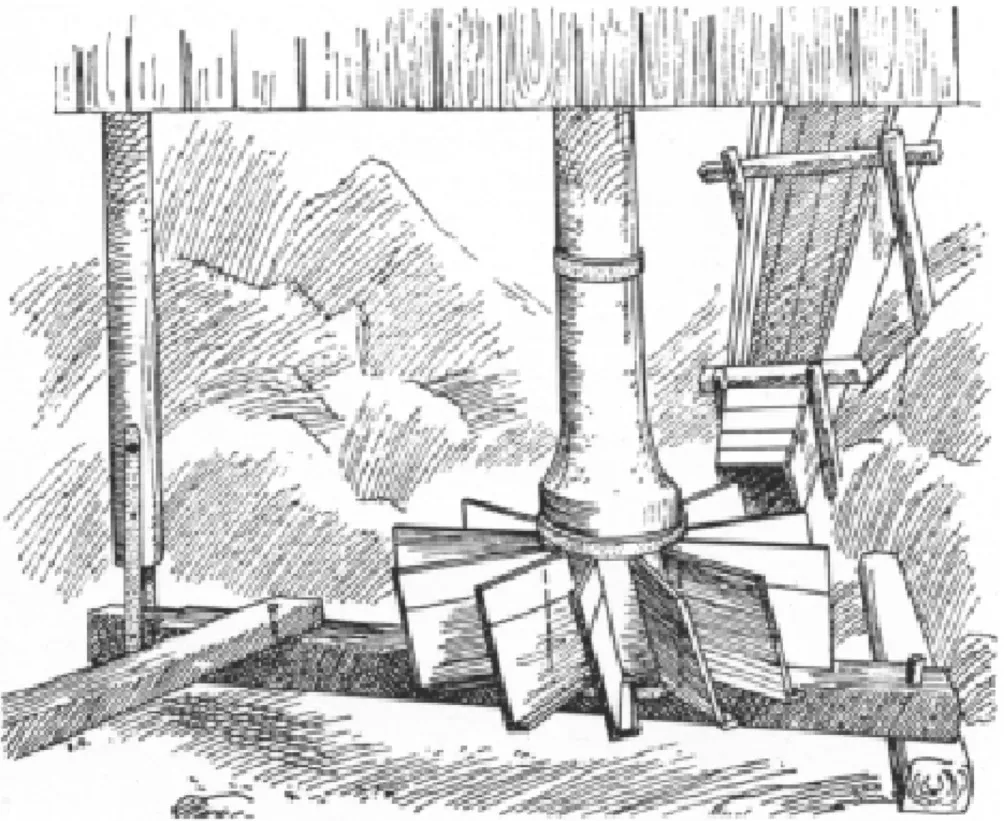
Water mills were very probably the precursors of windmills. Water mills, again, were developed from devices that were operated by people or animals. The devices that are known to us from historical sources possessed a vertical main shaft to which cross bars were attached in order to drive the main shaft. The cross bars were operated by farm animals such as horses, donkeys or cows. It seems only logical that the vertical windmills developed from these devices. However, there are few historical sources to provide proof of this. More sources can be found on the ‘Nordic’ or ‘Greek’ water mills that evolved from the animal-operated devices (see Figure 1.2). These types of water mills had their origin about 1000 BC in the hills of the Eastern Mediterranean area, and were also used in Sweden and Norway [1].
c1-fig-0002
Figure 1.2 Water wheel with vertical axis of rotation near Göteborg, Sweden. From Ernst, The Mills of Tjorn (1965) published by Mardiska Museet, Stockholm [2]. Reproduced with permission of Mardiska Museet, Stockholm
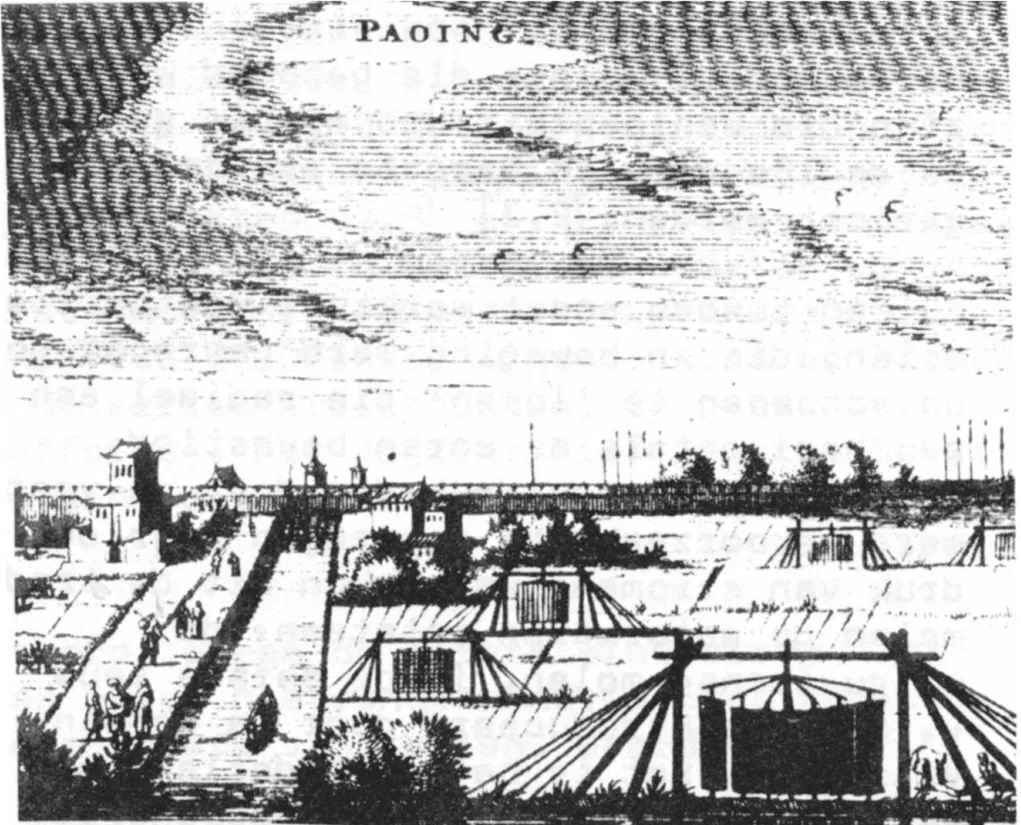
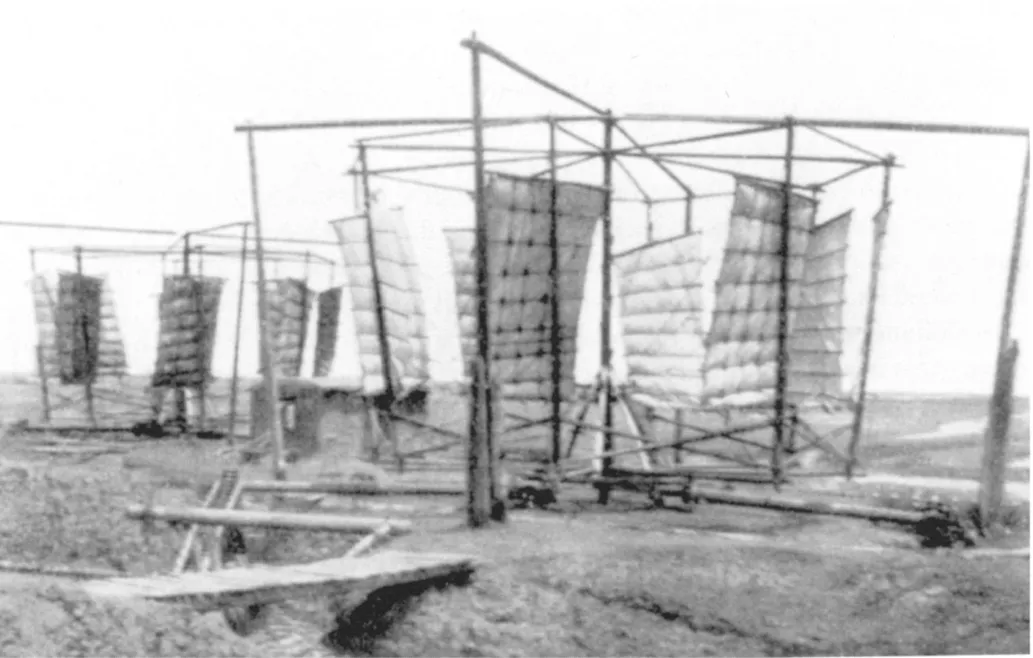
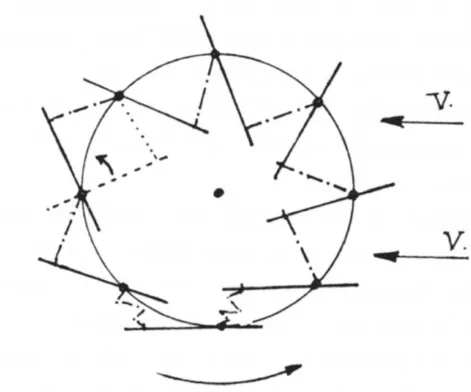
The first windmills with vertical main shafts were found in Persia and China (See Figures 1.4). In the middle of the seventh century AD, the building of windmills was a highly prized trade in Persia [3]. In China, vertical windmills were introduced by traders. The first European to report on the windmills in China was Jan Nieuhoff, who travelled there in 1656 with one of the Netherlands ambassadors. Figure 1.3 shows an illustration by Jan Nieuhoff [4]. Similar windmills were in use in China until quite recently (see Figure 1.4).
c1-fig-0003
Figure 1.3 Drawing of Chinese windmills in Paoying (Chiangsu) by Jan Nieuhoff, 1656 [4]. Reproduced with permission of Cambridge University Press
c1-fig-0004

c1-fig-0004
Figure 1.4 Left: Chinese wind wheels at Taku that pump brine solutions for the extraction of salt (Hopei [3]). Reproduced with permission of E & F N Spons; right: schematic depiction of the function of a Chinese windmill. Solid lines represent blades and dash-dotted lines represent sails [5].
Other types of devices were treadmills that were operated by the bodily strength of people or animals. Spades were arranged radially to the main shaft. The horizontal water mill developed from the treadmill by the replacement of people or animals by flowing water. A further development in the first century AD was the so-called Vitruvian water mills, which were introduced by the Roman Vitruvius. This water mill can be seen as the prototype for the undershot water mill that can be found throughout Europe in rivers and streams with low water-level diffe...

Table of contents

  1. Cover
  2. Title page
  3. Copyright page
  4. Preface
  5. About the Authors
  6. 1 The History of Wind Energy
  7. 2 The International Development of Wind Energy
  8. 3 Wind Resources, Site Assessment and Ecology
  9. 4 Aerodynamics and Blade Design
  10. 5 Rotor Blades
  11. 6 The Drive Train
  12. 7 Tower and Foundation
  13. 8 Power Electronics and Generator Systems for Wind Turbines
  14. 9 Control of Wind Energy Systems
  15. 10 Grid Integration
  16. 11 Offshore Wind Energy
  17. Index
  18. End User License Agreement