Part I
In the Beginning Was the Gesture
In this part . . .
Here’s where we explore the foundations of body language, the way of silently communicating that can improve your impact factor and relationships once you grasp the basics. In this part, we go back in time to the origins of body language, how it’s evolved, and its ability to reveal thoughts, feelings, and attitudes.
Chapter 1
Defining Body Language
In This Chapter
Finding out how body language speaks for you
Understanding what you’re communicating
The science of body language is a fairly recent study, dating primarily from around 60 years ago, although body language itself is, of course, as old as humans. Psychologists, zoologists and social anthropologists have conducted detailed research into the components of body language – part of the larger family known as non-verbal behaviour.
If you’re quiet for a moment and take the time to pay attention to body language movements and expressions that silently communicate messages of their own, you can cue in on gestures that convey a feeling and transmit a thought. If you pay close attention, you can identify gestures that you automatically associate with another person, which tell you who she is. In addition, you may notice other types of gestures that reveal a person’s inner state at that moment.
In this chapter, you discover how to interpret non-verbal language, exploring the gestures and actions that reveal thoughts, attitudes and emotions. Also, you have a quick glance at some of the research into this unspoken language and recognise similarities and differences throughout the world. In addition, you find out how you can use gestures to enhance your relationships and improve your communication.
Discovering How Body Language Conveys Messages
When cave-dwellers discovered how to decipher grunts and to create words to convey their message, their lives became a lot more complex. Before verbal communication, they relied on their bodies to communicate. Their simple brains informed their faces, torsos and limbs. They instinctively knew that fear, surprise, love, hunger and annoyance were different attitudes requiring different gestures. Emotions were less complex then, and so were the gestures.
Speech is a relatively new introduction to the communication process and is mainly used to convey information, including facts and data. Body language, on the other hand, has been around forever. Without relying on the spoken word for confirmation, the body’s movements convey feelings, attitudes and emotions. Like it or not, your body language, or non-verbal behaviour, says more about you, your attitudes, moods and emotions, than you may want to reveal.
According to research conducted by Professor Albert Mehrabian of the University of California, Los Angeles, 55 per cent of the emotional message in face-to-face communication results from body language. You only have to experience any of the following gestures or expressions to know how true the expression is, ‘Actions speak louder than words’:
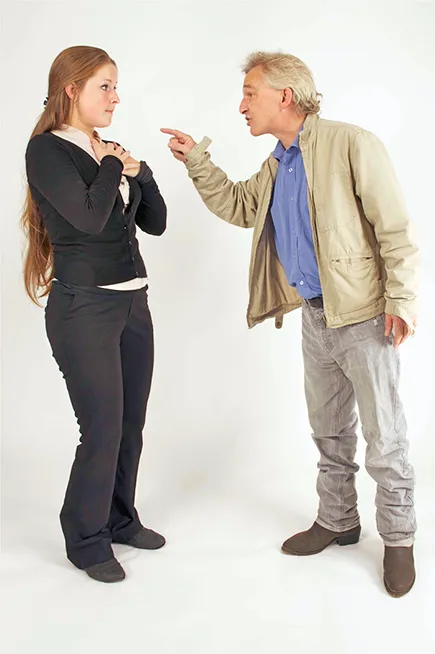
Someone pointing her finger at you
A finger wagging in your face
Your hand placed over your heart
Figure 1-1 shows two different gestures conveying two very different messages.
Figure 1-1: A pointing finger and hand over the heart convey different messages.
Projecting an image in the first 30 seconds
You can tell within the first seven seconds of meeting someone how she feels about herself by the expression on her face and the way she moves her body. Whether she knows it or not, she’s transmitting messages through her gestures and actions (check out the Body Language For Dummies app for an example).
You walk into a room of strangers and from their stance, movements and expressions, you receive messages about their feelings, moods, attitudes and emotions. Look at the teenage girl standing in the corner. From her slouching shoulders, her lowered head and the way her hands fidget over her stomach, you can tell that this little wallflower is lacking in self-confidence.
Another young woman in this room of strangers is standing in a group of contemporaries. Her eyes twinkle, she throws her head back as she laughs, her hands and arms move freely and openly and her feet are planted firmly beneath her, hip width apart. This woman is projecting an image of self- confidence and joie de vivre that draws people to her.
How you position your head, shoulders, torso, arms, hands, legs and feet, and how your eyes, mouth, fingers and toes move, tell an observer more about your state of being, including your attitude, emotions, thoughts and feelings, than any words you can say.
Transmitting messages unconsciously
Although you’re capable of choosing gestures and actions to convey a particular message, your body also sends out signals without your conscious awareness. Dilated or contracted eye pupils and the unconscious movements of your hands and feet are examples of signals that reveal an inner emotion that the person signalling may prefer to conceal. For example, ...