![]()
Chapter 1
Fishing for Life
In which we finally get the point of fishing! We find out we already have all the answers, discover happiness isn’t for sale and that it’s certainly not ‘out there’. We peep at academic porn and get a cool quote from Groucho Marx.
Andy W and I have been working for numerous years as personal development trainers in businesses and schools. We’ve covered bread-and-butter topics that all trainers worth their salt should be able to deliver. You know, subjects such as communication, leadership, conflict resolution, assertiveness, coaching skills, goal setting, teams... blah, blah, blah. But recently we’ve discovered something new. Well ‘new’ might be a bit strong, but certainly ‘different’. We’ve blended some of the more modern concepts and hot topics into a workshop that we boldly call ‘The Art of Being Brilliant’. And, do you know what? It really works!
What do you think about the story of Jimmy’s Diary? How did it make you think and feel? Because our aim is to get you to think and feel very differently. To realise what’s important in life. And to make changes where necessary.
We are both very excited about the future. In fact Andy and I have got a lot in common. You’re bright so will have cottoned on to the fact that we’re both called ‘Andy’. We’ve both worked all over the world. We’re both dads. We’re both ‘self help junkies’, having read every personal development book that’s ever been published. We laugh at the same things. We’re both devilishly young and good looking. We’re both prone to exaggeration...
You get the picture. Most importantly, we share a philosophy and a common outlook on how training should be. It has become very clear to us over the last couple of years that the people we work with already know everything there is to know about creating a happy and successful life. Everyone has all the resources they need. How exciting is that? You already have all the answers! It’s just that the majority of people have lost touch with them. Or forgotten them. And the result is that we hit peaks of happiness and positivity on an ad hoc basis. We feel ‘brilliant’ sporadically. Sometimes quite by accident – because we’re waiting for the right conditions. Maybe a holiday will make us happy. Or a new shirt. Or a car. Or a few beers?
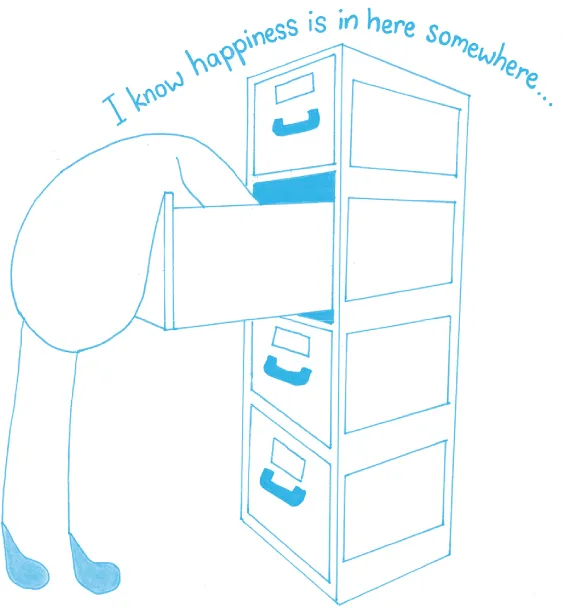
The problem is that most people are looking in the wrong place. Richard Wilkins (http://www.theministryofinspiration.com) describes it brilliantly when he talks of people searching for happiness, fulfilment and positive feelings in the filing cabinet marked ‘external’. Happiness is ‘out there’ somewhere.
You should listen to Richard – after all, he is the UK’s self-styled ‘Minister of Inspiration’ and, to be honest, you’ve got to have some guts to give yourself that title. Many ‘gurus’ fail to live up to their own hype. Richard sets his hype very high and clears the bar with ease. The man is brilliant.
So we agree with Richard – we believe that most people are looking for happiness and fulfilment in the wrong filing cabinet. We think you should check out the filing cabinet marked ‘internal’. All the great feelings you ever experienced are already inside you!
So our job has become easy. We don’t have to teach people anything. All we have to do is devise a cunning way of reconnecting people with their own internal resources, putting them in touch with information which has been buried in their unconscious mind. Or, to keep it simple, get them to look in the right filing cabinet, the one marked ‘internal’.
Oh, and this book is the key!
I used to teach on MBA programmes. Boy, did I work hard. I would roll up my sleeves and get stuck into Maslow, Herzberg and maybe throw in a dash of ‘situational leadership’. Oh, and let’s not forget the tried and trusted Belbin and Myers Briggs.
Who cares if they’ve covered it a dozen times before? Bring on the self perception questionnaire – you might have changed since last time! I was happiest when scribing interlocking circle diagrams on a flipchart. Or maybe drawing a pyramid. I used to call it ‘academic pornography’. A real turn on for managers.
Except it wasn’t. You see, the penny’s dropped. Theories have their place. In fact, hats off to those clever boffins who come up with interlocking circles and sexy new acronyms (I feel SMART needs a rebrand though, it’s gone way past its sell-by date). The problem with traditional management training is that life isn’t a theory. It’s very, very practical.
And relentless – it just keeps coming at us. In fact, let’s face it, for most people, life is exhausting. The morbid obesity of change is weighing us down. So we’ve come to the conclusion that the world doesn’t need any more complex theories.
We need stuff that works. The simpler the better. We need to reconnect with what’s important. Not in a Buddhist1, inner peace, tofu-eating way – more of an upgrade-of-the-software-between-our-ears kind of way. This book is crammed full of common sense. The trouble is, it certainly isn’t common practice!
So Andy W and I have pooled the best bits of what we know. There are a few case studies, some funny stuff and some questions to make you think about your work, relationships and life. There is plenty of academia behind it, but we’ve weeded out the nonsense and debunked the academic porn. Without you knowing it, we’ll be sneaking in concepts such as ‘Positive Psychology’, ‘Appreciative Inquiry’, ‘Neuro Linguistic Programming’ and ‘Emotional Intelligence’. We like to think of the book as an intellectual smoothie – a blend of the best ingredients, with the pith removed!
The Art of Being Brilliant is designed around half a dozen commonsense principles – we call them the ‘super six’. The book’s also designed to make you think. Maybe even to make you laugh. But the underlying message is deadly serious. We’re talking about you and your life. Read it. Do it. The results will reverberate positively at work and at home. It’s become abundantly clear to us that ‘success’ isn’t about becoming a different person. It’s a matter of finding out what really works for you, and doing more of it!
The reality is that life is too short. Why settle for being anything less than yourself, brilliantly?
1 Other religions are available.
![]()
Chapter 2
Shiny Happy People
In which we come clean about Positive Psychology, we find out why Britain fails to qualify for the ‘Happiness World Cup’, a blissful picture is painted, Woody Allen tries to depress us and we’re introduced to mood hoovers and 2%ers.
We’ve been advocates of the relatively new field of positive psychology since its inception in the late 1990s. I’ve been so enthused about it myself that I’m doing a doctorate on it! Psychology was part and parcel of my first degree. I read numerous academic tomes on depression, anxiety, eating disorders, phobias...and became an expert on all things negative! In fact, it was quite depressing studying it!
Interestingly, I was recently asked to do a talk at an NHS conference. The theme of the conference was mental health and wellbeing. Right up my street, so I agreed and they slotted me in as the final speaker on Day 3. A few days before the conference I received the agenda and it wasn’t about health and wellbeing at all! To give you a flavour, the speakers on Day 1 were talking about suicide rates in Bridgend and depression amongst social workers. Day 2 started with a corker, Prozac addiction, before moving on to sleeping disorders and the rise of youth crime. My supposedly uplifting talk, called ‘The Art of Being Brilliant’, had been slotted in after ‘Exponential Anorexia’.
My heart sank! Such a snappy title! How could I follow that?
The entire conference was devoted to mental ill-health and feeling grim. It was homing in on what was going wrong and, to be frank, it’s typical of the world of research and medicine. I’m not suggesting it’s wrong to have conferences about such subjects. I’m suggesting it’s normal. We’ve spent billions of pounds producing pills to cure depression but it seems to be getting worse!
Strap yourself in, because I feel compelled to give you the science bit. Traditional strands of psychology were couched in terms of the study of ill people. We’d spent hundreds of years studying what was wrong with people. In a nutshell, you’d only ever go and see a psychologist if you were ill. You’d never book yourself in for an appointment if you were feeling great!
‘Positive psychology’ has existed formally since the late 1980s. Its popularity mushroomed with the publication of Dr Martin Seligman’s book, Authentic Happiness in 2003. However, even the good Doctor wouldn’t claim to have invented ‘positivity’ and ‘happiness’ – they’ve been on the radar for centuries! Check out Plato and Confucius for a start. Or the big fella they call Buddha. And more recently Carl Rogers, Richard Bandura, Howard Gardiner and the God of management courses the world over, Abe Maslow (if I hear his ‘hierarchy of needs’ trotted out on any more courses I’ll scream and scream until I’m sick). All have elements of self-fulfilment, happiness and efficacy in their studies. So it’s hitting today’s headlines but I guess positive psychology is best described as having a short history with a very long past.
There’s a general acknowledgement that psychology has followed a...