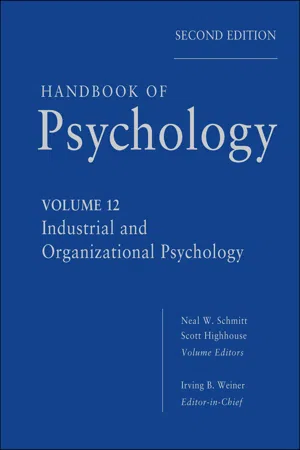
Psychology is of interest to academics from many fields, as well as to the thousands of academic and clinical psychologists and general public who can't help but be interested in learning more about why humans think and behave as they do. This award-winning twelve-volume reference covers every aspect of the ever-fascinating discipline of psychology and represents the most current knowledge in the field. This ten-year revision now covers discoveries based in neuroscience, clinical psychology's new interest in evidence-based practice and mindfulness, and new findings in social, developmental, and forensic psychology.
eBook - ePub
Handbook of Psychology, Industrial and Organizational Psychology
- English
- ePUB (mobile friendly)
- Available on iOS & Android
eBook - ePub
Handbook of Psychology, Industrial and Organizational Psychology
About this book
Information
Part I
Conducting and Communicating Research in Industrial–Organizational Psychology
Chapter 1
A Snapshot in Time: Industrial–Organizational Psychology Today
Author Note: We are very grateful to the following people who took the time to provide their thoughtful contributions to this chapter: Herman Aguinis, Clay Alderfer, Neal Anderson, Talya Bauer, Terry Beehr, David Chan, Dave Day, Kevin Ford, John Hazer, Chuck Hulin, Steve Kozlowski, Ron Landis, Joel Lefkowitz, Mike McDaniel, Fred Oswald, Rob Ployhart, Bob Pritchard, Chuck Reeve, Bob Sinclair, Paul Spector, Donald Truxillo, Jeff Vancouver, Bob Vandenberg, and Fran Yammarino.
“I” Versus “O” Tension
Psychology Versus Business Tension
Science Versus Practice Tension
Conclusion
References
As we write this chapter, the field of industrial–organizational psychology in the United States has survived its third attempt at a name change. To provide a little perspective, the moniker industrial psychology became popular after World War I, and described a field that was characterized by ability testing and vocational assessment (Koppes, 2003). The current label, industrial–organizational (I-O) psychology, was made official in 1973. The addition of organizational reflected the growing influence of social psychologists and organizational development consultants, as well as the intellectual and social milieu of the period (see Highhouse, 2007). The change to I-O psychology was more of a compromise than a solution—which may have succeeded only to the extent that everyone was equally dissatisfied. The first attempt to change this clunky label, therefore, occurred in 1976. Popular alternatives at the time were personnel psychology, business psychology, and psychology of work. The leading contender, however, was organizational psychology because, according to then-future APA Division 14 president Arthur MacKinney, “all of the Division's work is grounded in organizational contexts” (MacKinney 1976, p. 2). The issue stalled before ever making it to a vote of the full membership, but it simmered for nearly 30 years.
Although a name change initiative finally went to a vote in 2004, many were not satisfied with a process in which none of the alternatives garnered more than 50% of the ballots. Landy (2008) argued persuasively that he and many past division presidents were dissatisfied with an I-O moniker that seemed old-fashioned, too long, and out of step with international labels. As such, after a runoff of possible names, I-O psychology was pitted against organizational psychology in a 2010 vote of the membership of the Society for Industrial and Organizational Psychology (SIOP). It seemed that the nearly 40 years of discontent would finally be resolved with a name with which everyone could live. Alas, industrial-organizational psychology prevailed by a mere 15 votes (over 1,000 votes were cast)!
Perhaps it is fitting that our name remains a source of tension, as our field is filled with many fundamental tensions. In this chapter, we briefly discuss some of the tensions that have characterized I-O psychology and continue to exist at different degrees of force.
It is important to keep in mind that tensions are not necessarily bad. Kurt Lewin contended that tensions reflect a body that is alive and well, and, without tensions, we are not learning or accomplishing things.
“I” Versus “O” Tension
The tension between a testing and selection (I-side) focus versus attitudinal and social (O-side) foci has existed for at least 50 years. Employee selection has remained a dominant theme throughout the history of I-O psychology (Zickar & Gibby, 2007). Koppes and Pickren (2007) examined published I-O research between 1887 and 1930 and found that, with the exception of research on advertising, I-side research was predominant. Mason Haire (1959) used the term industrial social psychology to describe an alternative field that emphasized group processes, motivation, and attitude assessment and had an implicit humanistic foundation. During the same period, prominent scholars were advocating a more systems view of organizations, acknowledging the interrelatedness of an organization and its environment (Katz & Kahn, 1966; Schein, 1965). In order to enlarge the industrial psychology tent, therefore, the name of the field became I-O psychology (“Notification,” 1970). Commenting on the marriage of I-side and O-side topics, outgoing Division 14 president Robert Guion stated, “I think that there is no real great difference between traditional industrial psychology and what has become called organizational psychology so far as the topics are concerned. I think the difference has been more in methods and I would like to see more rigor in the methods, regardless of what people call themselves” (“TIP Talks,” 1973, p. 30). This comment reflected concerns about the perceived softness of research and practice on many O-side topics (e.g., attitude change, team building). The tables turned over the years, however, in that I-side researchers have been criticized for ignoring theory (Landy, 1986) and for failing to address issues about which managers care (Cascio & Aguinis, 2008).
Perhaps the current attention to levels of analysis issues will further blur this distinction between industrial psychology and organizational psychology. Ployhart and Moliterno (2009) described a multilevel model of human capital resources that links the aggregate unit-level resources to individuals' knowledge, skills, and abilities via a set of emergence-enabling states, which establish the social environment at the unit level. Moreover, task complexity at the unit level influences the type of behavioral, social, and affective enabling states that manifest themselves at the unit level. If one begins to study the organization and the individuals in it at different levels of analysis, one is forced to study and understand factors that have been characterized in the past as either industrial or organizational topics. Examples of I-O factors considered in this manner are beginning to appear in our journals (e.g., Ployhart, Weekley, & Ramsey, 2009; Sacco & Schmitt, 2005; Van Iddekinge et al., 2009) and, in each case, involve a merging of individual difference factors with unit and organizational characteristics and processes in the explanation of unit and organizational outcomes. These models require that both I and O factors be considered in any explanation of human behavior in organizations.
Psychology Versus Business Tension
The emigration of I-O psychologists and I-O training to business schools has been a long-time source of concern in the field (Highhouse & Zickar, 1997; Lawler et al., 1971; Naylor, 1971; Ryan & Ford, 2010). Ryan and Ford suggested that the distinctiveness of I-O psychology as a discipline is threatened when a majority of the scholarly gatekeepers and influencers are housed in schools of business. Table 1.1 shows the current location of people who won the SIOP early career award during the first decade of this century. Note that only 3 of the 12 award winners are currently housed in psychology departments. The remainder are in management (or related) departments in business schools. If we take these numbers as indicators of where the future and current stars of the field of I-O are doing their research and teaching, they suggest that only one of every four are training future I-O psychologists.
Table 1.1 Winners of the SIOP Distinguished Early Career Contributions Awards 2000–2010
| Awardee | Year | 2011 Home Institution |
| Dan Cable | 2001 | London Business School |
| Jose Cortina | 2001 | George Mason University* |
| Michele Gelfand | 2002 | University of Maryland* |
| David Chan | 2003 | Singapore Management University |
| Jeffrey LePine | 2004 | University of Florida |
| Jason Colquitt | 2005 | University of Florida |
| Filip Lievens | 2006 | Ghent University* |
| Gilad Chen | 2007 | University of Maryland |
| Joyce Bono | 2007 | University of Minnesota |
| Remus Ilies | 2008 | Michigan State University |
| Hui Liao | 2009 | University of Maryland |
| Riki Takeuchi | 2010 | Hong Kong University of Science and Technology |
*Located in the Department of Psychology.
Judge (2003) noted that research-oriented business schools do not consider the leading I-O psychology journals (e.g., Journal of Applied Psychology, Personnel Psychology) to be the “right” journals. Adapting one's research program to management journals, however, often results in moving from a more micro (i.e., psychological) emphasis to a more macro (i.e., sociological or economic) emphasis (Staw, 1991). This may at least partially explain why studying topics at higher levels of analysis (see the articles cited earlier) has so engaged I-O psychology researchers in recent years. Even traditional I-O topics, such as assessment and selection, are now being viewed from the lens of strategy or supply-chain management (e.g., Cascio & Boudreau, 2011). Whereas this may provide some positive benefits to the field by making it more interdisciplinary, there is a danger that I-O psychology becomes synonymous with human resources management or organizational behavior (see Ryan & Ford, 2010, for an elaborated discussion of this). Later, we discuss in more detail concerns about the competing pressures that I-O psychologists in psychology departments face from the I-O practitioner community and from constituencies at their home institutions.
Management Customer Versus Worker Customer Tension
The question of whether I-O psychology serves managerial concerns or worker concerns was the focus of Loren Baritz's classic 1960 book (Baritz, 1960), The Servants of Power. Baritz, a sociologist, argued that the rise of industrial psychology between 1913 and 1920 corresponded with an upsurge of managerial interest in increasing profits by increasing attention to the human element. This resulted in a science, according to Baritz, that was beholden to the interests of managers rather than to the interests of the less powerful workers. Contributing to this perspective were high-profile indictments of employment testing in popular books published in the 1950s and early 1960s (i.e., The Organization Man, The Brainwatchers), which painted the picture of psychologists as management shills interested only in identifying potential employees who might be more easily exploited by management.
Most I-O psychologists view themselves as serving both management and workers when they ensure hiring is merit based, or when they help organizations create environments that are satisfying and motivating for people (Avedon & Grabow, 2010). There are compelling minority voices, however, that suggest that I-O psychologists must include humanist values among its core principles (e.g., Lefkowitz, 2010). Also, with the decline in union representation over the past several decades, the conflict between management and union interests does not receive the same attention in the United States that it receives in other countries. I-O p...
Table of contents
- Cover
- Title Page
- Copyright
- Editorial Board
- Handbook of Psychology Preface
- Volume Preface
- Contributors
- Part I: Conducting and Communicating Research in Industrial–Organizational Psychology
- Part II: Personnel Psychology
- Part III: Organizational Psychology
- Part IV: The Work Environment
- Author Index
- Subject Index
Trusted by 375,005 students
Access to over 1.5 million titles for a fair monthly price.
Study more efficiently using our study tools.
Frequently asked questions
Yes, you can cancel anytime from the Subscription tab in your account settings on the Perlego website. Your subscription will stay active until the end of your current billing period. Learn how to cancel your subscription
No, books cannot be downloaded as external files, such as PDFs, for use outside of Perlego. However, you can download books within the Perlego app for offline reading on mobile or tablet. Learn how to download books offline
Perlego offers two plans: Essential and Complete
- Essential is ideal for learners and professionals who enjoy exploring a wide range of subjects. Access the Essential Library with 800,000+ trusted titles and best-sellers across business, personal growth, and the humanities. Includes unlimited reading time and Standard Read Aloud voice.
- Complete: Perfect for advanced learners and researchers needing full, unrestricted access. Unlock 1.5M+ books across hundreds of subjects, including academic and specialized titles. The Complete Plan also includes advanced features like Premium Read Aloud and Research Assistant.
We are an online textbook subscription service, where you can get access to an entire online library for less than the price of a single book per month. With over 1.5 million books across 990+ topics, we’ve got you covered! Learn about our mission
Look out for the read-aloud symbol on your next book to see if you can listen to it. The read-aloud tool reads text aloud for you, highlighting the text as it is being read. You can pause it, speed it up and slow it down. Learn more about Read Aloud
Yes! You can use the Perlego app on both iOS and Android devices to read anytime, anywhere — even offline. Perfect for commutes or when you’re on the go.
Please note we cannot support devices running on iOS 13 and Android 7 or earlier. Learn more about using the app
Please note we cannot support devices running on iOS 13 and Android 7 or earlier. Learn more about using the app
Yes, you can access Handbook of Psychology, Industrial and Organizational Psychology by Irving B. Weiner,Neal W. Schmitt,Scott Highhouse, Neal W. Schmitt,Scott Highhouse in PDF and/or ePUB format, as well as other popular books in Psychology & History & Theory in Psychology. We have over 1.5 million books available in our catalogue for you to explore.