![]()
Part One: Fundamentals of Wireless Communication
![]()
Chapter 1
Introduction
All wireless communication standards, both existing and under development, adopt or consider adopting orthogonal frequency-division multiplexing (OFDM) modulation plus multiple-input multiple-output (MIMO) techniques as the transmission scheme. It is clear that MIMO-OFDM has become the definitive transmission scheme in current and future wireless communication systems.
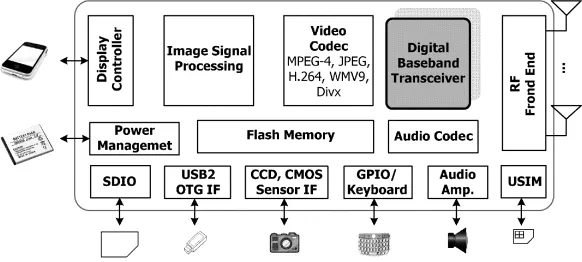
The pursuance of better ways of living has been instrumental in advancing human civilization. Communication services available at any time and place free people from the limitation of being attached to fixed devices. Nowadays, thanks to remarkable progress in wireless technology, affordable wireless communication service has become a reality. Mobile phones hook people up whenever and wherever they want. Digital audio and video broadcasting offers consumers high-resolution, better-quality, and even interactive programs. The devices are now thin, light, small, and inexpensive. Recently, smart phones capable of running multimedia and broadband applications have gained popularity and now account for a large share of the worldwide mobile phone sales. As shown in Figure 1.1, the digital baseband transceiver is an essential piece of such smart phones.
Several projects studying future wireless networks with different extents of coverage are under way. They will enable wireless access to the internet backbone everywhere, either indoors or outdoors, and in rural or metropolitan areas. In the following, their evolutions and future developments will be introduced. The essential role that the multiple-input multiple-output (MIMO) and orthogonal frequency-division multiplexing (OFDM) techniques play in wireless communication systems will become very clear.
1.1 Digital Broadcasting Systems
In the last century, most people satisfied their need for information and entertainment through audio and video broadcasting. The inauguration of AM radio can be traced back to the early twentieth century, while analog TV 5 programs were first broadcast before the Second World War. Around the middle of twentieth century, FM radio programs became available. These technologies, based on analog communication, brought news, music, drama, movies, and much more into our daily lives. To provide more and better programs, in the past several years, digital broadcasting techniques, such as digital audio broadcasting (DAB) and digital video broadcasting (DVB), have begun to replace the analog broadcasting technologies.
1.1.1 Digital Audio Broadcasting (DAB)
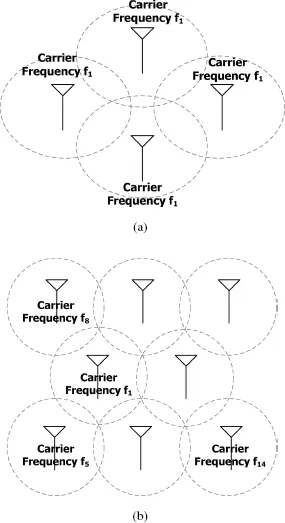
Digital Audio Broadcasting (DAB) is one of the first standards that uses the OFDM technique. The DAB project started in the mid-1980s [1]. Based on OFDM, DAB has one distinct benefit: it is a single-frequency network (SFN). In a single-frequency broadcasting network, one carrier frequency can be used for all transmitters to broadcast the same radio program in the entire country without suffering from co-channel interference. On the other hand, in the FM system, only one out of approximately 15 possible frequencies can be used, resulting in a very inefficient frequency re-use factor. A single-frequency network and a multi-frequency network are illustrated in Figure 1.2.
In the DAB system, it is not necessary to search for radio stations as is necessary with AM/FM radios. The programs of all radio stations are integrated in so-called multiplexes. Multiplexes save on the maintenance cost of individual radio stations. In addition, variable bandwidths can be assigned to each program, fulfilling their respective demands for sound quality. Music radio multiplexes can transmit at a rate up to the highest-quality 192 Kbps, while mono talk and news programs may use only 80 Kbps. Furthermore, the DAB system features better mobile reception quality thanks to the OFDM technique. In 2007, an upgraded standard DAB+ was announced, and it adopts an efficient audio compression scheme as well as powerful error-correcting codes to achieve more robust delivery of rich audio contents.
1.1.2 Digital Video Broadcasting (DVB)
Digital Video Broadcasting (DVB) is the European standard for digital television broadcasting [2]. The various DVB standards include DVB-S for satellites, DVB-C for cables, DVB-T for terrestrial transmission, and DVB-H for low-power handheld terminals. Among them, DVB-T and DVB-H utilize OFDM as the modulation scheme. DVB-T receivers started shipping in late 1990s and now DVB-T programs are available in many countries. Like the DAB system, DVB-T/H technology also supports countrywide SFNs. In addition, DVB-T/H standards offer several modes of operation that are tailored for large-scale SFN and high-mobility reception. The successful deployment experiences of DVB-T and the continuing advances in wireless communications have sparked calls for an upgrade in video services. In 2008, the second-generation digital terrestrial television standard, known as DVB-T2, was ratified. DVB-T2 aims to improve the spectral efficiency so that the capacity and coverage can be enhanced. The main features of this second-generation system include a high-order modulation scheme (256QAM), improved forward error-correcting (FEC) codes, and the multiple-input single-output (MISO) technique. It has been shown that 30–65% capacity increase can be obtained in DVB-T2 systems.
The basic digital stream in DVB-T is the MPEG-2 transport stream which contains one or more program streams. Each stream multiplexes compressed video, audio, and data signals. The DVB-T...