![]()
Chapter 1
Introduction to the Facilitation and Activity Guide
You made a wise choice when you decided to help students learn about and develop their emotional intelligence (EI). Research summarized in The Student EQ Edge: Emotional Intelligence and Your Academic and Personal Success shows how important EI is in predicting success in college and across a wide variety of professional careers. Unlike IQ, EI can be learned and improved at any age. Rarely, however, do secondary schools, colleges, or universities teach this topic to students. You chose to do so, and your students will benefit.
EMOTIONAL INTELLIGENCE DEFINED AND RESEARCH OVERVIEW
Emotional intelligence is “a set of emotional and social skills that influence the way we perceive and express ourselves, develop and maintain social relationships, cope with challenges, and use emotional information in an effective and meaningful way” (Stein & Book, 2011, p. 13). Research with college students demonstrates that EI can predict academic success. Consider the following examples:
Schulman (1995) found that the EI skill of optimism was a better predictor of first-year students’ college GPA than their SAT score.
Schutte and Malouff (2002) found that incorporating emotional skills content into a college transition course enhances student retention. First-year students who received emotional awareness and development strategies in their course not only demonstrated growth in EI between pre- and post-measures, but were also more likely to persist to the next academic term than a cohort of students who did not receive the emotional intelligence content.
Mann and Kanoy (2010) found that first-year college GPA could be predicted by the following EI scales: optimism, independence (negative predictor), self-regard, impulse control, and problem solving. The students with the highest GPAs (3.35 and higher) scored higher on EI than the middle third of students (2.50–3.34) for assertiveness, stress tolerance, and problem solving; mid-performing students scored higher on social responsibility and impulse control than low-performing students.
Sparkman (2009) studied 783 college students over a five-year period and found relationships between EI and college outcomes.
- Social responsibility, followed by impulse control and empathy, were the three strongest positive predictors of college graduation.
- Self-actualization, social responsibility, and happiness were positive predictors of cumulative GPA, but very high independence and interpersonal relationship skills were negative predictors of cumulative GPA. Students who will not ask for help when they need it (high independence) tend not to do as well as those who seek help from Learning Centers, Career Centers, or Counseling Centers. And if a student is too skilled at interpersonal relationships, it’s likely that person spends more time doing just that—interacting with others—which leaves less time for study.
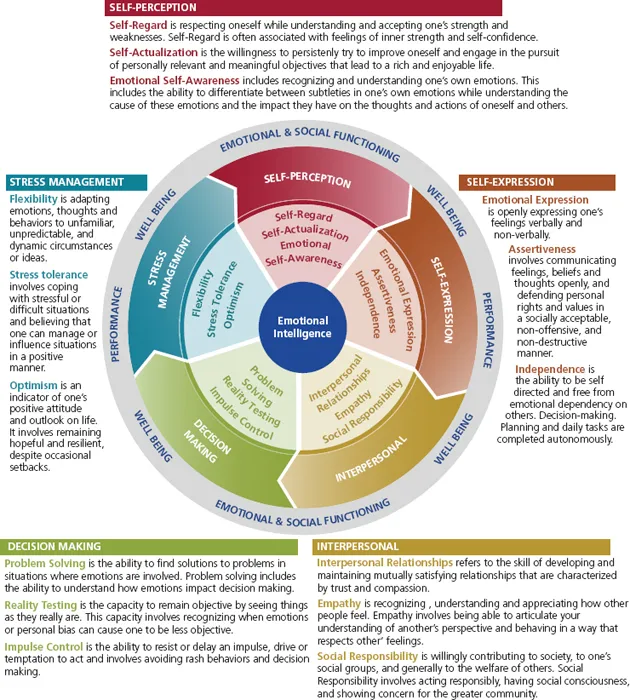
Figure 1.1 shows the five realms and 16 scales of emotional intelligence as measured by the EQ-i 2.0. Consult The Student EQ Edge: Emotional Intelligence and Your Academic and Personal Success for additional information about each scale.
PLANNING YOUR CLASSES
One of the authors, Korrel, has been a college professor for over 30 years, and during that time she has learned there is no one style or formula of teaching that works best at all times and with all classes. Passion about what you teach and actively engaging students are key ingredients. Throughout this guide, you’ll find exercises, tips, and ideas to help you engage students in their learning. Rarely will the plan dictate that something must be done in small groups or must be done in class rather than assigned for homework. Sometimes it can work just as well to have a class of 20 to 25 discuss a topic rather than dividing into four or five small groups. This is especially true if you need to monitor the discussion for accuracy, focus, or progress. For those of you who prefer a more detailed plan for teaching each topic, each chapter will contain suggested activities for leading a 50- to 60-minute class or a three- to four-hour workshop. (These three- to four-hour workshops can be broken into two or three different segments for a class that meets two or three times per week.) Additionally, Appendix A contains a suggested course syllabus that can be used for a semester-long class or adapted to accommodate a two- to three-day student workshop.
STUDENT REFLECTION
Reflection is one of the most effective tools to encourage student cognitive and social-emotional growth; thus each activity in this book will contain reflection questions for students. Reflection—unlike reasoning, which requires a systematic process that is evidence based—allows students to engage in mental inquiry meant to help develop self-discovery rather than help them arrive at a correct answer. The more reflection they do, the better! Thus this Facilitation and Activity Guide provides two different opportunities for reflection.
- Reflection questions are included on the student worksheets. Ask students to submit written responses or to think about their responses prior to class discussion, or include the questions during the in-class debrief.
- In-class debrief questions should be discussed in class after the worksheet or activity has been completed. Debriefs are designed to solidify learning and insights related to an activity.
Because reflection promotes cognitive growth, it’s a key part of student learning. And it’s possible to grade worksheets and the reflection questions for quality. Appendix B provides an example grading rubric for a reflection exercise.
STUDENT EMOTIONAL INTELLIGENCE ASSESSMENT
Students can complete the EQi 2.0, a reliable and valid measure of emotional intelligence that provides scores for overall emotional intelligence, five realms (self-perception, self-expression, interpersonal, decision making, and stress management), and the 16 scales outlined in each chapter of this book. For more information about how to give the EQi 2.0 to your students, go to ei.mhs.com. Free assessments of emotional intelligence are also available but are not guaranteed to be reliable or valid and most likely will not align with the chapters outlined in the Facilitation and Activity Guide or the Student Workbook.
FACILITATING CLASS DISCUSSIONS
For the first couple of days, while you’re building rapport, choose activities and discussions that are fairly safe but highly engaging. Also, have the group develop guidelines, or you can suggest three to five like the following suggestions. Either way, make sure everyone in the class agrees to some version of these guidelines:
- Personal information that is shared does not get repeated outside of class.
- Use conventions of good interaction, including not interrupting others, not dominating the conversation, and not judging others’ comments.
- Everyone must participate some of the time and listen all of the time.
To make sure everyone gets to participate, encourage the students to be brief. Succinct comments help the conversation flow better. Introverted students are encouraged by the idea that they don’t have to talk for long, and extroverts who have some self-awareness appreciate the help in self-monitoring. And everybody appreciates not having one or two people who drone on and on!
Finally, give small groups questions to discuss and then have them “report out” to the larger group. There are two reasons for doing this. First, if there are inaccuracies in content (for example, maybe they don’t understand the definition of self-regard), those can be corrected. Second, if they have to report out, they usually take the assignment more seriously.
AGREE-DISAGREE ACTIVITIES
When discussing controversial issues or trying to get students to take a position on an issue, using an agree-disagree activity usually works well. Here’s how it works. On the far right side of the board, write the word “agree” and on the opposite side, write the word “disagree.” (Or just point to each side of the room if you don’t have a white board to write on.) Then pose your question and have students get up and move to the side of the room that best represents their opinion. Standing in the middle of the room is highly discouraged! Ask students from each side to explain why they chose to agree or disagree with the statement you read. For example, near the end of your course, after students have learned a lot about emotional intelligence, you might pose the following question: “Emotional intelligence learning should be required of all students at this school.”
ORGANIZATION OF THIS GUIDE
This guide and the activities within it are organized so you can find what you want and pick and choose the activities that work best for your class.
Chapters follow the same order and numbering as found in The Student EQ Edge: Emotional Intelligence and Your Academic and Personal Success and in The Student EQ Edge: Student Workbook.
Although some of you will prefer the “pick and choose” approach when selecting activities for your class, each chapter outlines a comprehensive plan for a 60-minute class and one for a half-day workshop. You will find these suggestions in the “Planning Your Class” section.
If you only have a few hours within an existing course to discuss emotional intelligence, it’s probably best to pick two or three scales that are highly relevant to that class (for example, emotional self-awareness, empathy, and interpersonal relationships in an Interpersonal Communication course) and focus on building those skills.
Each chapter contains these elements:
- Student Learning Outcomes
- Suggested Reading, Movies, and TV Shows—students love watching movie or TV clips; these clips are very effective for demonstrating EI concepts, and watching others demonstrate effective or ineffective EI makes the concepts come alive.
- A list of activities by name, with a brief description.
- A step-by-step guide for preparing to lead the activity, facilitating it, and debriefing it, and the expected time each will take.
- A copy of the worksheet found in The Student EQ Edge: Student Workbook.
MATERIALS
For almost every class period you will need access to the following:
- White board or flip chart
- Markers
- TV with DVD or VCR player
- Internet connection (if you want to access TV clips through www.hulu.com or YouTube clips)
Also, we highly recommend you have a copy of The Student EQ Edge: Emotional I...